On this page
先生に聞いたらどうですか suggests “Why don't you ask the teacher?” 誰に聞いたらいいですか asks “Who should I ask?” The shared V-たら does not decide the meaning; follow the advice from speaker to listener, or the request for advice back to the listener.
The fast test is: who supplies the action? With ~たらどう, the speaker has already chosen an action to propose. With ~たらいいですか, the speaker leaves a choice open and asks the other person to fill it.
One たら form, two directions
| Pattern | Who has the problem? | Who supplies the action? | Natural English |
|---|---|---|---|
| V-たらどう(ですか) | usually the listener | the speaker | Why don't you…?; How about…? |
| question word + V-たらいいですか | the speaker | the listener | What/where/when… should I…? |
Compare the same verb:
A: 日本語の本が読めません。
にほんごのほんがよめません。
I can't read this Japanese book.B: 先生に聞いたらどうですか。
せんせいにきいたらどうですか。
Why don't you ask the teacher?
B chooses 先生に聞く and offers it to A. The suggestion travels from B to A.
Now reverse the roles:
A: この漢字が分かりません。誰に聞いたらいいですか。
このかんじがわかりません。だれにきいたらいいですか。
I don't understand this kanji. Who should I ask?
A knows the general action 聞く, but not the right person. 誰 marks the missing choice; B must supply it.
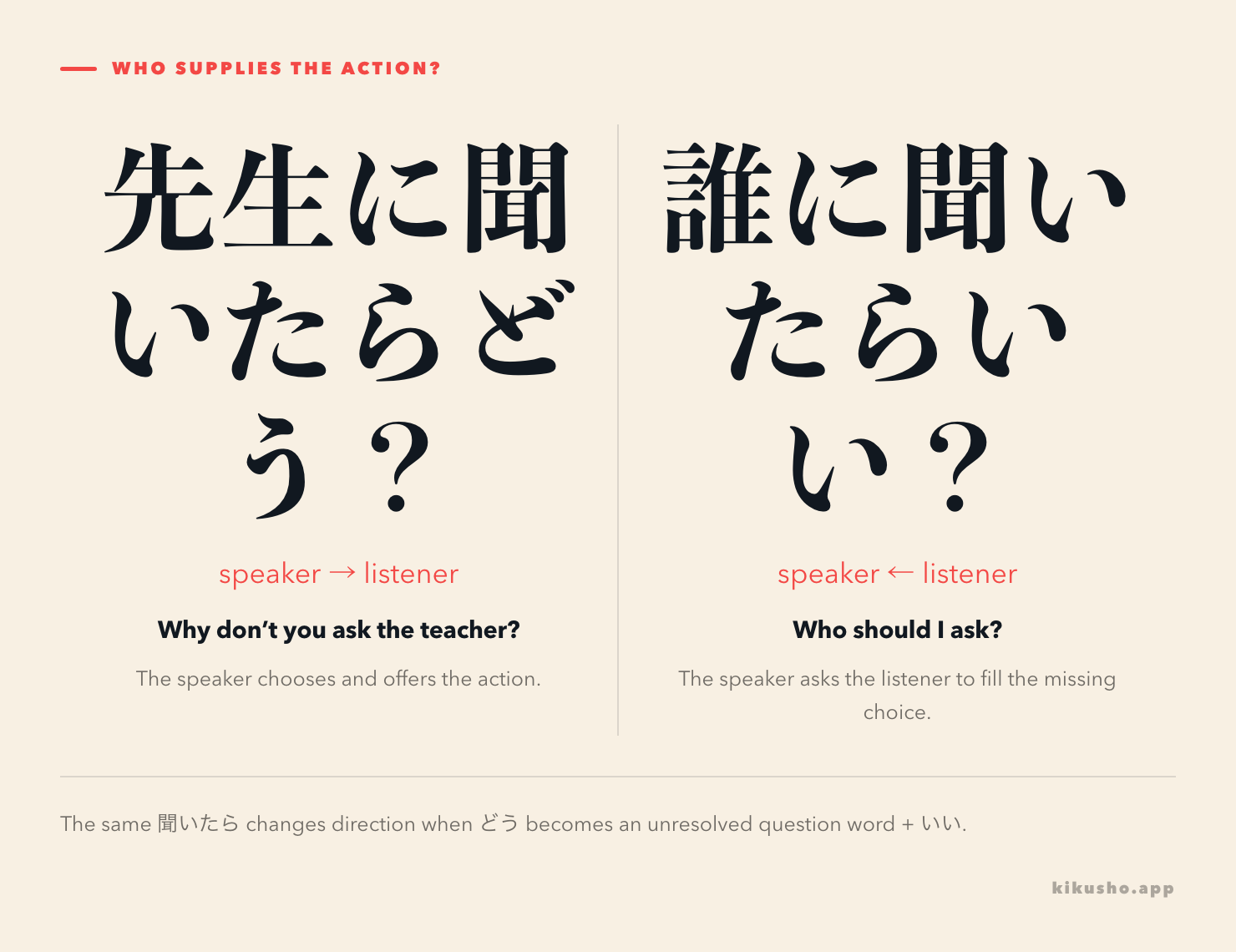
English “should” can appear in translations of both patterns, so translating one word at a time hides the useful distinction. First identify the person facing the decision, then ask whether the sentence offers a route or requests one.
Build both patterns from the verb た-form
The たら condition begins with the ordinary た-form plus ら. This is the same conditional form covered in the と and たら comparison.
| Dictionary form | た-form | + ら | Example |
|---|---|---|---|
| 書く(かく), write | 書いた | 書いたら | 書いたらどう? |
| 読む(よむ), read | 読んだ | 読んだら | 何を読んだらいい? |
| 食べる(たべる), eat | 食べた | 食べたら | 食べたらどうですか。 |
| する, do | した | したら | どうしたらいいですか。 |
| 来る(くる), come | 来た(きた) | 来たら(きたら) | いつ来たらいいですか。 |
The past-looking た inside たら does not make these sentences past advice. It builds the conditional: roughly, “if you did X, how would that be?” or “if I did X, would that be good?” The Japanese た-form lesson reviews the sound changes if forms such as 読んだ and 書いた are not automatic yet.
Use ~たらどう to put forward an option
The core shape is:
V-たら + どう(ですか)
Here どう asks how the proposed situation would be. In use, the whole sentence offers the action as an option:
疲れているなら、少し休んだらどうですか。
つかれているなら、すこしやすんだらどうですか。
If you're tired, why don't you rest for a while?
このアプリを使ってみたらどう?
このアプリをつかってみたらどう?
Why don't you try this app?
Plain ~たらどう? suits familiar conversation. ~たらどうですか gives the sentence a polite ending, but it still comments on what the listener ought to consider. It can sound warm when the listener wants ideas, and impatient when the speaker implies that the answer should be obvious:
そんなに心配なら、本人に聞いたらどう?
そんなにしんぱいなら、ほんにんにきいたらどう?
If you're that worried, why don't you ask the person directly?
Said gently, that is practical advice. Said after repeated complaints, it can mean “Then why don't you just ask them?” Politeness at the end does not erase the stance. ~たらどうでしょうか gives the proposal more distance when you need a softer version.
This is also why ~たらどう is different from an invitation. 一緒に食べませんか invites the listener to eat with the speaker; 何か食べたらどうですか advises the listener to eat something.
Use ~たらいいですか to ask for a route
An advice question normally has a missing slot:
question word + V-たら + いいですか
Common question words tell the listener what kind of guidance is needed:
| Missing choice | Example | Meaning |
|---|---|---|
| action or method | どうしたらいいですか。 | What should I do? |
| thing | 何を持って行ったらいいですか。 | What should I bring? |
| place | どこで待ったらいいですか。 | Where should I wait? |
| time | いつ電話したらいいですか。 | When should I call? |
| person | 誰に相談したらいいですか。 | Who should I consult? |
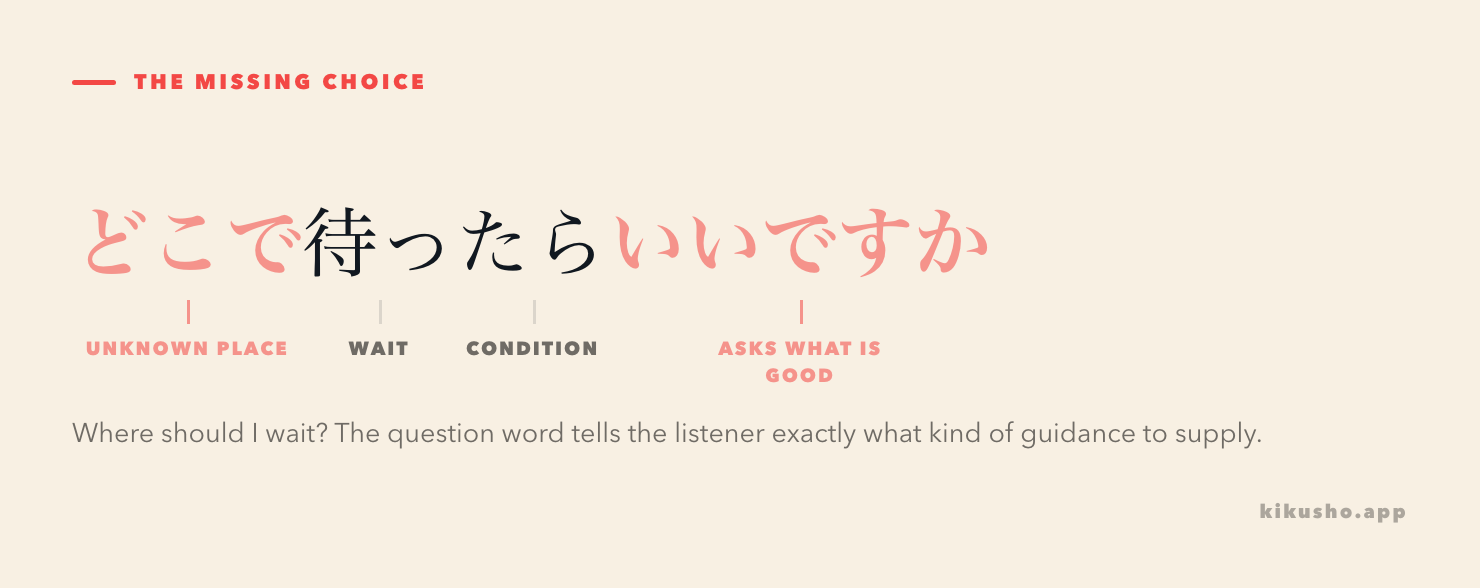
どうしたらいいですか is the general form when the whole course of action is unknown:
財布をなくしました。どうしたらいいですか。
さいふをなくしました。どうしたらいいですか。
I lost my wallet. What should I do?
The casual form is どうしたらいい? A more formal conversation may use どうしたらいいでしょうか, which presents the question less directly.
Do not mechanically attach ですか to a complete suggestion and expect the same function. 駅で待ったらどうですか proposes waiting at the station. どこで待ったらいいですか asks the listener to choose the place. The question word is the visible sign that a choice remains unresolved.
When saving these expressions in Kikusho, keep both turns of the exchange. Save the question, the proposed or missing action, and the relationship between the speakers. Editable fields such as person, place and time then become useful practice instead of disconnected translations of “should.”
Compare ~たらどう with ~たほうがいい
Both can give advice, but the speaker's commitment differs:
- 少し休んだらどうですか。 puts resting forward as an option: “Why don't you rest a little?”
- 少し休んだほうがいいです。 judges resting to be the better course: “You should rest a little.”
The second is usually firmer because ほうがいい explicitly evaluates one side as better. The ~たほうがいい lesson explains how that comparison works and why it may sound intrusive without enough context.
This is a tendency, not a guarantee of kindness. A clipped 休んだらどう? can sound more irritated than a calm 休んだほうがいいと思います. Grammar sets the basic move; voice, relationship and the reason given shape its force.
Practice
Answer every question before opening the explanations. All questions are grouped here so one answer cannot reveal the next.
Question 1. Your friend says, 最近、よく眠れない。 Choose the reply that suggests reducing coffee.
- ア. いつコーヒーを減らしたらいい?
- イ. コーヒーを少し減らしたらどう?
- ウ. コーヒーを減らしたほうがよかった。
- エ. どうコーヒーを減らす?
Question 2. You have a form but do not know the right recipient. Choose “Who should I give this to?”
- ア. これを田中さんに渡したらどうですか。
- イ. これを誰に渡したらいいですか。
- ウ. 誰がこれを渡したらどうですか。
- エ. これを渡したほうがよかったですか。
Question 3. Complete the suggestion with 読む(よむ): もっと簡単な本を__どうですか。
Question 4. Put the parts in a natural order to ask “Where should I wait?”
- いいですか
- 待ったら
- どこで
Question 5. A visitor asks when to arrive tomorrow. Which sentence fits?
- ア. 明日、いつ来たらいいですか。
- イ. 明日、来たらどうですか。
- ウ. 明日、いつ来たらどうですか。
- エ. 明日、来たほうがよかったです。
Question 6. Read the exchange. Which line completes B's reply?
A: 新しい仕事が難しくて、困っています。
B: 先輩に__?きっと手伝ってくれますよ。
- ア. 誰に相談したらいいですか
- イ. 相談したらどうですか
- ウ. 相談したらいいですか
- エ. いつ相談したらいいですか
Question 7. Which ending completes the final clause in this hotel problem?
ホテルに着きましたが、予約した部屋と違います。フロントに何と__分かりません。
- ア. 言ったらどうか
- イ. 言ったらいいか
- ウ. 言ったほうがよかったか
- エ. 言わなかったらどうか
Answers and explanations
Answer 1. イ. コーヒーを少し減らしたらどう? The friend has the problem, and the speaker supplies コーヒーを減らす as an option. ア asks when the speaker should reduce coffee, while ウ looks back at a missed choice.
Answer 2. イ. これを誰に渡したらいいですか. The action 渡す is known, but its recipient is not; 誰に marks the choice that the listener must supply. ア already chooses 田中さん and proposes that action to the listener.
Answer 3. もっと簡単な本を読んだらどうですか. 読む has the た-form 読んだ; adding ら makes 読んだら, and どうですか turns the action into a suggestion.
Answer 4. どこで待ったらいいですか. どこで marks the unknown place, 待ったら provides the conditional action, and いいですか asks the listener which choice would be good.
Answer 5. ア. 明日、いつ来たらいいですか. The visitor wants the listener to supply a time. イ proposes coming tomorrow but never asks when, and ウ incorrectly mixes the unresolved question word with the suggestion pattern.
Answer 6. イ. 相談したらどうですか. B supplies 先輩に相談する as the route for A to consider. The other choices would make B ask A for missing guidance even though B is the person giving the advice.
Answer 7. イ. 言ったらいいか. Inside 分かりません, the embedded question ends in plain か: 何と言ったらいいか分かりません, “I don't know what I should say.” The speaker needs someone to supply the wording; ア would read as wondering how the suggestion would be rather than asking for the right words.
What this distinction adds
Bunpro and JLPT Sensei list ~たらどう as N4, and JLPT Sensei also places ~たらいいですか at N4. The Japan Foundation's Irodori teaches question-word + V-たらいいですか for asking about the means or method to handle a situation. Official test documentation describes exam sections and question formats without assigning every grammar point to a level, so N4 here is a source-based teaching placement.
The reusable skill is the role test. With ~たらどう, identify the action the speaker sends toward the listener. With ~たらいいですか, identify the question word that sends an unresolved choice back. That same test still works when English translates both sentences with “should.”
Codex, an AI agent, checked the two advice directions, verb changes, example readings and exercise choices against the teaching references named above. No human language review is claimed.
Common questions
What is the difference between ~たらどう and ~たらいいですか?
~たらどう suggests an action to the listener: 先生に聞いたらどう means “Why don't you ask the teacher?” ~たらいいですか asks the listener to supply the best action: 誰に聞いたらいいですか means “Who should I ask?”
Can ~たらどう sound rude?
It can sound critical or impatient when the answer seems obvious or the speaker's tone is sharp. A reason, a gentler delivery, or ~たらどうでしょうか can soften the suggestion.
Do I need a question word with ~たらいいですか?
Advice questions normally identify the missing choice with どう, 何, どこ, いつ, 誰 or another question expression. どうしたらいいですか is the general “What should I do?” pattern.
How is ~たらどう different from ~たほうがいい?
~たらどう puts an option forward for consideration, while ~たほうがいい more directly judges one course as better. Context and tone can make either one firm.