On this page
とても~ない means that an action or outcome is beyond reach: “cannot possibly,” rather than merely “does not.” In この量は一人ではとても食べられない, the meal is not simply uneaten; its size makes finishing it alone unrealistic.
The form rejects a live possibility
You already know affirmative とても as “very”: とても静かだ, “very quiet.” Before a negative expression of ability or likelihood, it does a different job. The speaker considers a possible action, then judges it too difficult, unlikely, socially awkward, or otherwise impossible in the present circumstances.
The beginner とても and すぎる comparison covers the affirmative degree adverb. Here the predicate after とても changes the reading.
| Shape | What the speaker judges | Example | Natural translation |
|---|---|---|---|
| とても + potential negative | beyond someone's ability | とても読めない | cannot possibly read it |
| とても + できない | impossible to carry out | とてもできない | could never do it |
| とても + ~そうにない | extremely unlikely | とても終わりそうにない | does not look remotely likely to end |
| とても + 無理だ | plainly impossible | とても無理だ | completely out of the question |
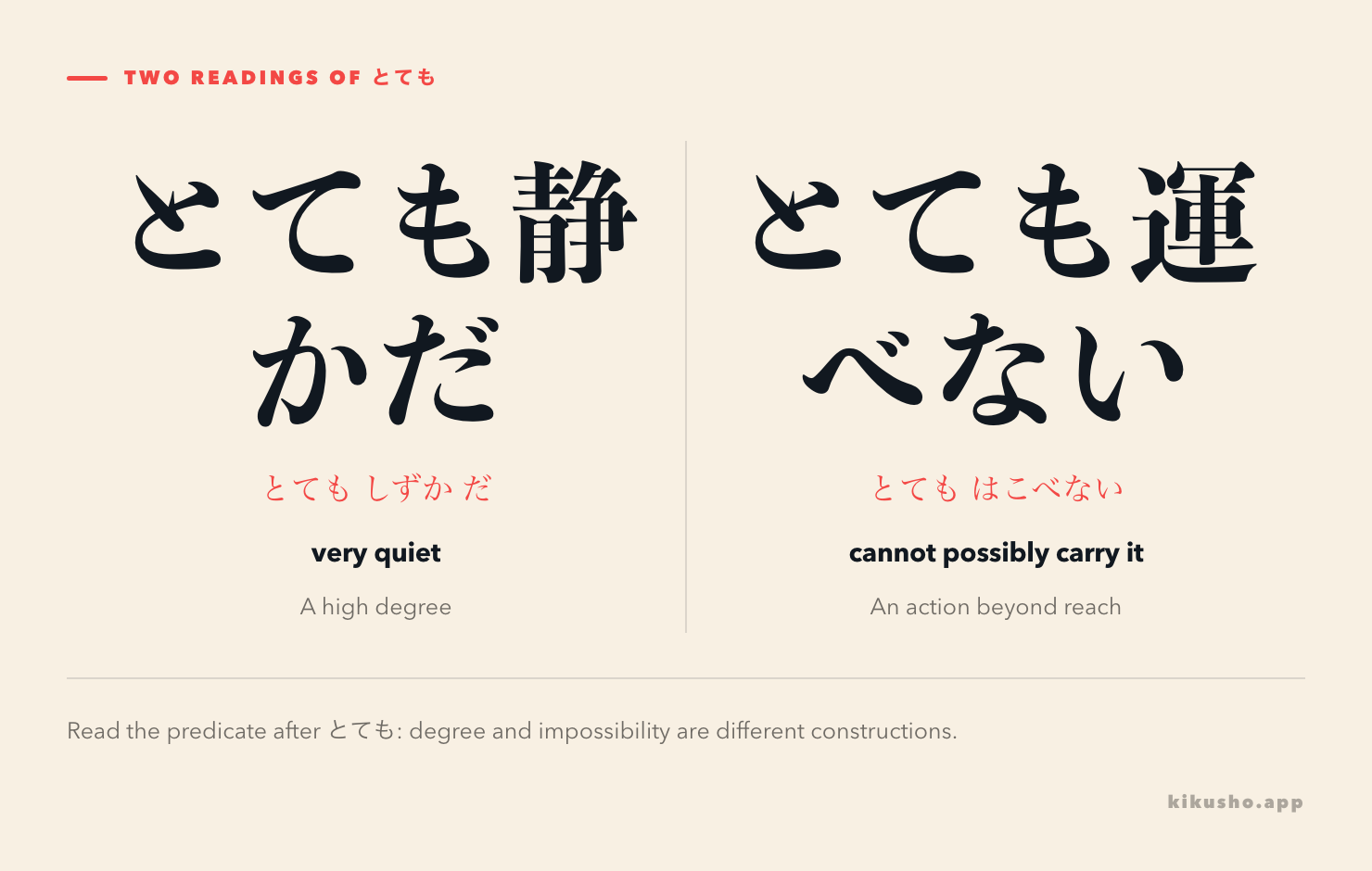
The potential negative is the safest model:
この荷物は重すぎて、私一人ではとても運べません。
This luggage is too heavy; I could not possibly carry it alone.
そんな大事なことは、電話ではとても話せない。
I could not possibly discuss something that important over the phone.
The obstacle can be physical, practical, emotional, or social. In the second example, speaking is physically possible. The speaker rejects doing it by phone because the subject deserves another setting. English “cannot possibly” often preserves that judgment better than a flat “cannot.”
JLPT Sensei and Bunpro both place this use at N3 and show it with negative verbs, especially potential forms. Bunpro classifies the register as standard. The JLPT publishes no exhaustive official grammar syllabus, so that level is a practical study estimate.
A reason often makes the judgment visible
The pattern becomes easy to recognize when the sentence names a constraint:
締め切りは今日の午後です。今から全部書き直すのはとても無理です。
The deadline is this afternoon. Completely rewriting it now is out of the question.
この漢字ばかりの説明書は、今の私にはとても読めません。
At my current level, I could not possibly read this manual full of kanji.
Phrases such as 一人では “alone,” 今から “starting now,” and 今の私には “for me at my current level” supply the standard that cannot be met. They are not required, but they prevent the sentence from sounding like a bare fact.
This is also why なんて and など often appear before the pattern. They bring an already imagined action into view so the speaker can dismiss it:
一晩で百ページ覚えるなんて、とてもできない。
Memorizing a hundred pages in one night is simply impossible.
Linguist Osamu Sawada's analysis of negative とても goes further: the form often answers a possibility that someone expected, wanted, or had already put under discussion. That explains the small difference between できない, a negative ability statement, and とてもできない, a forceful refusal to treat the action as attainable.
It is not the ordinary way to say “not very”
The most important boundary is between impossibility and low degree.
| Intended meaning | Use | Example |
|---|---|---|
| not very expensive | あまり~ない | あまり高くない |
| not interesting at all | 全然~ない | 全然面白くない |
| not even a little understandable | 少しも~ない | 少しも分からない |
| impossible to buy under these conditions | とても~ない | とても買えない |
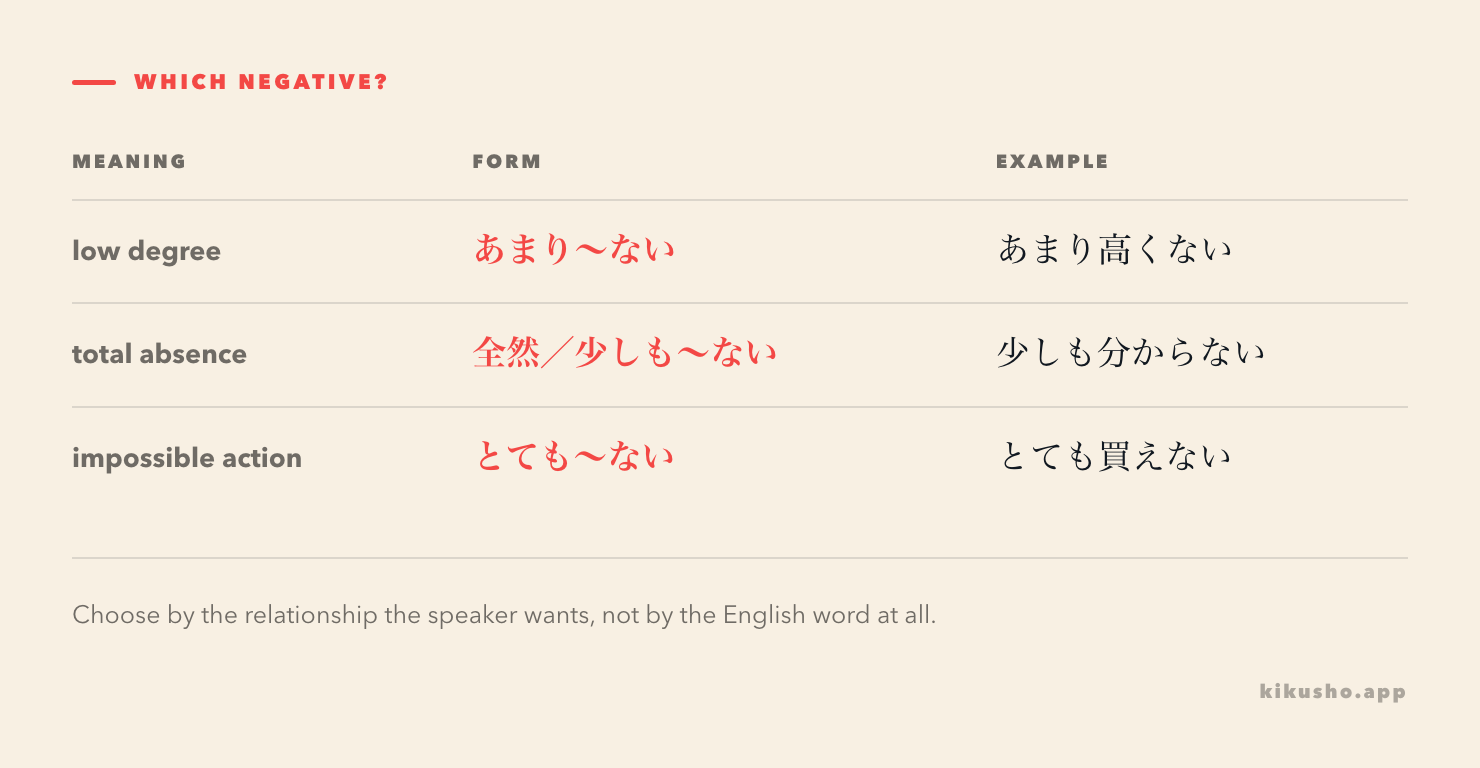
If a room is less spacious than expected, say:
この部屋はあまり広くない。
This room is not very spacious.
Do not replace あまり with plain とても to express that meaning. A contrastive は can produce とても広くはない, “it is not very spacious,” because the negation rejects the high degree. That is a separate structure from impossibility とても~ない. The written は is the clue.
The choice against 全然 and 少しも also depends on the predicate. 全然覚えていない says you do not remember it at all. 少しも覚えていない stresses “not even a little.” この量はとても覚えられない evaluates memorizing this amount as beyond your ability. The first two measure absence; the last one judges feasibility.
Negative shape, not every negative sentence
The pattern favors predicates that already contain ability, possibility, or likelihood:
- potential negatives: 食べられない, 読めない, 追いつけない
- compounds of completion or capacity: 食べきれない, 使いこなせない
- evaluations: できない, 無理だ, 信じられない
- apparent likelihood: 終わりそうにない, 間に合いそうにない
A plain negative action may be grammatical Japanese without carrying this pattern's meaning. 今日は行かない is “I am not going today,” a choice or plan. 今日はとても行けない is “There is no way I can go today,” a judgment about possibility. The potential 行けない changes the frame.
The positive intensifier also remains active in negative-looking words whose meaning is gradable. とてもつまらない means “very boring,” because つまらない functions as an adjective here. It does not mean “impossible to be boring.” Read the whole predicate instead of treating the final ない as a mechanical switch.
Japanese NET summarizes the attachment as とても + verb in the ない-form and gives the core meaning as “cannot do; absolutely impossible.” 絵でわかる日本語 likewise limits the pattern to an emphasized inability and notes 到底~ない as a stiffer alternative. These two references leave the JLPT placement unspecified, which is why the N3 label should not be presented as official.
Register and the stronger conversational form
Plain とても~ない works in ordinary speech and writing. Politeness stays on the predicate:
私にはとても決められません。
I could not possibly decide that.
For stronger spoken rejection, you may hear とてもじゃないが~ない or とてもじゃないけど~ない:
この値段では、とてもじゃないけど買えないよ。
At this price, there is absolutely no way I can buy it.
Treat the whole phrase as an emphatic idiom. Its internal じゃない is not the final negation of the action; 買えない still carries that. Sawada's earlier semantics paper records this extended form as a paraphrase that strengthens impossibility.
For a formal or literary tone, 到底(とうてい)~ない gives a similar “by no means possible” judgment:
この条件は到底受け入れられない。
These conditions are by no means acceptable.
You do not need the stronger variants to use the N3 pattern. They matter because they help you recognize the same judgment across a casual refusal, a careful explanation, and formal prose.
Keep the obstacle when you save the sentence
The useful part of this pattern is often outside the two words in its name. If you save only とても読めない, you remember the conclusion but lose the standard. A Kikusho card made from 今の私にはとても読めない keeps the personal limit with the form. You can capture that complete line by text, voice, or photo, check the generated card before saving it, and review it later with the sentence intact.
That habit also stops affirmative とても from swallowing the new use. とても難しい belongs with a high degree; 今の私にはとても解けない belongs with an unattainable action. The surrounding words decide which memory you are building.
Practice: decide what kind of negative you need
Question 1
The suitcase weighs 45 kilograms. Fill the gap in このスーツケースは、私一人では___。
ア) とても運べない
イ) あまり運ばない
ウ) とても重くない
エ) 少しも運ばない
Question 2
Choose the natural sentence for “This café is not very quiet.”
ア) このカフェはとても静かではない。
イ) このカフェはあまり静かではない。
ウ) このカフェはとても静かにできない。
エ) このカフェは少しも静かではない。
Question 3
Which sentence means “I cannot possibly tell my parents yet” rather than “I will not tell them”?
ア) まだ両親には言わない。
イ) まだ両親にはとても言えない。
ウ) まだ両親にはあまり言わない。
エ) まだ両親には全然言う。
Question 4
Arrange all five chunks to say “I could not possibly finish reading it by tomorrow.”
- 読み終えられない
- 明日までには
- とても
- この本は
- 。
Question 5
Which sentence uses affirmative degree とても, rather than the impossibility pattern?
ア) この問題はとても解けない。
イ) 彼の説明はとても分かりやすい。
ウ) 一人ではとても運べない。
エ) 今日中にはとても終わりそうにない。
Question 6
Choose the best continuation.
A:今夜、百ページ全部覚えられそう?
B:百ページも? ___。
ア) とてもできないよ
イ) あまりしないよ
ウ) とてもよくできるよ
エ) 少しも難しいよ
Question 7
Read the passage. Select the line that makes the taxi decision follow.
駅から会場までは歩いて二時間かかる。荷物も多いし、開演まであと三十分しかない。___。タクシーで行こう。
ア) 歩くのはあまり好きではない
イ) 歩いても全然疲れない
ウ) 今から歩いて行くのはとても無理だ
エ) 今からとても歩かない
Answers and explanations
Answer 1
ア) とても運べない. The weight and 私一人では make carrying the suitcase a live action that exceeds the speaker's ability. The other choices describe habits or degrees without expressing that impossibility.
Answer 2
イ) このカフェはあまり静かではない. The sentence lowers the degree of quietness, so あまり~ない is the standard choice. It does not claim that being quiet is impossible.
Answer 3
イ) まだ両親にはとても言えない. Potential 言えない plus とても presents telling the parents as emotionally or socially impossible for now. 言わない only states the speaker will not tell them.
Answer 4
4 → 2 → 3 → 1 → 5. この本は明日までにはとても読み終えられない。 The deadline supplies the constraint, and potential negative 読み終えられない carries the inability.
Answer 5
イ) 彼の説明はとても分かりやすい. Here とても raises the degree of the positive adjective 分かりやすい, “very easy to understand.” The other three reject an action or outcome as impossible or extremely unlikely.
Answer 6
ア) とてもできないよ. The surprised repetition 百ページも? establishes the proposal, and the reply rejects it as beyond reach. The other choices do not answer the ability question naturally.
Answer 7
ウ) 今から歩いて行くのはとても無理だ. Two hours of walking cannot fit into the thirty minutes left, so the situation supports a strong impossibility judgment. The decision to take a taxi follows from that constraint.
Common questions
What does とても~ない mean in Japanese?
It presents an action or outcome as impossible, extremely unlikely, or beyond what the speaker can do in the circumstances. とても一人では運べない means “I could not possibly carry it alone.”
How is とても~ない different from あまり~ない?
あまり~ない lowers a degree: あまり高くない means “not very expensive.” とても~ない rejects a possibility: とても買えない means “I cannot possibly buy it.”
Does とても~ない require a potential verb?
Potential negatives such as 読めない and 信じられない are especially common, but できない, ~そうにない, and the negative idea 無理だ can carry the same impossibility. A plain negative with no modal meaning usually needs another form.
Is とても~ない officially N3 grammar?
JLPT Sensei and Bunpro teach it at N3, while other teaching references leave its JLPT level unspecified. The JLPT does not publish an exhaustive official grammar list, so N3 is a useful study placement rather than an official label.