On this page
書き直す begins where ordinary 書く left a result that needs changing. It means “rewrite” or “write again properly,” combining the first verb's action with 直す (なおす), “correct” or “put right.”
The basic pattern is verb ます-stem + 直す. The second attempt may fix an error, replace an unsatisfactory result, or return something to a better state. That corrective viewpoint separates ~直す from a neutral もう一度 + verb, which only says the action happens another time.
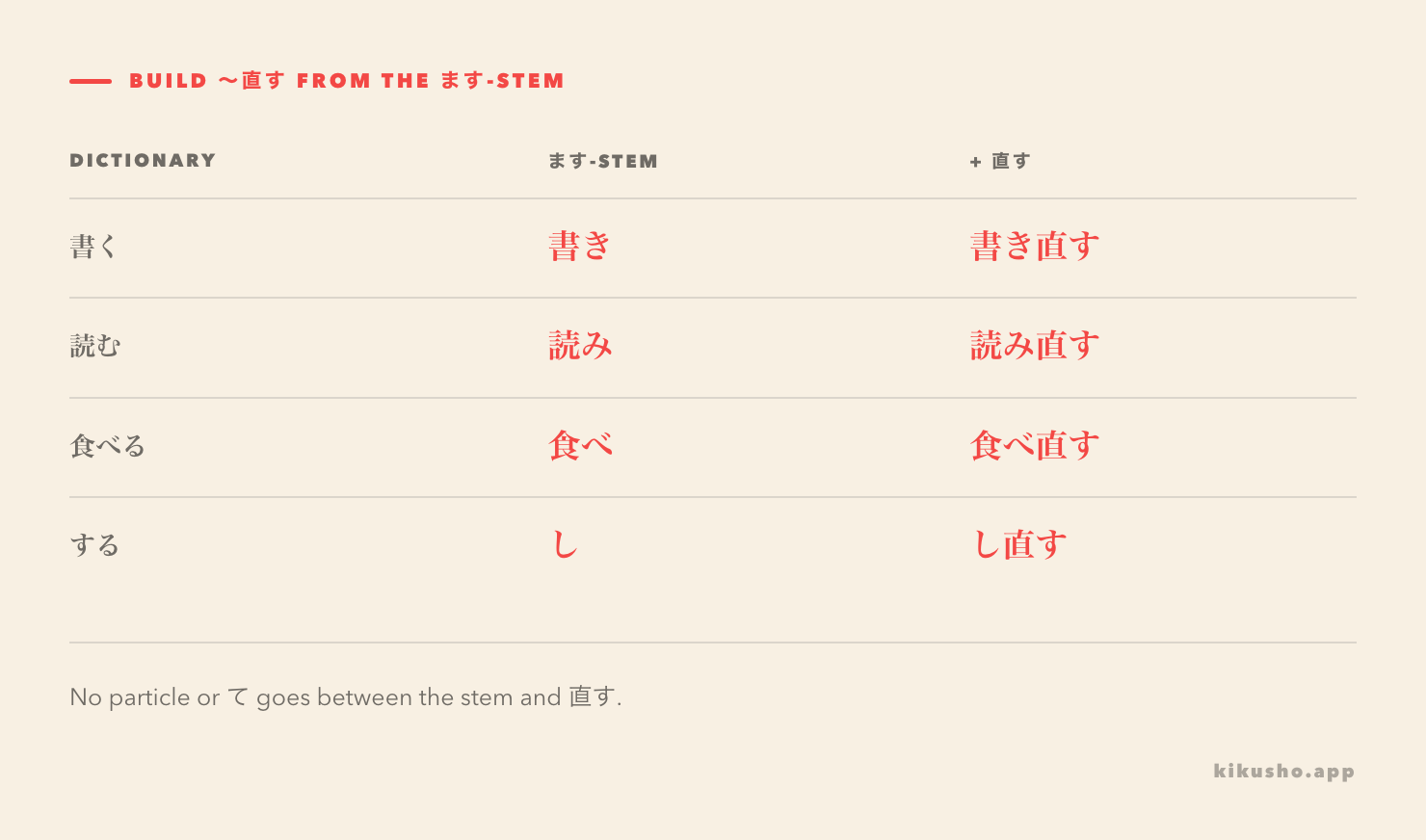
Attach 直す to the ます-stem
Remove ます from the polite form and attach 直す directly. No particle or て goes between the two verbs.
| Dictionary form | Polite form | ます-stem | Compound |
|---|---|---|---|
| 書く, write | 書きます | 書き | 書き直す, rewrite |
| 読む, read | 読みます | 読み | 読み直す, reread or check again |
| 食べる, eat | 食べます | 食べ | 食べ直す, eat again in a corrective way |
| する, do | します | し | し直す, do again |
For 電話をかける, the stem is かけ, so 電話をかけ直す means to call again. 書く直す and 書いて直す do not form this construction. The first keeps the dictionary ending; the second creates a sequence that could mean “write it and fix it,” with two separate actions.
JLPT Sensei's N3 reference gives the same stem attachment and describes the second action as a way to fix the first result. Mikke's teacher activity page independently uses Vます + 直す with examples such as redoing, rewriting, copying again, and resending.
Correcting the result matters more than counting attempts
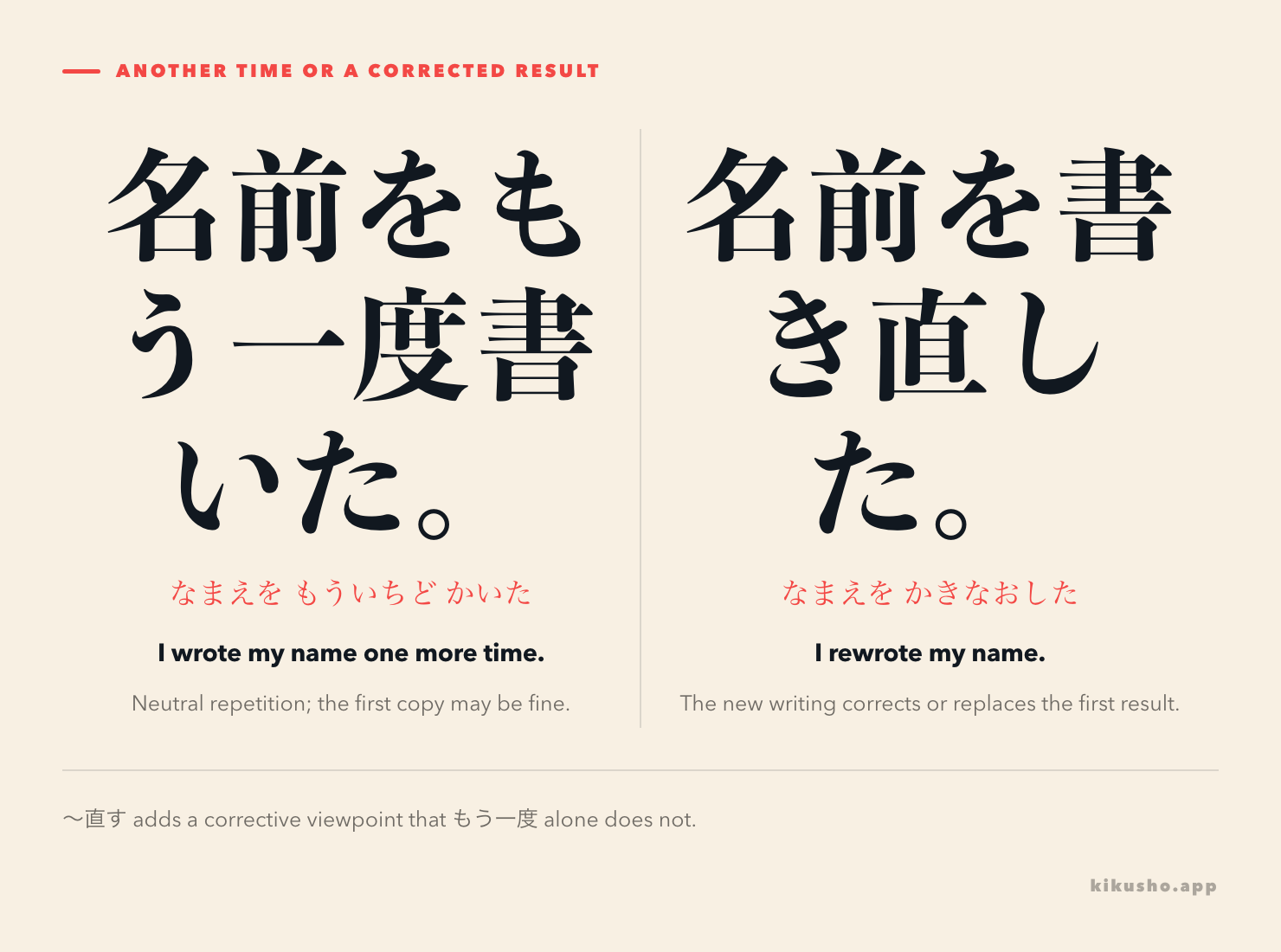
Compare a repeated action with a corrective one:
- 名前をもう一度書いた。 (なまえを もういちど かいた) — “I wrote my name one more time.”
- 名前を間違えたので、書き直した。 (なまえを まちがえたので、かきなおした) — “I wrote my name again because I had made a mistake.”
The first sentence only counts another writing event. Perhaps the form required two copies; nothing says the earlier name was bad. The second replaces or corrects the result of the first writing. An academic corpus study of ~直す notes that many uses foreground correction of an undesirable result more strongly than repetition itself.
The cause often makes this nuance explicit. 誤字があったので、文を書き直した (ごじが あったので、ぶんを かきなおした) names a typo. 説明が分かりにくかったので、言い直した (せつめいが わかりにくかったので、いいなおした) replaces an unclear wording. サイズを間違えたので、作り直した (サイズを まちがえたので、つくりなおした) remakes something after choosing the wrong size.
Correction need not follow a factual mistake. 先輩の話を聞いて、考え直した (せんぱいの はなしを きいて、かんがえなおした) means the speaker reconsidered after hearing a senior colleague. The earlier decision may have been reasonable; new information made a different conclusion preferable.
The compound behaves like one す-verb
Once the compound is built, the first element stays fixed and the final 直す conjugates as a godan verb.
| Function | 書き直す form | Example |
|---|---|---|
| Plain past | 書き直した | 文を書き直した, rewrote the sentence |
| Polite | 書き直します | 後で書き直します, I will rewrite it later |
| Negative | 書き直さない | 全部は書き直さない, I will not rewrite all of it |
| て-form | 書き直して | ここを書き直してください, please rewrite this part |
| Volitional | 書き直そう | 最初から書き直そう, let's rewrite it from the start |
This is the same division of labour seen across Japanese compound verbs: the first verb supplies the action and remains in its stem, while the final verb carries tense, polarity, and politeness. The earlier lesson compares several second verbs. Here the focus is what 直す contributes and where that meaning stops.
The object normally belongs to the first action. レポートを書き直す rewrites a report because レポートを書く is the underlying relationship. 計画を考え直す reconsiders a plan because one can 計画を考える. Attaching 直す changes how the action is carried out; it does not randomly replace the first verb's particles.
Common compounds range from transparent to extended
Some combinations are easy to interpret from their parts:
| Compound | Core use | What changes |
|---|---|---|
| 書き直す | rewrite | A written result is replaced or corrected |
| 言い直す | rephrase; say correctly | The wording or delivery changes |
| やり直す | redo; start over | A task or broader attempt begins again |
| 作り直す | remake | A created object or plan is made again |
| 考え直す | reconsider | A judgement or decision is examined again |
| 読み直す | reread; check by reading again | The text is read again, often to verify it |
やり直す is the general option when no more specific first verb is needed: 最初からやり直す means “start over from the beginning.” し直す also means “do again,” but often keeps a named する-action: 設定し直す, reset or configure again; 確認し直す, check again. The choice depends on the noun and the established expression, not a universal English pairing.
Other compounds have conventional extensions. 提案を見直す can mean review or reconsider a proposal, while 彼の実力を見直した can mean that you revised your opinion of his ability, often more favourably. 会社を立て直す is not merely “stand the company again”; it means rebuild or restore the business. 景気が持ち直す means the economy recovers. The corpus study identifies these kinds of extended and sometimes intransitive uses as a reason dictionaries cannot describe every ~直す compound with one mechanical formula.
Treat the pattern as productive, but do not assume any imaginable stem creates a natural word. If a compound carries a specialized meaning or appears with an unexpected subject, learn that whole expression. 見直す, 立て直す, 出直す, and 持ち直す deserve dictionary checks rather than word-by-word invention.
Standalone 直す and compound ~直す are related, not identical
In パソコンを直す (パソコンを なおす), 直す is the main verb: “repair the computer.” In メールを書き直す, it is the second half of a compound: “rewrite the email.” Both involve moving something away from an unsatisfactory state, but only the compound repeats or reworks the action named first.
Kanji also helps separate nearby verbs. 治す (なおす) means cure or heal something: 病気を治す, cure an illness. 直る (なおる) is intransitive: パソコンが直った, “The computer was fixed / started working again.” These distinctions belong to the independent verb family; the grammatical suffix taught here is written ~直す.
The construction itself is neutral in politeness. Conjugate its ending for the situation: ここを書き直して is casual, ここを書き直してください is a direct polite request, and この部分を書き直していただけますか asks more softly. The corrective implication remains in each version, so asking someone to 言い直す or 書き直す can point out a problem even when the ending is polite.
When you meet a compound in a corrected draft, callback request, or revised plan, keep the entire phrase in Kikusho. A card for 誤字があったので、この文を書き直した preserves the reason for doing the action again. During offline review, that cause distinguishes corrective 書き直す from a neutral second copy far better than the gloss “rewrite” by itself.
JLPT placement is editorial rather than official. JLPT Sensei and Mikke label ~直す N3, matching Kikusho's September 2026 reference inventory; Migaku presents the same pattern in an N4 guide. The attachment is accessible early, while the extended meanings and productivity limits justify revisiting it at N3.
Practice: choose whether the first result is being repaired
Complete all seven prompts before the shared answer section.
Question 1 — grammar choice. Which form correctly means “reread” using 読む + 直す?
- A. 読む直す
- B. 読んで直す
- C. 読み直す
- D. 読ま直す
Question 2 — nuance choice. A form requires two identical copies of your name; the first copy is correct. Which sentence merely says you wrote it one more time?
- A. 名前を書き直した。
- B. 名前をもう一度書いた。
- C. 名前を言い直した。
- D. 名前が直った。
Question 3 — sentence composition. Say “There was a typo, so I rewrote this sentence.” Use 誤字, この文, and 書き直す in the plain past.
Question 4 — grammar choice. In which sentence is 直す a standalone repair verb rather than the second half of a compound?
- A. レポートを書き直した。
- B. 時計を直した。
- C. 計画を考え直した。
- D. 説明をし直した。
Question 5 — meaning in context. 新しい資料を読んで、計画を見直した。 What happened?
- A. The speaker visually found the lost plan.
- B. The speaker repaired a broken pair of glasses.
- C. The speaker reviewed or reconsidered the plan.
- D. The plan recovered by itself.
Question 6 — sentence composition. Politely ask someone to explain it again because the first explanation was unclear. Use 説明する, 分かりにくかった, and ~てください.
Question 7 — text grammar. Complete the final sentence with the suitable form of 作る + 直す.
ケーキのサイズを間違えました。注文と違うので、最初から__。
Answers and explanations
Answer 1. C, 読み直す. 読む → 読みます → 読み supplies the stem, followed directly by 直す. A keeps the dictionary ending, B describes two separate actions, and D uses the wrong stem.
Answer 2. B, 名前をもう一度書いた. The prompt gives no error or unwanted result; it only requires a second correct copy. 書き直した would introduce a corrective view of the earlier writing. C changes the action to speaking, and D says the name itself was fixed.
Answer 3. One model answer is 誤字があったので、この文を書き直した。 (ごじが あったので、このぶんを かきなおした). この文 remains the object of 書く, and the final 直す takes the past form 直した.
Answer 4. B, 時計を直した. Here 直す is the entire verb and means “repaired the watch.” A, C, and D contain 書き + 直す, 考え + 直す, and し + 直す, each built from another verb's stem.
Answer 5. C. 計画を見直した means the speaker reviewed or reconsidered the plan after reading new material. This is an established extended use of 見直す. It does not describe finding the plan, repairing glasses, or an intransitive recovery.
Answer 6. One model answer is 説明が分かりにくかったので、もう一度説明し直してください。 (せつめいが わかりにくかったので、もういちど せつめいしなおしてください). 説明する → 説明します → 説明し attaches to 直す, which then takes 直して before ください. In a real conversation, the softer 説明し直していただけますか may suit a delicate correction.
Answer 7. 作り直します completes 注文と違うので、最初から作り直します。 (ちゅうもんと ちがうので、さいしょから つくりなおします), “It differs from the order, so I will remake it from the beginning.” 作る → 作り supplies the stem, and the incorrect size gives the corrective reason.
Common questions
How do you attach 直す to another Japanese verb?
Use the verb's ます-stem and attach 直す directly: 書きます becomes 書き直す, 食べます becomes 食べ直す, and します becomes し直す. The compound then conjugates through its final 直す.
What is the difference between 書き直す and もう一度書く?
Both can involve writing again, but 書き直す normally presents the new writing as a correction or improvement. もう一度書く merely counts another performance and does not itself judge the first one.
Does every verb combine naturally with ~直す?
No. The pattern is productive, but conventional combinations matter. Common compounds such as 書き直す, やり直す, 考え直す, and 見直す should be learned with their usual objects and meanings.
Is compound ~直す the same as the verb 直す, “repair”?
They are related but structurally different. パソコンを直す uses 直す as the main verb, while 文を書き直す attaches it to 書き and means to rewrite the sentence so its earlier result is corrected.