On this page
~てみる means doing something as a trial to find out what it is like or what happens. Put みる after a verb's て-form: 押してみる is “press it and see,” while 押す simply says “press it.”
This lesson teaches the assigned N4 construction てみる, inventory item g-4fa2f8174811. JLPT Sensei's N4 entry and Bunpro's N4 lesson place it at N4; the Japan Foundation's Irodori grammar notes teach the exploratory use in Elementary 1 Lesson 12. Those levels are teaching guides, because the JLPT organizers do not publish an exhaustive grammar syllabus. Review verb groups and their forms before learning the て-form needed here.
Attach みる after て or で
The formula is verb て-form + みる. Change the first verb before you add the auxiliary; 読む takes 読んで, so “try reading” is 読んでみる, not 読むみる. The で stays voiced. Tofugu's grammar guide independently sets out the attachment and conjugations, while Irodori Lesson 12 shows the polite form and trial invitations.
| Dictionary verb | て- or で-form | Trial form | What you might discover |
|---|---|---|---|
| 食べる (たべる, eat) | 食べて | 食べてみる | How it tastes |
| 読む (よむ, read) | 読んで | 読んでみる | Whether it is interesting |
| 行く (いく, go) | 行って | 行ってみる | What a place is like |
| する (do) | して | してみる | How an activity feels |
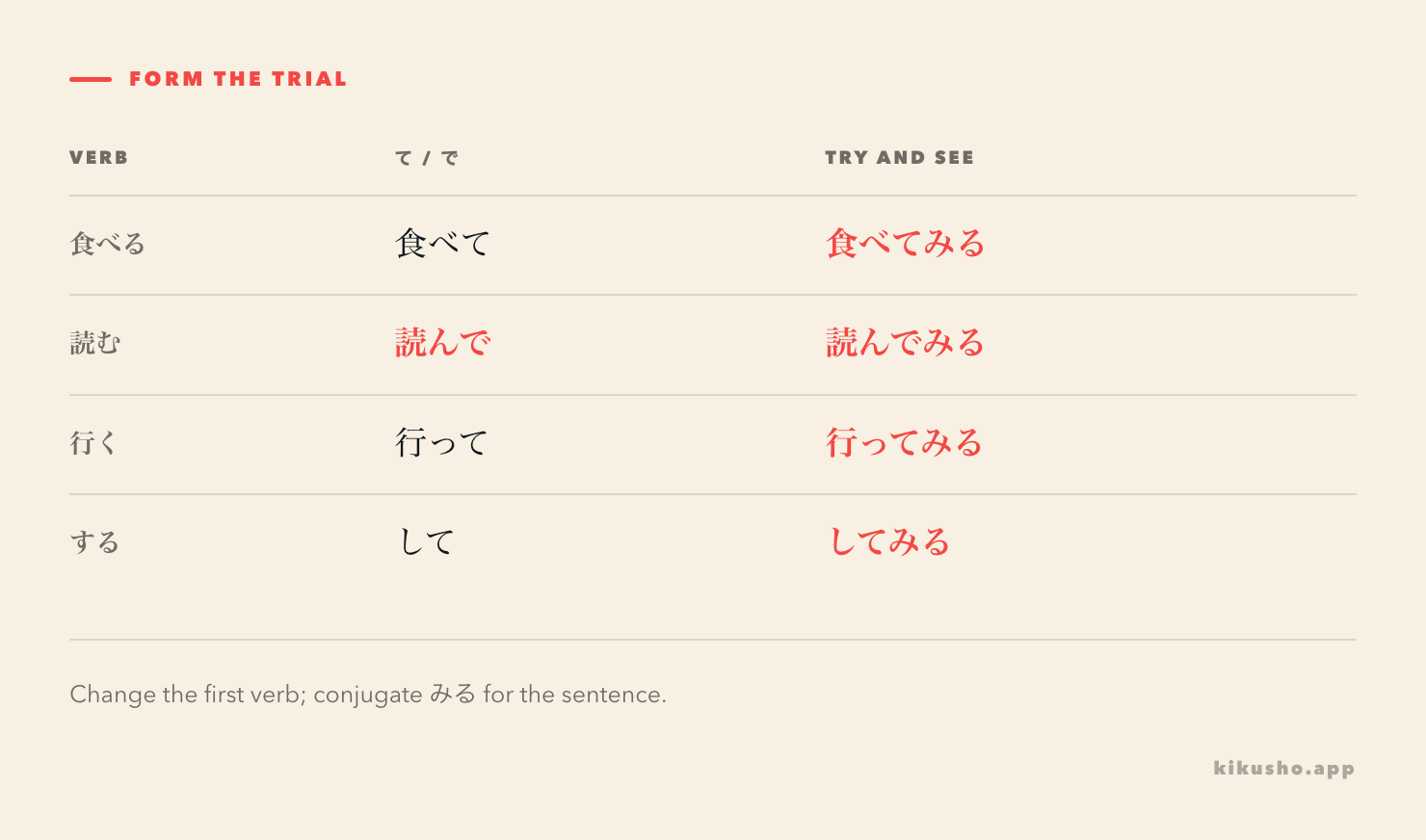
Conjugate みる for the time and situation: 読んでみます is polite nonpast, 読んでみた is plain past, and 読んでみました is polite past. 読んでみたい says “I want to try reading,” without claiming I have read anything yet. 読んでみてください invites another person to try. The auxiliary is usually written みる in kana; the kanji-or-hiragana guide explains why grammatical みる differs from the full verb 見る (“look”).
A trial gives you a result to observe
There is a strange button on a device. このボタンを押してみます (この ボタンを おしてみます) says “I'll try pressing this button and see what happens.” The speaker intends to carry out the press, then learn from the result. Plain このボタンを押します states the action without making the experiment the point.
After walking an unfamiliar street, この道を歩いてみました (この みちを あるいてみました) says “I tried walking this route.” The past form presents a walk that happened, giving the speaker grounds to report what it was like. You can add 静かでした (しずかでした, “It was quiet”) as the observation. The form works for a small test as well as a first experience; “try” does not mean the task itself must be easy.
The Japan Foundation uses the form for new activities and products, including an offer with ~てみてください. このスープを飲んでみてください (この スープを のんでみてください) offers a taste of soup. このコートを着てみたいです (この コートを きてみたいです) expresses a wish to try a coat on; wishing is not a past trial. The same exploratory meaning runs through the offer and the wish.
Past ~てみた and a blocked attempt are different
ドアを押してみた (ドアを おしてみた) reports that I pressed the door to test it, even if it remained shut. ドアを押そうとしたけど、手が届かなかった (ドアを おそうとしたけど、てが とどかなかった) says I was going to press it, but could not reach it; no press took place. The latter uses the separate volitional + とする construction to describe an attempted action that might never happen. Tofugu and Bunpro's comparison both make this distinction. You need not master that other construction here to read the difference: ask whether the trial action happened.
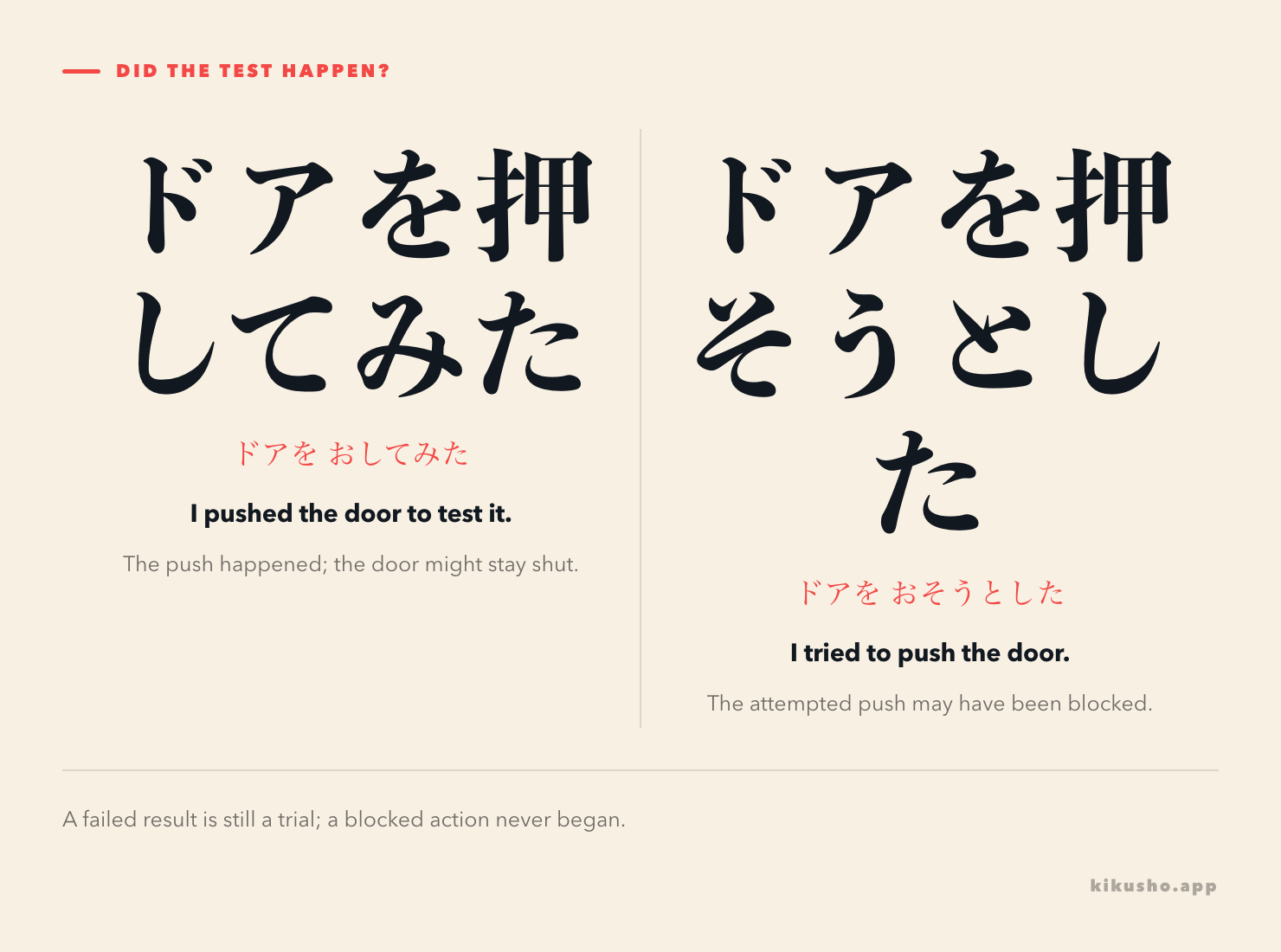
“Carried out” does not mean the larger goal succeeded. The door may still be locked after you push it. この本を読んでみたけど、難しかった (この ほんを よんでみたけど、むずかしかった) says I read enough to judge it difficult; it says nothing about finishing every page. Nor does ~てみる forbid trying a difficult activity. It marks taking the first exploratory step, rather than merely struggling to begin it.
みたい and みてください retain the same trial
別の方法で書いてみたい (べつの ほうほうで かいてみたい) means “I'd like to try writing it another way.” The desired experiment is still in the future. With a colleague's unfamiliar pen, このペンを使ってみてください (この ペンを つかってみてください) asks them to use it and see how it feels. 使ってください is a plain request to use it; the extra みて makes the trial the point. Irodori gives both wishing and offering patterns, and Tofugu confirms ~てみたい as a desire to try.
Compare ~ておく when you do something now for a later need: 書いておく prepares a written note for later; 書いてみる tests a way of writing to see the result. An English “try” can be either an experiment or sustained effort. For a repeated effort or habit, ~ようにする may fit better; Bunpro separates that use. The next time a sentence says “try,” look for its consequence, not only the verb form.
If a message says この道を歩いてみたら、静かだった, save the whole line in Kikusho rather than just 歩く. A text capture can keep the experiment beside the observation on the card; when you review it offline, you can recall which action gave the speaker that discovery.
Practice: choose the trial and build the form
Attempt all six questions before opening the explanations below.
Question 1 — grammar choice. You want to press an unfamiliar button and see what happens. Which sentence marks the action as a trial?
- A. このボタンを押してみます。
- B. このボタンを押します。
- C. このボタンを押しておきます。
Question 2 — grammar choice. You intended to push a high door, but you could not reach it, so you never pushed it. Which sentence reports that blocked attempt accurately?
- A. ドアを押してみたけど、手が届かなかった。
- B. ドアを押そうとしたけど、手が届かなかった。
- C. ドアを押しておいたけど、手が届かなかった。
Question 3 — sentence composition. Say politely that you will try reading this book to see what it is like. Use この本を読む and ~てみる.
Question 4 — sentence composition. Invite a friend to try using this pen. Use このペンを使う and polite ~てみてください.
Question 5 — text grammar. Complete this diary line using the past trial form of 歩く: 昨日、この道を__。静かだった。
Question 6 — text grammar. Read この本を読んでみたけど、難しかった. What does the speaker's use of 読んでみた establish about reading the book, and what does it leave unknown?
Answers and explanations
Answer 1. A, このボタンを押してみます。 押す → 押して → 押してみます adds a planned experiment. B only reports pressing; C marks doing it ahead of a later need, not trying it to learn the result.
Answer 2. B, ドアを押そうとしたけど、手が届かなかった。 The speaker intended to push, but did not touch the door. A's past 押してみた says a test push took place, conflicting with the inability to reach it. C also says the action was done, and ~ておく introduces a different advance-purpose meaning. ~ようとする is a neighbouring form, used here only to name the blocked attempt.
Answer 3. One model answer is この本を読んでみます。 (この ほんを よんでみます), “I'll try reading this book.” 読む → 読んで → 読んでみます keeps the voiced で and makes みる polite. No reading is reported as completed yet.
Answer 4. このペンを使ってみてください。 (この ペンを つかってみてください), “Please try using this pen.” 使う → 使って → 使ってみる → 使ってみてください invites the friend to test the pen, rather than merely asking them to use it.
Answer 5. 歩いてみた completes 昨日、この道を歩いてみた。静かだった。 (きのう、この みちを あるいてみた。しずかだった), “Yesterday I tried walking this route. It was quiet.” 歩く → 歩いて → 歩いてみた marks an actual trial in the past, followed by its observation.
Answer 6. The speaker did some reading, enough to find the book difficult. 読んでみた reports an exploratory action carried out, followed by an assessment. It does not tell us they finished the whole book. A failed attempt to begin reading would require a different expression.
Common questions
How do you form ~てみる?
Put the first verb in its て- or で-form and add みる. 読む becomes 読んでみる; 食べる becomes 食べてみる. The auxiliary changes for tense and politeness: 読んでみた and 読んでみます.
Does ~てみた say that the action happened?
In an ordinary account of a trial, yes: the speaker carried out enough of the action to discover what it was like. 読んでみた says they tried reading, but does not establish that they finished the entire book.
How do I invite someone to try something?
Use the first verb's て-form followed by みてください. このペンを使ってみてください invites someone to try using a pen and see how it feels.
Is the auxiliary written みる or 見る?
Write the auxiliary in kana as みる for the grammatical meaning “try and see.” 見る in kanji normally names the separate action of looking.