On this page
A Japanese city plan needs more than names for buildings. It needs words for the urban area, the road system, the signals and equipment that make it work, and the landmarks or events that give it an identity.
This N3 lesson teaches 市(いち), 信号(しんごう), 設備(せつび), 地方(ちほう), 塔(とう), 都会(とかい), 都市(とし), 道路(どうろ), 歩道(ほどう) and 都(みやこ). Several share a kanji with an earlier-level word but use a different reading or viewpoint, so learn each one inside a phrase rather than as an isolated spelling.
Ten words with different jobs in the city
| Headword | Reading | Grammar and selected sense | Phrase to retain |
|---|---|---|---|
| 市 | いち | noun; market or fair | 朝市が立つ: a morning market is held |
| 信号 | しんごう | noun; signal, traffic light | 信号が青に変わる: the light turns green |
| 設備 | せつび | noun; suru verb; equipment or installed facilities | 空調設備を更新する: upgrade the air-conditioning equipment |
| 地方 | ちほう | noun; region, local area, area outside a major centre | 関東地方: the Kanto region |
| 塔 | とう | noun; tower or pagoda | 展望塔に上る: go up an observation tower |
| 都会 | とかい | noun; city or city life, especially against the country | 都会で暮らす: live in the city |
| 都市 | とし | noun; city or urban area as a settlement or system | 都市を計画する: plan a city |
| 道路 | どうろ | noun; road or roadway | 道路を横断する: cross the road |
| 歩道 | ほどう | noun; pavement, sidewalk or pedestrian path | 歩道を歩く: walk on the pavement |
| 都 | みやこ | noun; capital, seat of government or cultural centre | 古い都を訪ねる: visit an old capital |
The English translations overlap, but the Japanese viewpoints do not. 市 is an event or place of trade in this record. 都市 and 都会 both concern city space, while 地方 places that space inside a wider region. 道路 and 歩道 describe parts of the transport environment. 信号 and 設備 help that environment function. 塔 and 都 can carry the history or identity of a place.
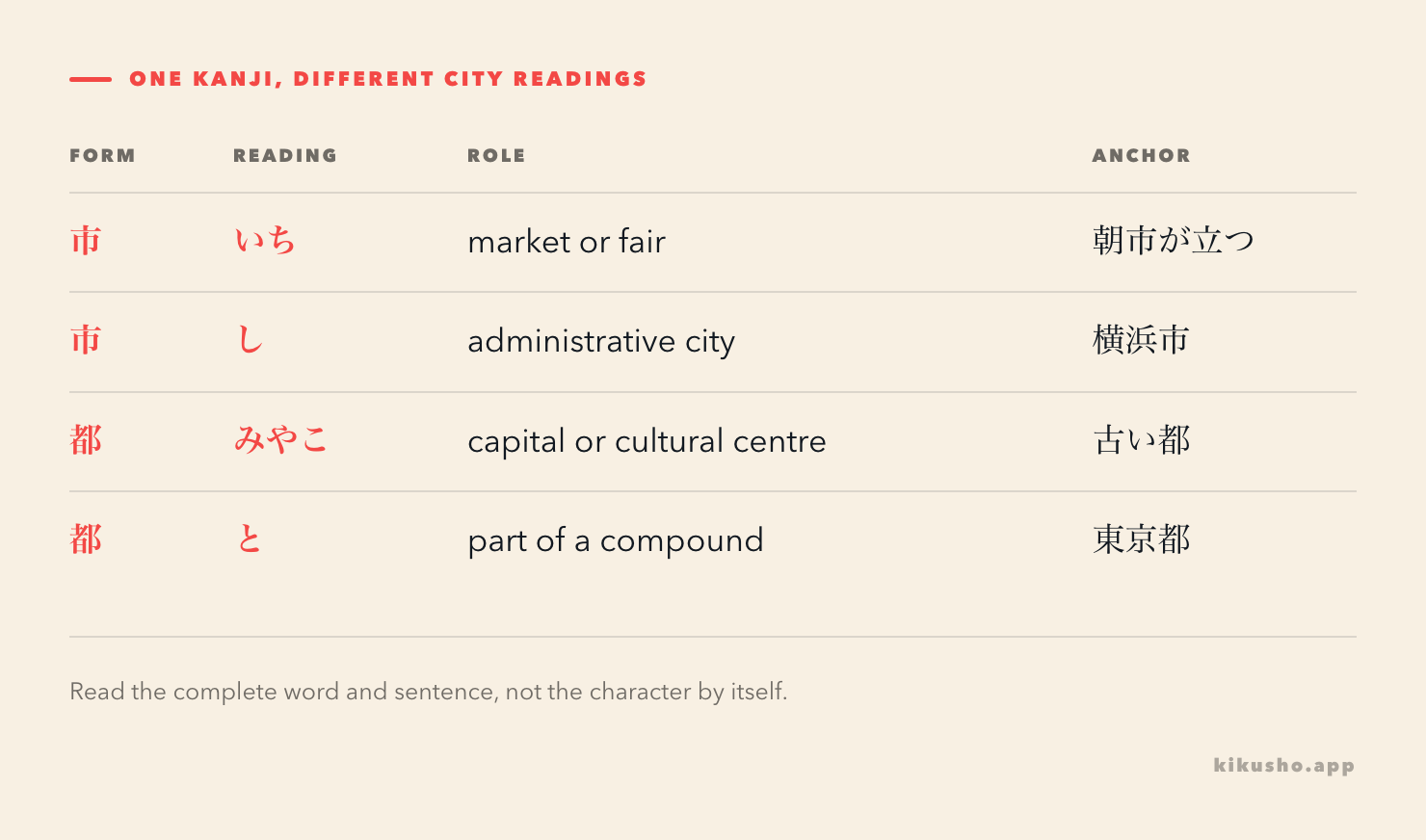
市(いち)is a market, not the administrative 市(し)
The assigned word 市(いち) means a market or fair where sellers and buyers gather. The dictionary entry for 市 records 市が立つ, for a market being held, and compounds such as 朝市, morning market, and 蚤の市, flea market.
港の広場では、毎週日曜日に市が開かれます。
みなとの ひろばでは、まいしゅう にちようびに いちが ひらかれます。
A market is held in the harbour square every Sunday.
This reading is easy to miss because the same kanji appears as 市(し), an administrative city, in 横浜市 and 市役所. The N4 city lesson owns that administrative reading. Compare the two complete phrases:
| Phrase | Reading | Meaning |
|---|---|---|
| 朝市へ行く | あさいちへ いく | go to the morning market |
| 市が計画を発表する | しが けいかくを はっぴょうする | the city announces a plan |
地方, 都市 and 都会 describe three viewpoints
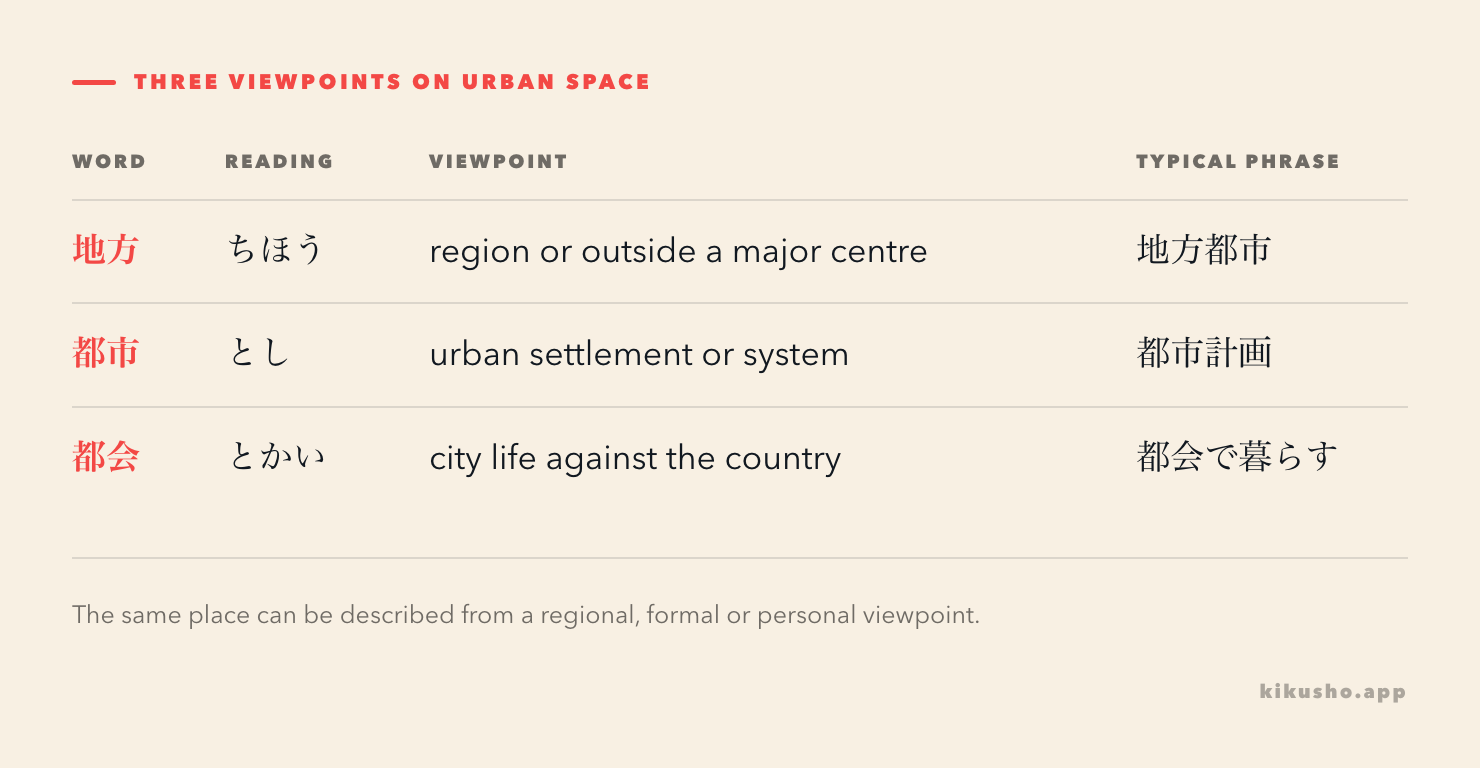
地方(ちほう) means a region within a country, as in 関東地方 or この地方. It can also mean areas outside the capital or another major metropolitan centre. The 地方 dictionary entry records both uses.
この地方は冬になると雪が多いです。
This region gets a lot of snow in winter.
Do not automatically translate 地方 as “countryside.” A 地方都市 is a regional city and may be densely built. 田舎(いなか) more directly presents a place as rural or as somebody's home region away from a major city.
都市(とし) is the neutral, often formal word for a city or urban area as a population centre and organised system. It suits planning, geography, policy and compounds:
- 都市計画: urban planning
- 都市部: urban areas
- 地方都市: regional city
The 都市 dictionary account describes a concentrated settlement with political, economic or cultural functions. It also notes that an administrative 市(し) does not always correspond exactly to the built-up 都市: municipal boundaries can include rural land, and one urban area can cross boundaries.
この都市では、駅の周辺に人口が集中しています。
In this city, the population is concentrated around the station.
都会(とかい) is common when the speaker imagines city life in contrast with the country. It appears in personal observations such as 都会で働く, work in the city, 都会の生活, city life, and 都会育ち, city-bred.
兄は都会の生活に慣れましたが、私は静かな町のほうが好きです。
My older brother has become used to city life, but I prefer a quiet town.
The difference is one of viewpoint, not a hard boundary on a map. A report can analyse a place as a 都市, while a resident calls the same place 都会 because of its crowds, transport and pace of life.
都(みやこ)points to a capital or cultural centre
The independent noun 都(みやこ) traditionally names the place where a ruler and central government are based. It can therefore describe historical capitals such as Nara or Kyoto. The Kanjipedia entry for 都 also records a broader cultural use: a city can be called a centre of music, flowers or another activity.
京都は長い間、日本の都でした。
Kyoto was Japan's capital for a long time.
その町は「音楽の都」として知られています。
The city is known as a “capital of music.”
Do not carry the みやこ reading into 都市(とし) or 都会(とかい). The N4 record 都(と) also has a different administrative job in 東京都. These are distinct vocabulary records even though they share one kanji.
道路 contains the traffic system; 歩道 reserves space for people
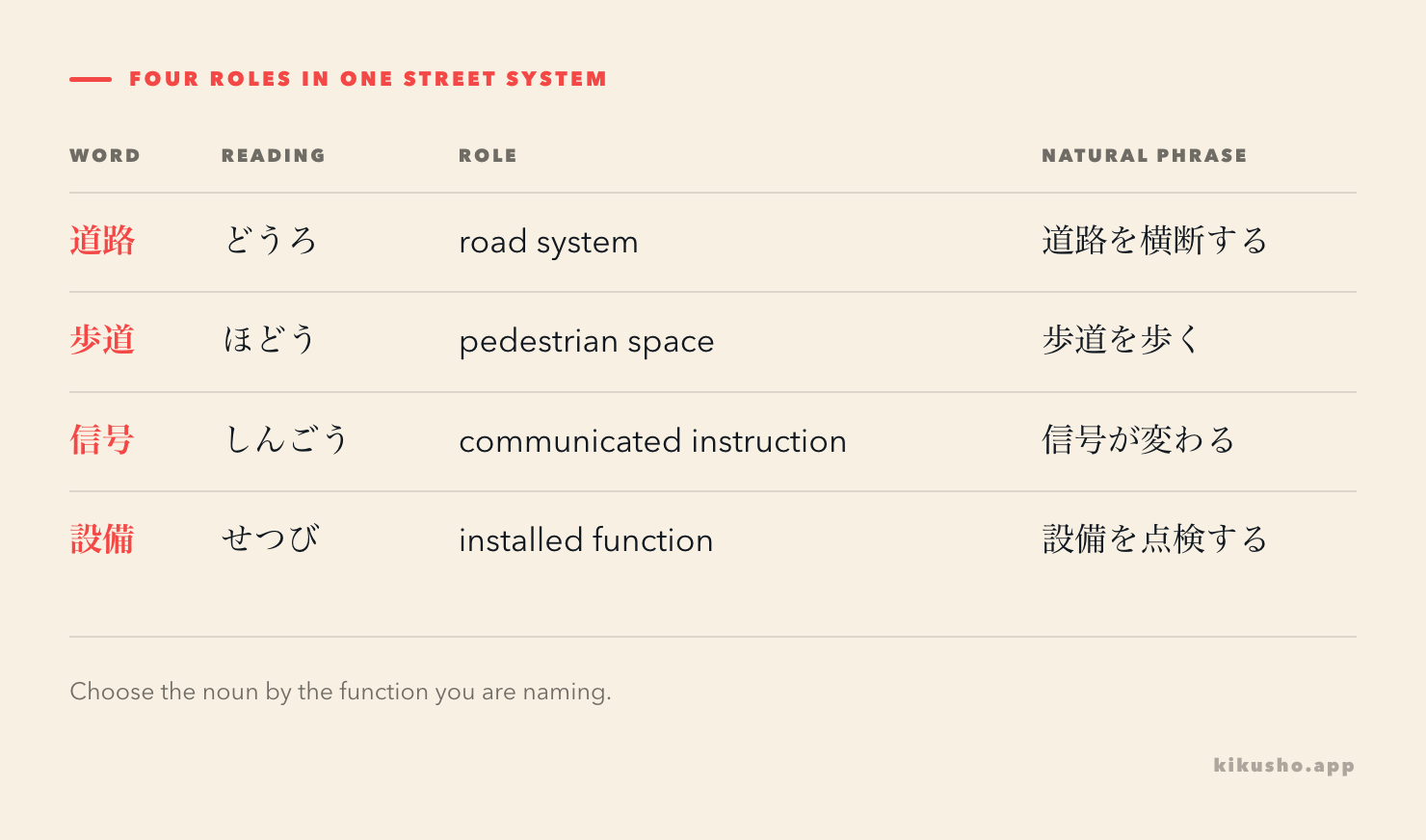
道路(どうろ) is a road or roadway used for general traffic. It is more formal and infrastructural than the broad everyday word 道(みち), which can mean a physical path, a route, a way of doing something or even a discipline. The 道路 entry treats bridges and tunnels as parts of the road system and describes roads as containing elements such as carriageways, pavements, signs and signals.
大雨のため、一部の道路が通行止めになりました。
Because of the heavy rain, some roads were closed to traffic.
歩道(ほどう) is the part set aside for people walking. The 歩道 definition distinguishes it from the vehicle carriageway and also permits the wider sense of a pedestrian path.
安全のため、道路を渡る前に歩道で待ってください。
For safety, wait on the pavement before crossing the road.
The particles reflect the scene. 歩道を歩く uses を for the route through which somebody moves. 道路を横断する marks the area crossed. 道路が混んでいる instead makes the road the subject of a state.
信号 gives information; 信号機 is the device
信号(しんごう) is a signal communicated through colour, light, sound, movement or another agreed sign. In ordinary street directions it also means a traffic light:
二つ目の信号を左に曲がってください。
Please turn left at the second traffic light.
信号が青に変わるまで待ちましょう。
Let's wait until the light turns green.
信号機(しんごうき) names the physical signal apparatus more explicitly. 信号 can instead focus on the displayed indication, the information it conveys, or the traffic light as a familiar landmark. The definition of 交通信号 covers both the coloured indication and its machine, which explains why everyday usage overlaps.
Japanese calls the permissive light 青信号, literally a blue signal, even when the lamp appears green. Learn 赤信号, 青信号 and 信号が変わる as whole combinations.
設備 is what a facility has installed
設備(せつび) means equipment, installations or provisions put in place for a purpose. The 設備 dictionary entry includes both the act of equipping and the things installed.
市は図書館の空調設備と消防設備を更新しました。
The city upgraded the library's air-conditioning and fire-safety equipment.
施設(しせつ) usually presents the whole facility, institution or site. A library, sports centre or treatment plant can be a 施設; its lifts, lighting and ventilation are 設備. The boundary can overlap because large installed provisions may also be called facilities in English. The practical question is whether the sentence points to the site as a place or to what has been fitted there to make it work.
| Focus | Natural choice | Example |
|---|---|---|
| the place or institution | 施設 | 公共施設を利用する: use a public facility |
| installed systems or equipment | 設備 | 防災設備を点検する: inspect disaster-prevention equipment |
| making the provisions complete | 設備 | 設備を整える: put the necessary equipment in place |
塔 covers both a pagoda and a tall tower
塔(とう) can name a Buddhist pagoda or a tall, narrow structure. The dictionary entry for 塔 gives religious examples such as 五重塔 and functional or architectural examples such as テレビ塔, 鉄塔 and a church tower.
丘の上の展望塔から都市全体が見えます。
You can see the entire city from the observation tower on the hill.
寺の五重塔は町の象徴です。
The temple's five-storey pagoda is a symbol of the town.
Do not invent a rigid rule that traditional structures use 塔 and modern ones use タワー. Modern structures can take either, and established names decide. 東京タワー uses タワー, while a communications tower may be 電波塔.
One redevelopment plan connects all ten words
Read this invented plan first for its main idea, then find each target word:
この地方の都市では、駅前の道路と歩道を広げ、信号や照明設備を更新する計画が進んでいる。古い塔を地域の象徴として保存し、週末には広場で市を開く。都会から訪れる人にも、かつて都として栄えた町の歴史を伝えることが目的だ。
In a city in this region, a plan is under way to widen the roads and pavements and upgrade the traffic signals and lighting equipment. The old tower will be preserved as a local symbol, and a market will be held in the square on weekends. The aim is also to communicate the history of the town, which once flourished as a capital, to visitors from major cities.
The first sentence uses 地方 to locate a 都市, then divides the street into 道路 and 歩道 and names two working elements, 信号 and 設備. The second preserves a 塔 and creates a recurring 市(いち). The final sentence contrasts visitors from 都会 with a town that once served as a 都(みやこ).
Kikusho's dated September 2026 audit places these ten precise spelling-and-reading records at N3. Both broad baseline files trace back to Waller's list and therefore count as a single placement lineage. Japanesetest4you separately labels several exact records N3, including 信号, 設備, 都会 and 道路. Because the JLPT issues no complete current vocabulary specification, N3 is a practical study placement rather than a promise about a test form.
The N5 city lesson supplies everyday landmarks, and the N4 lesson adds administrative areas, venues and transport sites. This page moves from labels on a map to language used in plans, reports and comparisons between regions.
The N2 continuation adds 会館, 商店, 消防署, 広場 and 役所 through a municipal redevelopment notice.
Practice
Work through the entire city scene before revealing the solution panel.
1 · Market reading
How is 市 read in 日曜日に広場で市が開かれる?
A. し
B. いち
C. みやこ
D. とし
2 · Signal spelling
Which spelling matches しんごう?
A. 信仰
B. 新号
C. 信号
D. 新郷
3 · Urban report
A formal report describes population and transport planning in a large urban settlement. Which word fits best?
この__では、公共交通の利用者が増えている。
A. 都市
B. 市
C. 塔
D. 歩道
4 · Road and pavement
Which sentence uses 道路 and 歩道 naturally?
A. 車は歩道を走り、人は道路だけで待つ。
B. 道路が青に変わり、歩道を更新する。
C. 歩道を運転してから、道路に座る。
D. 道路を渡る前に、歩道で待つ。
5 · Library equipment
What does 図書館の設備を整える mean most closely?
A. declare the library an administrative city
B. put the library's necessary equipment and installations in place
C. hold a market inside the library
D. move the library to the countryside
6 · Historical capital
How is 都 read in 奈良は古い都です?
A. と
B. つ
C. みやこ
D. とかい
7 · City landmark
Which phrase can describe either a high observation structure or a Buddhist pagoda?
A. 信号
B. 設備
C. 塔
D. 地方
8 · Redevelopment purpose
Read the redevelopment passage above. Why will the town preserve the old tower and hold a weekend market?
A. To remove all pedestrian space from the station area.
B. To prove that 地方 always means an isolated village.
C. To replace its history with a new administrative boundary.
D. To strengthen the area's identity and share the former capital's history with visitors.
Answers and explanations
1 · B. 市 is いち when it means a market or fair. The administrative city reading is し, while みやこ is a reading of 都 and とし is 都市.
2 · C. 信号(しんごう) means a signal or traffic light. 信仰 is しんこう, “religious faith,” so its final kanji and consonant distinction matter.
3 · A. 都市 suits a neutral or formal discussion of an urban settlement and its systems. 市 would need the いち market meaning assigned here or a clear administrative し context; the other choices do not name the settlement.
4 · D. A pedestrian can wait 歩道で and then 道路を渡る. The other sentences assign vehicle movement, signal colour or human actions to the wrong nouns.
5 · B. 設備を整える means to put the equipment or provisions needed for a purpose in place. It says nothing about municipal status, a market or a rural move.
6 · C. Independent 都 meaning a historical capital is read みやこ here. と appears in compounds and in the administrative word 東京都; とかい is the complete word 都会.
7 · C. 塔(とう) covers a tower and a Buddhist pagoda. A compound or context specifies the type, as in 展望塔 or 五重塔.
8 · D. The plan preserves 塔 as a regional symbol, creates a weekend 市, and tells visitors that the town once flourished as a 都. Those details support identity and historical interpretation, not the other claims.
Common questions
What is the difference between 都市 and 都会?
都市(とし)is a neutral or formal term for an urban settlement or system, common in planning and compounds such as 地方都市. 都会(とかい)evokes the city or city life in contrast with the countryside and is common in personal descriptions such as 都会で暮らす.
Is 市 read いち or し?
市 is いち when it means a market or fair, as in 朝市 and 蚤の市. It is し when it means an administrative city or appears in a city name such as 横浜市. This lesson's assigned N3 record is the market reading いち.
What is the difference between 設備 and 施設?
設備(せつび)focuses on installed equipment or provisions needed for a purpose, such as air-conditioning or fire-safety equipment. 施設(しせつ) usually names a facility, institution or site as a whole.
Does 地方 mean countryside?
地方(ちほう)can mean a region within a country or an area outside the main metropolitan centres. It does not automatically mean rural countryside; 地方都市 is a regional city, while 田舎 more directly suggests the country.