On this page
The twelve N4 records in this lesson are 田舎(いなか), 会場(かいじょう), 教会(きょうかい), 空港(くうこう), 警察(けいさつ), 郊外(こうがい), 市(し), 神社(じんじゃ), 駐車場(ちゅうしゃじょう), 寺(てら), 都(と) and 港(みなと). They do not all name buildings: some locate an area, some name an institution or event venue, and others identify transport or religious sites.
Twelve map words with twelve different jobs
| Map label | Kana | What it denotes | Useful context |
|---|---|---|---|
| 田舎 | いなか | noun; countryside, rural area, home region | 田舎で育つ, grow up in the countryside |
| 会場 | かいじょう | noun; venue for a meeting or event | 会場に着く, arrive at the venue |
| 教会 | きょうかい | noun; church, especially a Christian community or building | 教会で礼拝が行われる, a service is held at the church |
| 空港 | くうこう | noun; airport | 空港に到着する, arrive at the airport |
| 警察 | けいさつ | noun; the police as an institution or collective | 警察に連絡する, contact the police |
| 郊外 | こうがい | noun; outskirts, suburbs | 市の郊外に住む, live on the outskirts of a city |
| 市 | し | noun or suffix; administrative city | 横浜市, Yokohama City |
| 神社 | じんじゃ | noun; Shinto shrine | 神社にお参りする, visit a shrine to pray |
| 駐車場 | ちゅうしゃじょう | noun; car park, parking lot | 駐車場に車を止める, park a car in the car park |
| 寺 | てら | noun; Buddhist temple | お寺を訪ねる, visit a temple |
| 都 | と | noun or suffix; Tokyo as a metropolitan prefecture or government | 東京都, Tokyo Metropolis |
| 港 | みなと | noun; harbour, port | 船が港に入る, a ship enters the port |
The table has four layers. 田舎, 郊外, 市 and 都 place something inside a region or administrative area. 港, 空港, 駐車場 and 会場 identify functional places. 警察 names an institution. 神社, 寺 and 教会 name religious communities or sites.
田舎 and 郊外 locate you at different distances from a city
田舎(いなか) places a scene away from a major urban centre. It can mean the countryside or a quiet rural area with fewer houses. It can also mean a person's home region or family hometown, even when that place is not extremely remote. The dictionary entry for 田舎 records both the rural sense and the “home region” sense.
父は海の近くの田舎で育ちました。
ちちは うみの ちかくの いなかで そだちました。
My father grew up in the countryside near the sea.
Calling somebody else's hometown 田舎 can sound like a judgment that it is unsophisticated or remote. A speaker can comfortably say 私の田舎, my home region, but should not assume every small city is 田舎.
郊外(こうがい) stays attached to a city. It is the area adjoining the built-up centre, often translated as “outskirts” or “suburbs.” The dictionary definition of 郊外 centres on land next to a city or around its edge.
私たちは市の郊外に住んでいます。
わたしたちは しの こうがいに すんでいます。
We live on the outskirts of the city.
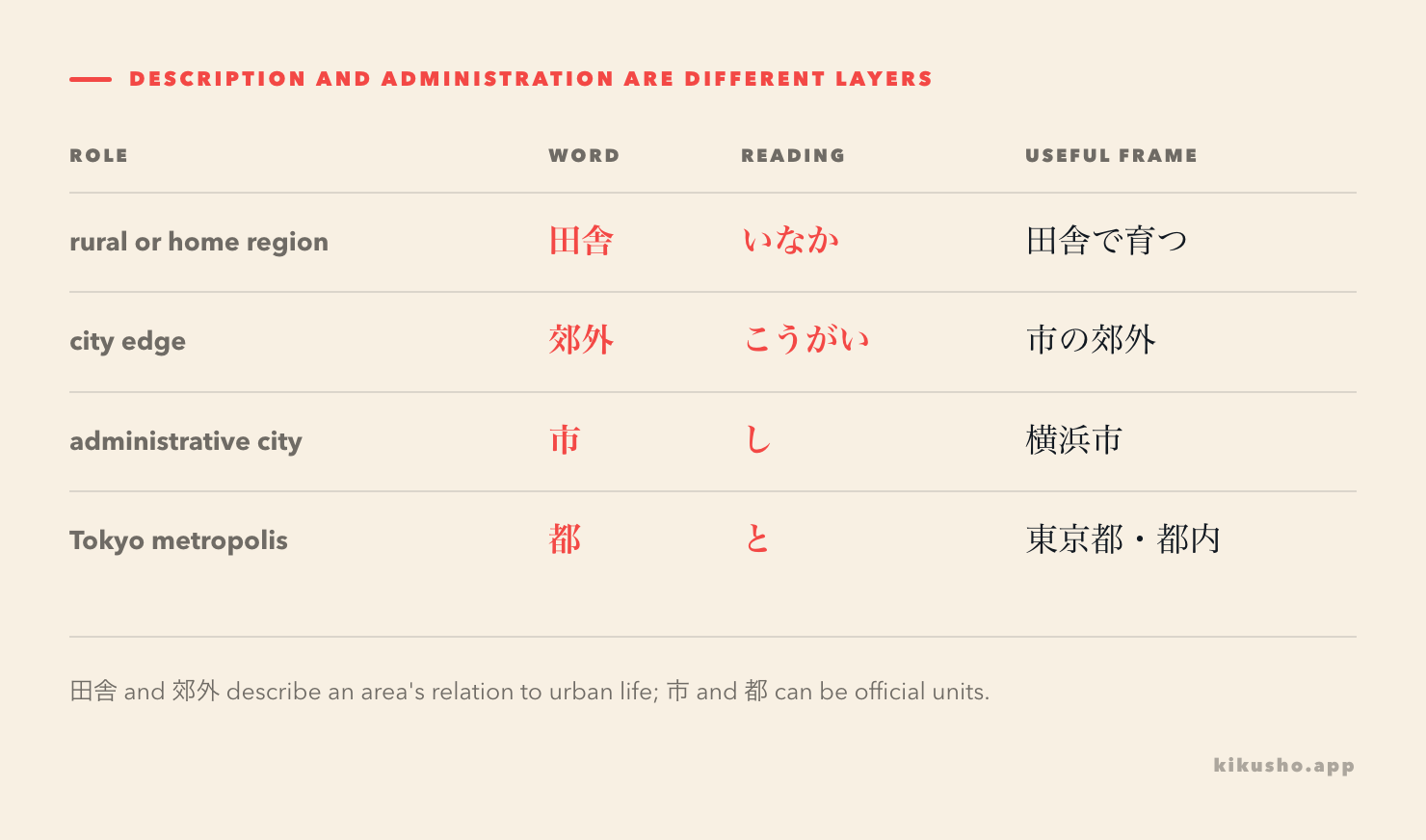
田舎 and 郊外 can both contain fields and detached houses, but they answer different questions. 田舎 contrasts a place with urban life. 郊外 locates it in relation to a particular city.
市 and 都 are administrative readings, not generic city synonyms
The assigned record 市(し) is the administrative word “city” and the suffix used in official city names:
- 横浜市(よこはまし) — Yokohama City.
- 市役所(しやくしょ) — city hall or city office.
- 市が新しい図書館を建てた — the city built a new library.
The same kanji has a separate reading いち, meaning a market, as in 朝市(あさいち). That is a different lexical record. Reading a map label such as 京都市 as きょうといち would turn “Kyoto City” into the wrong word.
都(と) also needs its exact reading and administrative context. Modern Japan has one 都, 東京都(とうきょうと). The government's statistical categories distinguish 都道府県 from 市区町村, and dictionary material notes that the current 都 is Tokyo.
東京都には二十三区のほかに、市や町や村もあります。
とうきょうとには にじゅうさんくの ほかに、しや まちや むらも あります。
Tokyo Metropolis contains cities, towns and villages in addition to its twenty-three wards.
The reading と appears in 東京都, 都内(とない), 都立(とりつ), 都営(とえい) and 都民(とみん). The independent reading みやこ means a capital or imperial city and belongs to a different record. For a present-day address, write 東京都に住んでいる, not a bare 都に住んでいる intended to mean merely “I live in a metropolis.”
N3 adds 市(いち), 都(みやこ), 地方, 都市 and 都会.
港 and 空港 share a kanji but serve different vehicles
港(みなと) is a harbour or port where ships enter, leave or stop. Its physical setting can be on the sea or a navigable river.
朝、大きな船が港に入りました。
あさ、おおきな ふねが みなとに はいりました。
A large ship entered the port in the morning.
空港(くうこう) is an airport equipped for public air transport. The dictionary explanation of 空港 connects it with passenger and cargo aviation, while the 港 entry centres on ships, safe entry and mooring.
空港から市内までバスで四十分です。
くうこうから しないまで バスで よんじゅっぷんです。
It takes forty minutes by bus from the airport to the city centre.
The kanji 港 changes reading with word shape:
- independent 港: みなと
- compound 空港: くうこう
- other compounds: 出港(しゅっこう), departure from port; 港町(みなとまち), port town
Do not infer that 空港 is literally a harbour for aircraft in every grammatical detail. It is the established word “airport”; people and baggage move through it with ordinary place patterns such as 空港に着く and 空港で荷物を受け取る.
会場 and 駐車場 describe a use assigned to a place
The suffix-like element 場(じょう) helps form nouns for places with a defined function.
会場(かいじょう) is wherever a meeting, examination, exhibition, concert or other event is held. It does not promise a dedicated hall or even an indoor building. A school gym, hotel room, park or temporary outdoor area can become the 会場 for an event. The dictionary definition says it is the place where a gathering or event is held.
試験の会場は駅の近くの大学です。
しけんの かいじょうは えきの ちかくの だいがくです。
The exam venue is a university near the station.
駐車場(ちゅうしゃじょう) is a designated place to leave cars or other vehicles. 駐車 is the act of parking; adding 場 names the place.
会場の前に広い駐車場があります。
かいじょうの まえに ひろい ちゅうしゃじょうが あります。
There is a large car park in front of the venue.
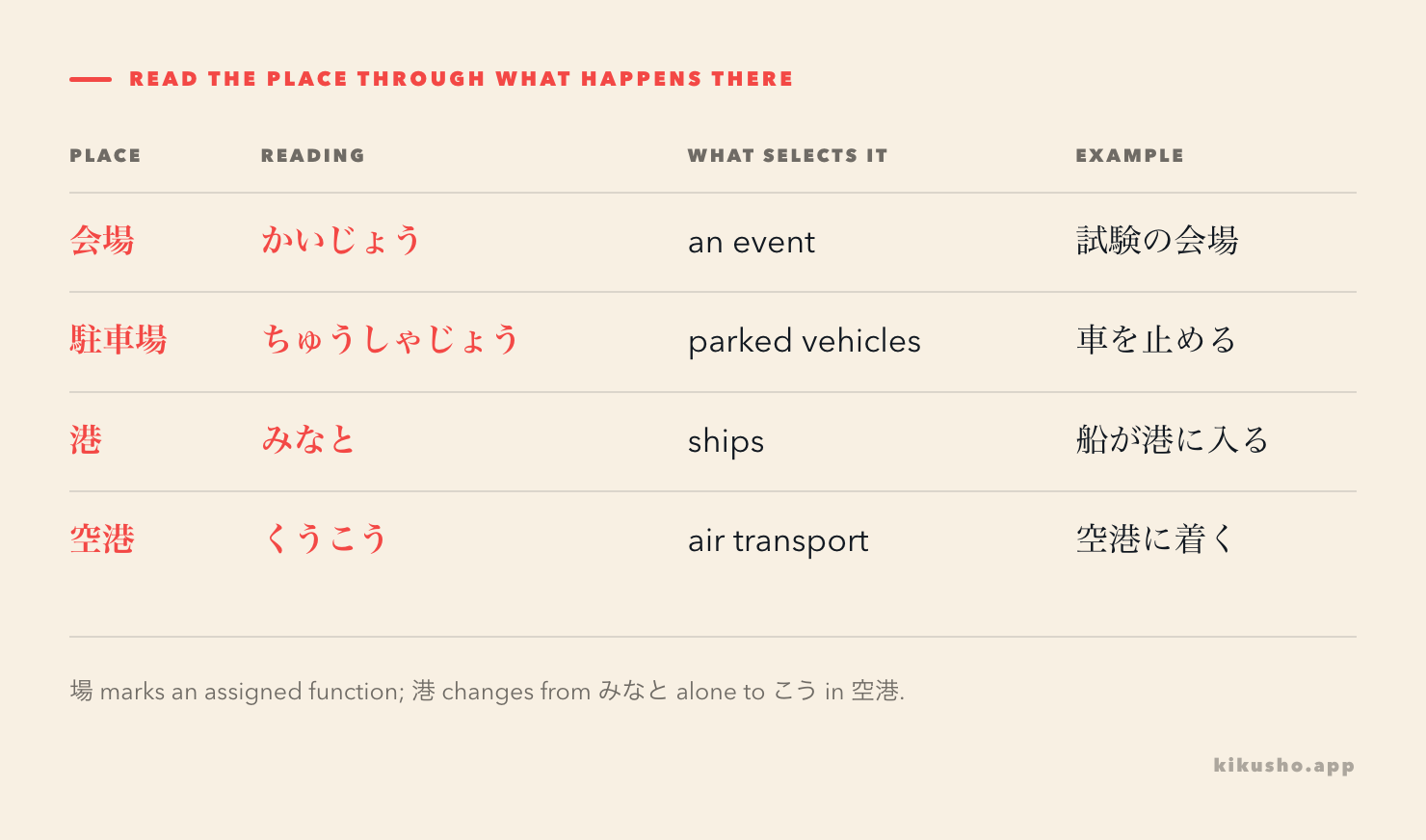
The paired sentence keeps both words concrete: an event determines the 会場, and cars determine the purpose of the 駐車場. Neither noun tells you the architectural form.
警察 is the police; 警察署 is the station
警察(けいさつ) primarily names the police as an institution, organisation or collective. This matters because the inherited gloss “police; police station” can hide three useful words:
| Referent | Word | Example |
|---|---|---|
| the institution or police collectively | 警察 | 警察に連絡する, contact the police |
| a police-station building or office | 警察署(けいさつしょ) | 警察署に行く, go to the police station |
| an individual officer | 警察官(けいさつかん) | 警察官に道を聞く, ask a police officer for directions |
財布をなくしたので、警察に連絡しました。
さいふを なくしたので、けいさつに れんらくしました。
I contacted the police because I lost my wallet.
Conversation can use 警察に行く to mean going to the local police office. That is ordinary metonymy: the institution stands for the place where it is represented. When the physical destination itself matters, 警察署 is precise. A 交番(こうばん), introduced in the N5 town lesson, is a smaller neighbourhood police post within a police station's jurisdiction.
神社, 寺 and 教会 identify different religious traditions
神社(じんじゃ) is a Shinto shrine. 寺(てら) is a Buddhist temple. The Japan National Tourism Organization's shrine and temple guide explains the religious distinction and notes the torii gate associated with shrines and the sanmon gate often found at temples.
教会(きょうかい) usually means a Christian church in everyday Japanese. It can name the community or organisation as well as the building used for worship. The dictionary entry records both senses.
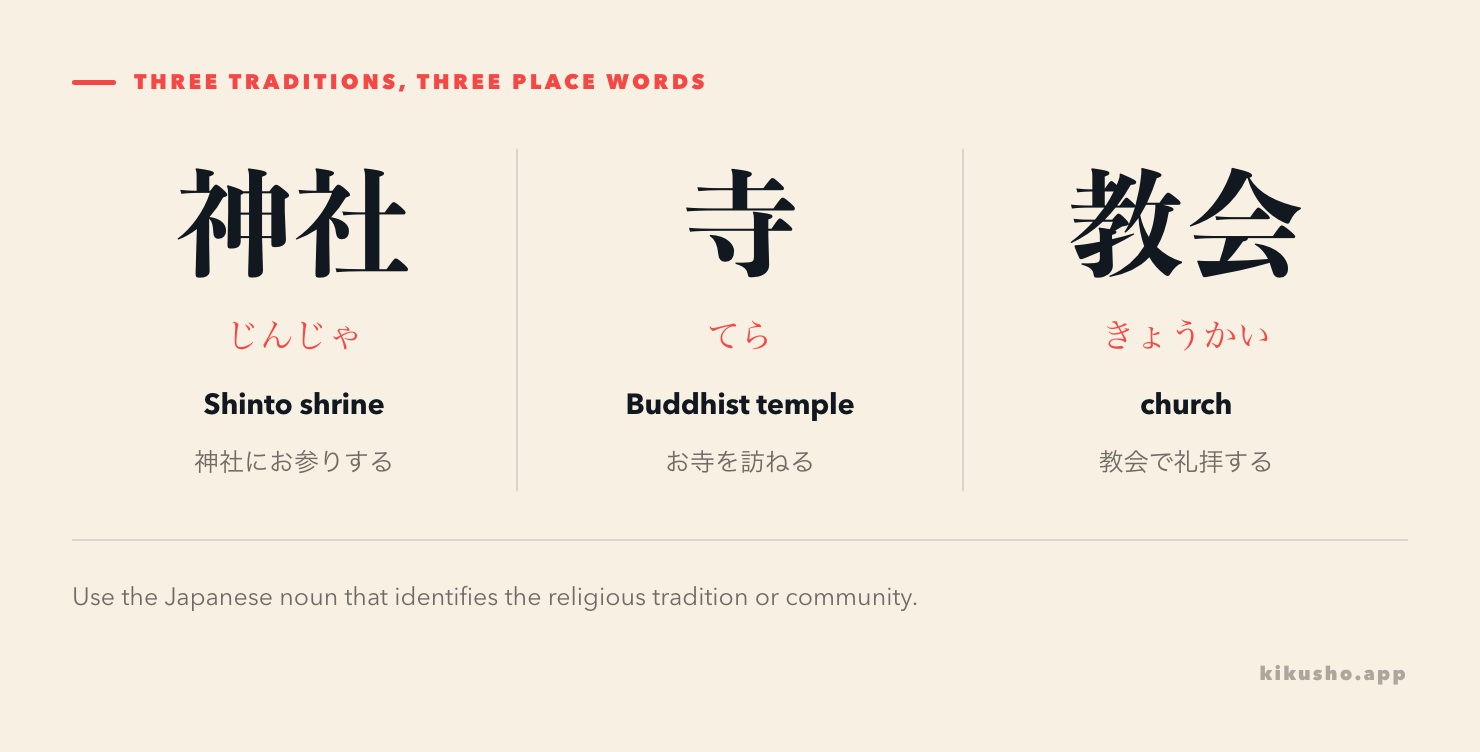
Natural route and activity phrases keep the distinction visible:
- 神社にお参りする — visit a Shinto shrine to pray.
- お寺を訪ねる — visit a Buddhist temple.
- 教会で礼拝が行われる — a worship service is held at a church.
The polite お寺(おてら) is frequent in everyday speech. Proper names may end in 寺 with a Sino-Japanese reading, as in 東大寺(とうだいじ), but the independent assigned word is 寺(てら).
Do not confuse 教会 with the homophone 協会(きょうかい), an association or society. A sports association can be a 協会; a church is normally 教会. The kanji before 会 identifies the institution.
One journey connects all twelve records
私の田舎は港の近くにあります。今は東京都の郊外に住み、市内の会場で働いています。会場の隣には駐車場があり、近くに神社とお寺と教会もあります。来週は警察の説明会を手伝った後、空港へ行きます。
わたしの いなかは みなとの ちかくに あります。いまは とうきょうとの こうがいに すみ、しないの かいじょうで はたらいています。かいじょうの となりには ちゅうしゃじょうが あり、ちかくに じんじゃと おてらと きょうかいも あります。らいしゅうは けいさつの せつめいかいを てつだった あと、くうこうへ いきます。
My home region is near a port. I now live on the outskirts of Tokyo Metropolis and work at a venue in the city. Beside the venue is a car park, and nearby there are also a shrine, a Buddhist temple and a church. Next week, after helping with an information session held by the police, I will go to the airport.
The paragraph does not pretend that all twelve nouns are equivalent landmarks. 田舎, 郊外, 東京都 and 市内 set geographic scales. 会場 and 駐車場 name functions assigned to places. 警察 identifies the organisation behind the session. The remaining nouns are physical destinations with different purposes.
For route particles, に/へ points toward a destination, で marks where an action happens, and を can mark a route through a place. The location-particle guide develops those choices beyond this vocabulary set.
N4 is a study placement, not an official word boundary
Kikusho's September 2026 inventory places all twelve spelling-and-reading records at N4, and its imported sources record no internal disagreement. Those two broad snapshots descend from the same Tanos/Waller family, so they are one placement tradition rather than two independent votes. Japanese Compass and independent N4 lists also group most or all of this set at N4.
Other course lists move several familiar place words earlier or later. One independent place list labels 田舎 N1, 郊外 and 駐車場 N2, and 港, 神社 and 寺 N3, while the Japan Foundation's practical Irodori materials introduce words such as 神社 and 駐車場 according to communicative need rather than a JLPT boundary. These differences show editorial sequencing, not changes in the meanings or readings taught here.
The official JLPT FAQ states that the test organisers do not publish an exhaustive current vocabulary, kanji or grammar syllabus. N4 here is therefore a transparent study placement. The exact records still matter: 市 is し, 都 is と, and 港 is みなと, even when the same kanji takes another reading elsewhere.
When you save these nouns in Kikusho, capture the phrase that reveals the role: 市の郊外, 試験の会場, 警察に連絡する, 船が港に入る. A bare English label such as “city,” “police” or “temple” leaves out the administrative reading or institutional boundary that the Japanese sentence needs.
Check the map before revealing the solutions
Map check 1 · three readings
Write the kana readings for 会場, 駐車場 and 港.
Map check 2 · rural area or city edge
Complete the sentence: 市の中心から電車で三十分の__に住んでいます。
- A. 郊外
- B. 会場
- C. 警察
- D. 教会
Map check 3 · exact administrative reading
Which pair is read correctly?
- A. 横浜市(よこはまいち)・東京都(とうきょうみやこ)
- B. 横浜市(よこはまし)・東京都(とうきょうと)
- C. 横浜市(よこはまし)・東京都(とうきょうど)
- D. 横浜市(よこはまいち)・東京都(とうきょうと)
Map check 4 · institution, building or person
Which sentence specifically says “I went to the police station”?
- A. 警察署に行きました。
- B. 警察官に行きました。
- C. 警察を建物しました。
- D. 駐車場を警察しました。
Map check 5 · ship or aircraft
Choose the natural pair: 船が__に入り、飛行機が__に着いた。
- A. 空港・港
- B. 会場・駐車場
- C. 港・空港
- D. 郊外・田舎
Map check 6 · event-defined place
A concert will be held in a city park. What can the park become for that event?
- A. 会場
- B. 市
- C. 都
- D. 警察官
Map check 7 · three traditions
Which mapping is accurate?
- A. 神社: Shinto shrine; 寺: Buddhist temple; 教会: church
- B. 神社: airport; 寺: police; 教会: car park
- C. 神社: church; 寺: Shinto shrine; 教会: port
- D. 神社: city; 寺: suburb; 教会: countryside
Map check 8 · read the complete scene
Read: 田舎から空港に着いた後、市の郊外にある会場まで行き、隣の駐車場で友達を待った。 Which summary is correct?
- A. The speaker left a church and waited at a harbour.
- B. The speaker arrived from the countryside, went to a venue on the city's outskirts and waited in the adjacent car park.
- C. The police moved a Buddhist temple into Tokyo Metropolis.
- D. A ship landed at an airport inside a shrine.
Answers and explanations
1 · Three readings
The readings are 会場(かいじょう), 駐車場(ちゅうしゃじょう) and 港(みなと). The first two use 場(じょう)for a place with an assigned function. 港 takes the independent reading みなと.
2
A, 郊外. The phrase locates a residential area in relation to the city centre. 田舎 could describe a rural area more generally, but it would not express “the outskirts of the city” as directly.
3
B. 横浜市 ends in 市(し), and 東京都 ends in 都(と). 市(いち), “market,” and 都(みやこ), “capital,” are different readings and lexical uses.
4
A, 警察署に行きました. 警察署 names the station. 警察官 is an officer, while 警察 by itself normally names the institution or police collectively.
5
C, 港・空港. Ships enter a 港(みなと); aircraft arrive at an 空港(くうこう). The shared kanji takes different readings in the independent word and compound.
6
A, 会場. A venue is defined by the event being held there, so a park can serve as a concert venue without becoming a different kind of permanent building.
7
A. 神社 belongs to Shinto, 寺 to Buddhism, and 教会 ordinarily refers to a Christian church. The three nouns cannot be collapsed into one generic “temple.”
8
B. The route begins in the countryside, continues from the airport to a venue on the city's outskirts, and ends in the car park beside that venue. Each place phrase supplies a different stage of the trip.
Common questions
What is the difference between 田舎 and 郊外?
田舎(いなか)means the countryside, a rural area or someone's home region away from a major city. 郊外(こうがい)is the area around the edge of a city, often residential and still closely connected to that city.
Does 警察 mean a police station?
警察(けいさつ)primarily means the police as an institution or collective. 警察署(けいさつしょ)names a police station and 警察官(けいさつかん)a police officer. Conversation can use 警察 metonymically for the local police office, but the three words are not interchangeable in every sentence.
What is the difference between 港 and 空港?
港(みなと)is a harbour or port for ships. 空港(くうこう)is an airport for passenger or cargo aircraft. The kanji 港 takes its kun-reading みなと as an independent word and its on-reading こう inside 空港.
What is the difference between 神社, 寺 and 教会?
神社(じんじゃ)is a Shinto shrine, 寺(てら)is a Buddhist temple, and 教会(きょうかい)usually refers to a Christian church in everyday Japanese. 教会 can name both the religious community and the building it uses.