On this page
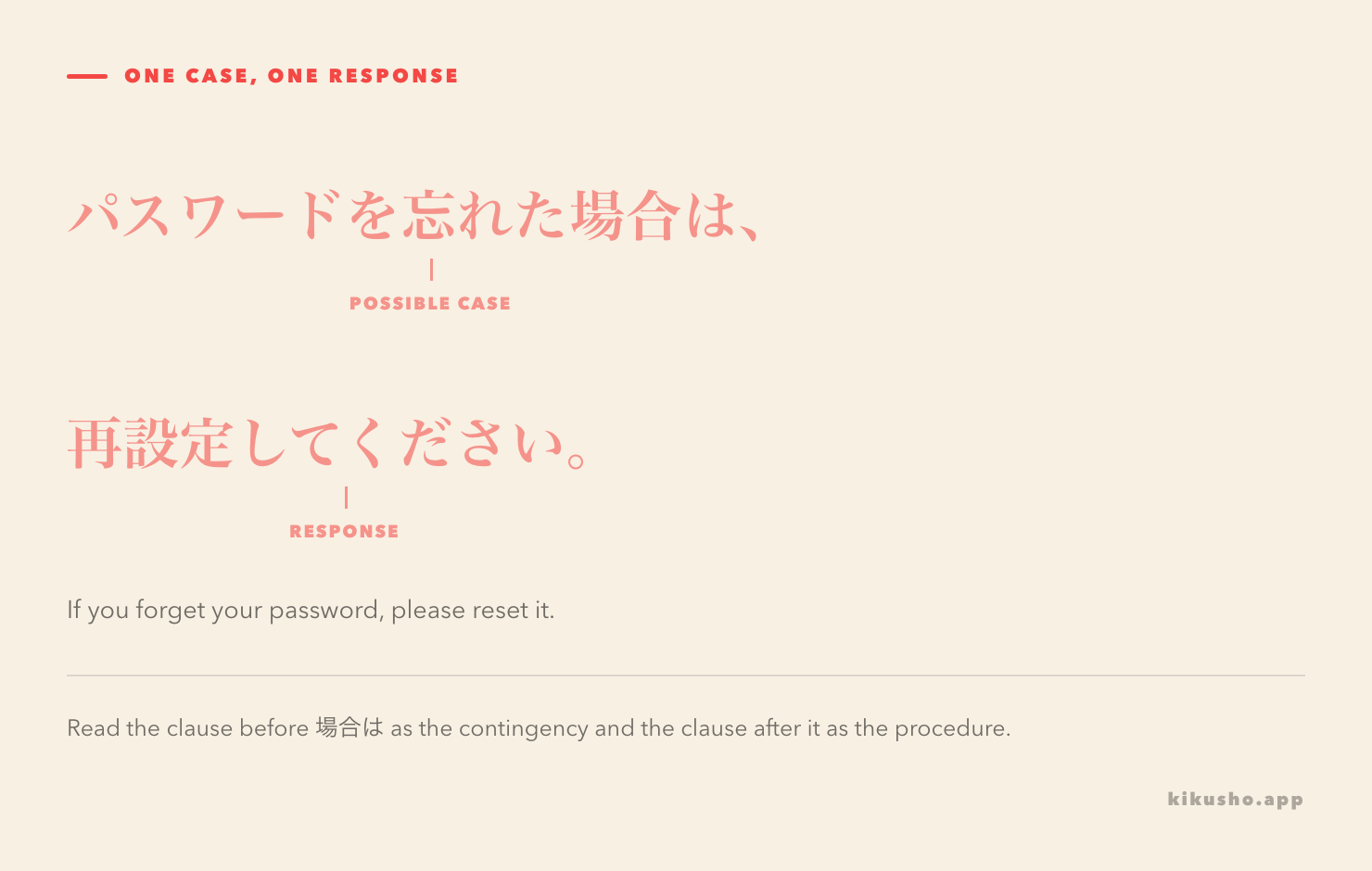
A notice uses 場合は, read ばあいは (baai wa), to turn a possible situation into a case and state the response for that case. パスワードを忘れた場合は、再設定してください means “If you forget your password, please reset it,” with the first clause naming the contingency and the second giving the procedure.
This shape makes 場合は common in rules, instructions, notices and careful explanations. It is less at home in a spontaneous personal “if,” where a conversational conditional such as たら often sounds lighter.
場合は names a case and assigns its response
The core pattern has two parts:
| Case | Response |
|---|---|
| パスワードを忘れた場合は | 再設定してください |
| if the password has been forgotten | please reset it |
The response may be an instruction, a rule, a result or a question about what to do:
- 欠席する場合は、前日までに連絡してください。 If you will be absent, please contact us by the previous day.
- 雨の場合は、試合を中止します。 In the event of rain, the match will be cancelled.
- 商品が届かなかった場合は、どうすればいいですか。 What should I do if the product did not arrive?
The speaker is not simply locating an event in time. Each first clause opens one branch of a plan, and the second clause tells you what applies inside that branch.
JLPT Sensei's 場合は lesson places the pattern at N4 and illustrates instructions after accidents, missed deadlines and other possible situations. Bunpro also labels it N4 and describes 場合 as the noun “case” or “situation.” Both placements come from teaching references. The JLPT itself does not publish a complete grammar syllabus.
Because 場合 is a noun, the modifier controls attachment
Treat 場合 as a noun being described. The word before it connects exactly as it would before another noun.
| Input | Before 場合は | Reading | Meaning |
|---|---|---|---|
| verb 遅れる | 遅れる場合は | おくれるばあいは | if you will be late |
| negative verb 参加しない | 参加しない場合は | さんかしないばあいは | if you will not participate |
| past verb 忘れた | 忘れた場合は | わすれたばあいは | if you forgot / have forgotten |
| い-adjective 高い | 高い場合は | たかいばあいは | if it is expensive |
| な-adjective 必要 | 必要な場合は | ひつようなばあいは | if it is necessary |
| noun 雨 | 雨の場合は | あめのばあいは | in the event of rain |
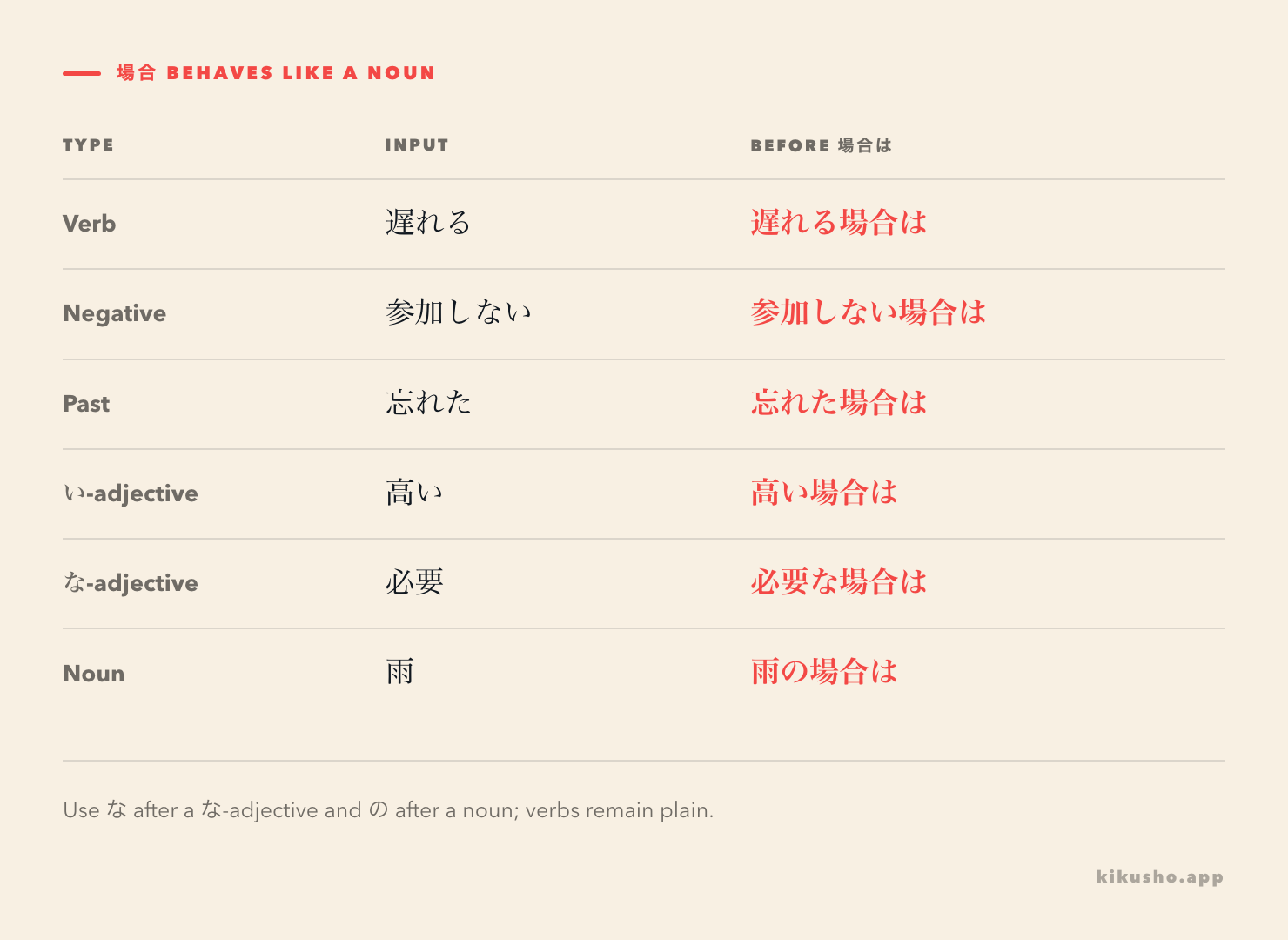
The two connectors learners most often lose are な and の. Use 危険な場合は, not 危険だ場合は. Use 火事の場合は, not 火事だ場合は. An い-adjective needs neither: 値段が高い場合は.
Verbs remain plain even when the response is polite. Say 参加する場合は、登録してください, not 参加します場合は. Politeness belongs in the main clause; it does not turn the modifier before a noun into a ます-form. Maggie Sensei's detailed 場合 guide independently documents this restriction and the noun, adjective, negative and past patterns.
Past noun and な-adjective forms keep だった: 休みだった場合は and 必要だった場合は. Negative descriptions can use a plain negative form, as in 必要ではない場合は. These forms classify a different case; the final response still chooses its own tense and politeness.
The verb form shows the stage inside the scenario
The form before 場合 does not simply copy the tense of the final clause. It describes how the event stands relative to the response.
Use a nonpast plain form when the case concerns a choice, plan or event that has not been completed:
オンラインで参加する場合は、前日までに登録してください。
オンラインでさんかするばあいは、ぜんじつまでにとうろくしてください。
If you will participate online, please register by the previous day.
Registration comes before participation, so 参加する presents the route the person plans to take.
Use a past form when the response applies after the triggering event or result is complete:
メールが届かなかった場合は、迷惑メールのフォルダを確認してください。
メールがとどかなかったばあいは、めいわくメールのフォルダをかくにんしてください。
If the email did not arrive, please check the spam folder.
The missing arrival must already be established before checking the other folder. The main instruction is still present or future; 届かなかった describes the earlier state inside the condition.
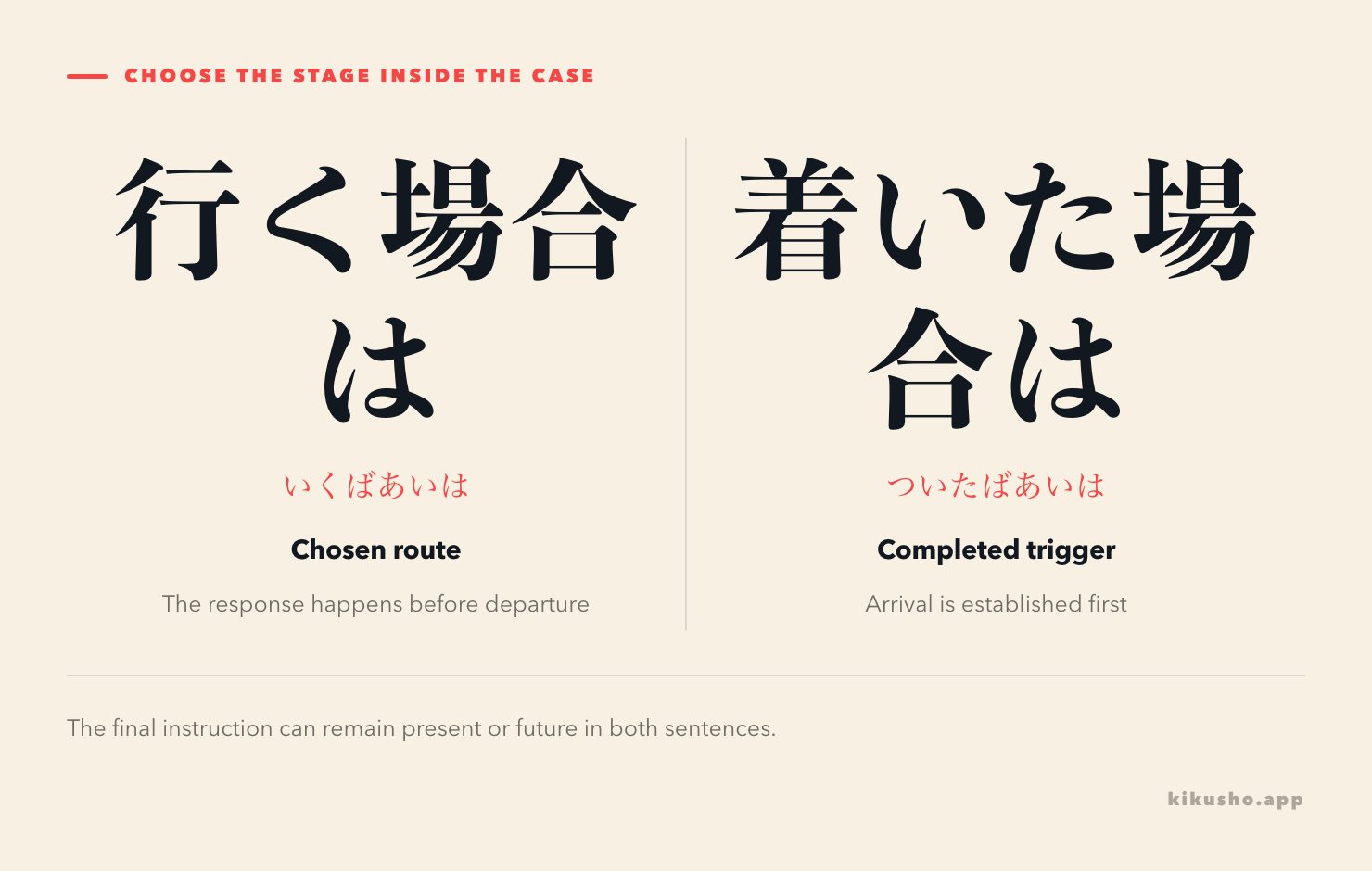
This distinction is about how the scenario is framed, so several forms may be grammatically possible while shifting the viewpoint. 車で行く場合は classifies choosing to go by car; 車で行った場合は starts from having gone by car. Maggie Sensei makes this before-versus-after relationship explicit rather than treating た as a marker that sends the entire sentence into the past.
Rules, notices and contingency plans are its natural home
場合は suits a speaker who is sorting possible cases and assigning an action to each one. You will see it in account help, school rules, event information, workplace procedures and safety notices:
避難する場合は、エレベーターを使わないでください。
ひなんするばあいは、エレベーターをつかわないでください。
If evacuating, do not use the elevator.
This wording sounds procedural. It does not imply that evacuation is expected right now. It gives the rule that applies if that branch becomes relevant.
The pattern can also compare an individual case rather than announce a contingency: 私の場合は、電車のほうが便利です, “In my case, the train is more convenient.” The same noun 場合 classifies one person or example against others. The lesson's main pattern remains the one that pairs a possible situation with its response.
A real moment still needs とき, and conversation often chooses たら
場合 and とき can overlap when a “time” is also a recurring kind of situation. 分からない場合は、質問してください and 分からないときは、質問してください can both tell someone to ask when they do not understand. The first sounds like a stated procedure; the second points more directly to the time of difficulty.
They are not interchangeable when とき names one actual moment:
昨日起きたとき、雨が降っていました。
きのうおきたとき、あめがふっていました。
When I woke up yesterday, it was raining.
This reports what was happening at a real time. It does not classify waking up as a possible case. MIT's Japanese grammar notes state this boundary directly: 場合 cannot replace 時 when 時 refers to a specific time rather than a case, occasion or situation. The とき and 間 lesson develops that time-locating role.
In an everyday conversation, たら often carries the same practical condition with less procedural weight:
- 遅れる場合は、事前に連絡してください。 If you expect to be late, please contact us in advance. A written rule.
- 遅れたら、電話して。 If you're late, call me. A familiar personal request.
Both are grammatical conditional instructions. The difference is the scene they build. 場合は sorts a case inside a plan; たら readily handles an event in ordinary conversation. The と and たら comparison explains why たら can introduce a request and how it differs from an automatic result in と.
は highlights the case but may be omitted
The noun 場合 can appear without は: 問題がある場合、連絡してください. Adding は presents that case as the topic or contrasts it with other cases: “As for the case where there is a problem…” Both versions appear in instructions.
At N4, keep 場合は as the dependable complete frame. It makes the two-part structure visible and gives you a clear place to pause before the response. A later 場合には can place additional focus on the situation where something applies; it is not needed to form the basic rule taught here.
The mistake that exposes a shaky model is usually before 場合: a noun followed by だ, a な-adjective missing な, or a polite verb inserted inside the modifier. Remembering that 場合 is a noun solves all three.
Practice
Complete the full set before checking the explanations below.
Question 1
Choose the standard sentence for a safety notice meaning “In the event of an earthquake, do not use the elevator.”
A. 地震だ場合は、エレベーターを使わないでください。
B. 地震の場合は、エレベーターを使わないでください。
C. 地震な場合は、エレベーターを使わないでください。
D. 地震です場合は、エレベーターを使わないでください。
Question 2
Choose the correct attachment for “If the room is quiet, please study here.”
A. 部屋が静かだ場合は、ここで勉強してください。
B. 部屋が静か場合は、ここで勉強してください。
C. 部屋が静かな場合は、ここで勉強してください。
D. 部屋が静かの場合は、ここで勉強してください。
Question 3
Use each piece once to build the Friday non-participation instruction. The sentence begins with 参加しない.
参加しない / 金曜日までに / 場合は / 連絡してください
Question 4
Read the event instructions and select the form that classifies online participation as the chosen route before it happens.
オンラインで( )、前日までに登録してください。
A. 参加します場合は
B. 参加したとき
C. 参加する場合は
D. 参加だ場合は
Question 5
The speaker is describing one actual moment yesterday, rather than a possible case. Choose the fitting word.
昨日、家に帰った( )、猫は寝ていました。
A. 場合は
B. とき
C. 場合の
D. 必要な場合は
Question 6
Read the support procedure. The customer should check another folder only after non-arrival has been established.
メールが( )、迷惑メールのフォルダを確認してください。
A. 届きません場合は
B. 届かなかった場合は
C. 届かないの場合は
D. 届くだった場合は
Question 7
The guidance below places a polite verb inside a noun modifier. Rewrite the entire sentence so it means “If you plan to consult the teacher, please make a reservation.”
先生に相談します場合は、予約してください。
Answers and explanations
Answer 1
B: 地震の場合は、エレベーターを使わないでください。 Read じしんのばあいは、エレベーターをつかわないでください. 地震 is a noun, so it takes の before the noun 場合. A and D put a sentence-ending copula inside the modifier, while C uses the な-adjective connector with a noun.
Answer 2
C: 部屋が静かな場合は、ここで勉強してください。 Read へやがしずかなばあいは、ここでべんきょうしてください. 静か is a な-adjective, so the affirmative nonpast modifier is 静かな. A keeps だ, B drops the needed connector and D uses noun-linking の.
Answer 3
参加しない場合は、金曜日までに連絡してください。 Read さんかしないばあいは、きんようびまでにれんらくしてください. The order is 参加しない / 場合は / 金曜日までに / 連絡してください. Plain negative 参加しない defines the case; the following clause supplies its deadline and response.
Answer 4
C: 参加する場合は. The complete sentence is オンラインで参加する場合は、前日までに登録してください, read オンラインでさんかするばあいは、ぜんじつまでにとうろくしてください. Participation is the planned route, and registration occurs beforehand. A incorrectly uses ます before a noun, B locates a time and changes the framing, and D inserts だ after a verb.
Answer 5
B: とき. 昨日、家に帰ったとき、猫は寝ていました reports what was true when the speaker returned home yesterday. 場合は would classify a possible or compared case instead of locating this actual event. C cannot connect the clause to the following statement, and D changes the content entirely.
Answer 6
B: 届かなかった場合は. Read とどかなかったばあいは. The negative past form presents failed arrival as established before the customer checks the spam folder. A embeds polite ません before 場合, C adds unnecessary の after a verb and D does not form a Japanese verb phrase.
Answer 7
先生に相談する場合は、予約してください。 Read せんせいにそうだんするばあいは、よやくしてください. The dictionary form 相談する modifies the noun 場合. Politeness remains in the response 予約してください; 相談します cannot be placed directly before 場合.
Keep the response attached to the case
A saved fragment such as 忘れた場合は tells you that something was forgotten but loses the rule that made the phrase useful. Keep 再設定してください beside it. The response reveals whether the source was account help, a warning, a workplace procedure or an ordinary conversation.
When you capture a notice in Kikusho, select the case clause and its instruction together, then check the editable example before saving. A review card with both halves lets you reconstruct the decision: identify what is being classified, choose the noun-like attachment, and recover the action assigned to that situation.
Common questions
What does 場合は mean in Japanese?
場合は, read ばあいは, means “in the case that” or “in the event of.” It frames a possible situation as a case, then the main clause gives the result, rule or action for that case. It is common in notices, instructions, procedures and careful explanations.
What form comes before 場合は?
A verb uses a plain form, an い-adjective attaches directly, a な-adjective takes な and a noun takes の: 遅れる場合は, 高い場合は, 必要な場合は and 雨の場合は. Past and negative forms can also modify 場合.
What is the difference between 場合は and たら?
Both can introduce a condition. 場合は explicitly classifies a situation and suits rules, contingency plans and written instructions. たら is a broader everyday conditional and often sounds more natural for a personal, conversational “if” or “when.”
Can 場合 replace とき?
Only when “time” also means a case or situation. 場合 cannot replace とき when you are locating an event at one actual moment, as in 昨日起きたとき、 雨が降っていました, “When I woke up yesterday, it was raining.”