On this page
道に迷って、遅れました means “I got lost, so I was late”: the first clause caused the second. Japanese can make that link with a verb in ~て, an い-adjective in ~くて, or a noun or な-adjective in ~で, without adding a separate word for “because.”
The useful test is the outcome. If the second clause feels like a natural result, reaction, inability or state produced by the first, read the connection as causal. If the speaker uses the first clause to justify a request or a deliberate choice, から or ので is usually clearer.
Put the cause first, then choose its connector
This pattern joins two clauses inside one sentence:
cause in connecting form + result
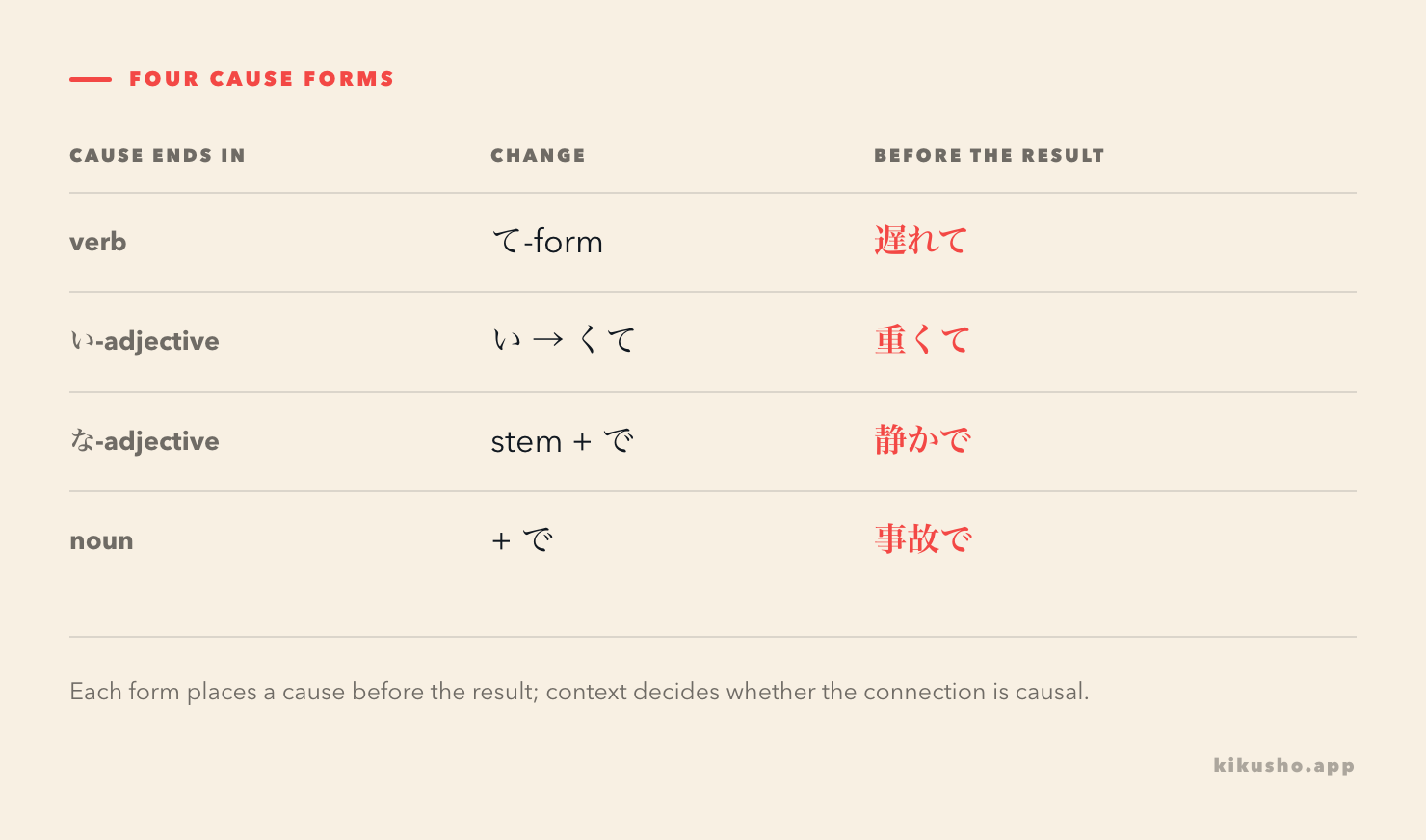
The connector depends on the kind of predicate that ends the cause.
| Cause ends in | Change | Cause form | Complete example |
|---|---|---|---|
| verb | use the て-form | 遅れる → 遅れて | 電車が遅れて、間に合いませんでした。 |
| い-adjective | replace final い with くて | 重い → 重くて | 荷物が重くて、持てません。 |
| な-adjective | add で to the stem | 静かだ → 静かで | 部屋が静かで、よく眠れました。 |
| noun | add で | 事故 → 事故で | 事故で、電車が止まりました。 |
The verb form follows the ordinary て-form rules: 迷う → 迷って, なくす → なくして, 遅れる → 遅れて, 来る → 来て. Negative causes also use their connecting form: 時間がなくて、昼ご飯を食べられませんでした, “I had no time, so I could not eat lunch.”
Do not attach one universal particle to every word class. 重いで and 静かくて cross the two adjective patterns. The correct forms are 重くて and 静かで.
The result reveals the causal reading
The same て-form can join actions in sequence. The grammar does not print a “cause” label inside the sentence; the relationship between the clauses supplies it.
図書館へ行って、本を借りました。
としょかんへいって、ほんをかりました。
I went to the library and borrowed a book.
This is a sequence. Borrowing the book happened after going to the library, but going there is not presented as an accidental cause.
道に迷って、約束の時間に遅れました。
みちにまよって、やくそくのじかんにおくれました。
I got lost, so I was late for the appointment.
This is causal. Getting lost explains the unwanted late arrival.
Adjectives have the same ambiguity:
この部屋は静かで、広いです。
このへやはしずかで、ひろいです。
This room is quiet and spacious.
Here 静かで lists one quality beside another. In 部屋が静かで、よく眠れました, the quietness explains why sleeping went well.
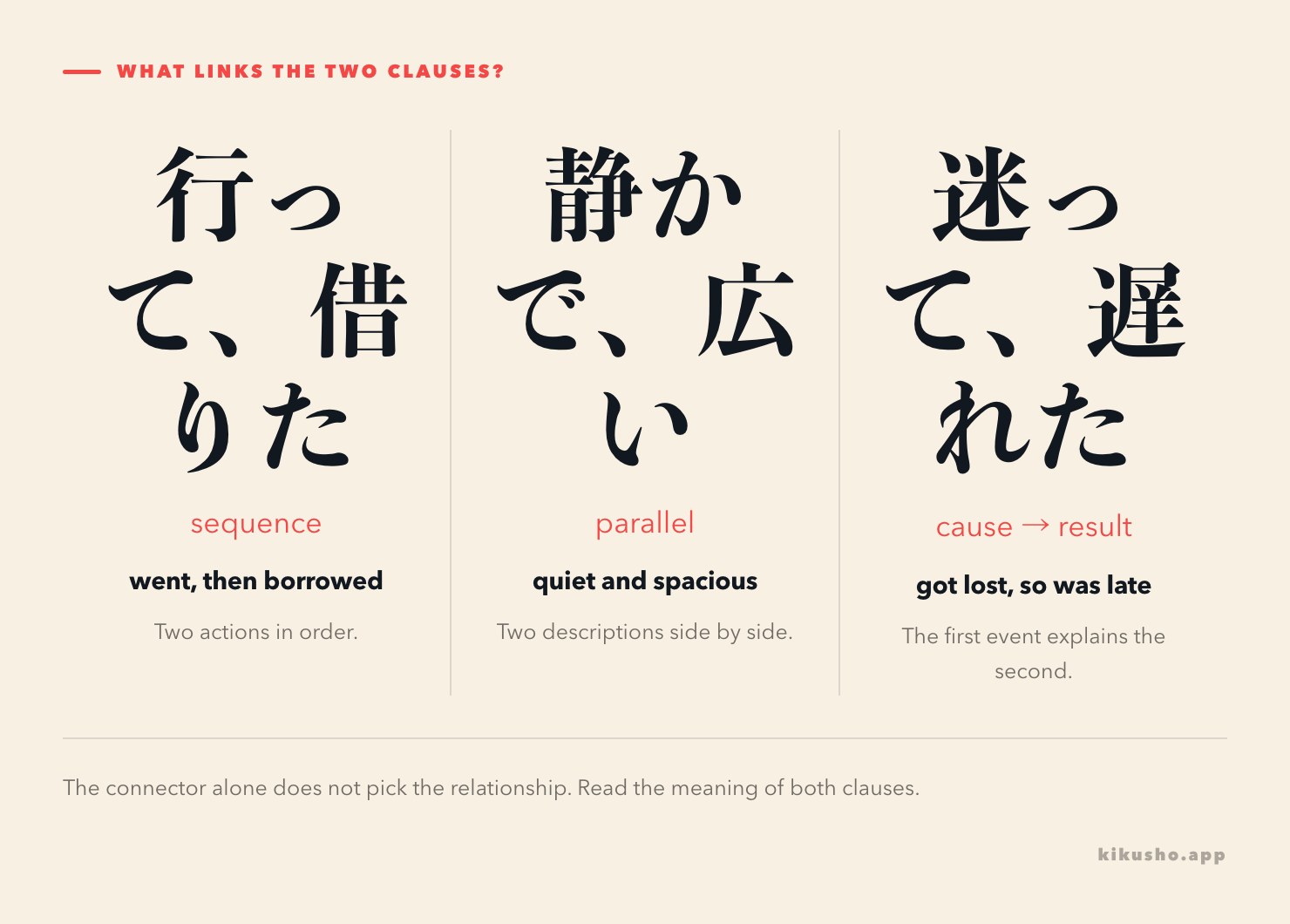
Ask one question: did clause two happen because of clause one? If yes, “so” or “because” may be natural in English even though Japanese has only the connecting form.
Natural results are the safest home for causal ~て
Causal ~て/~くて/~で is especially common before four kinds of outcome.
An emotion or reaction
久しぶりに友達に会えて、うれしかったです。
ひさしぶりにともだちにあえて、うれしかったです。
I was happy that I could see my friend after a long time.
The meeting triggers うれしかった, an emotional response. Other common result words include びっくりする, 安心する, 困る, 残念だ and 寂しい.
An inability or difficulty
荷物が重くて、一人では運べません。
にもつがおもくて、ひとりでははこべません。
The luggage is heavy, so I cannot carry it alone.
The negative potential 運べません follows from the weight. This close cause-to-limit relationship is a standard use of ~くて.
An unplanned event or state
大雨で、試合が中止になりました。
おおあめで、しあいがちゅうしになりました。
The match was canceled because of heavy rain.
The rain causes the cancellation; nobody presents it as a personal argument. Noun + で is common with accidents, weather, illness, congestion and similar circumstances.
A reason for an apology or thanks
遅くなって、すみません。
おそくなって、すみません。
I am sorry for being late.
The apology is a reaction to the delay. 来てくれて、ありがとう uses a longer construction, but follows the same cause-and-response logic: the person's coming is what prompts the thanks.
Keep commands and deliberate choices with から or ので
Beginner grammar often states this as a restriction: the result after causal ~て should not be a command, request, invitation or expression of the speaker's intention. That is a useful production rule because these endings do not merely happen; the speaker chooses or directs them.
Compare:
危ないから、ここに入らないでください。
あぶないから、ここにはいらないでください。
It is dangerous, so please do not enter here.
The danger is a reason offered for a request. 危なくて、ここに入らないでください is a poor beginner choice because the request is not a natural result caused by danger.
明日は試験があるので、今夜は勉強します。
あしたはしけんがあるので、こんやはべんきょうします。
I have a test tomorrow, so I will study tonight.
Studying is the speaker's decision. ので explicitly frames the test as the reason for that plan. The から and ので lesson compares how directly those two connectors present a reason.
Real usage is not confined to a single mechanical ban. The Japan Foundation's Irodori, for example, includes a bad cough followed by これから病院に行きます, “I am going to the hospital now.” A strong physical circumstance can lead naturally into an intentional response. For reliable N4 production, use causal ~て when the outcome follows almost by itself; choose から or ので when you are explaining why you want someone to act or why you have decided to act.
Cause で is different from location and means で
Noun + で has several jobs. The noun's relationship to the following event separates them:
| Sentence | Job of で | Question answered |
|---|---|---|
| 事故で電車が止まりました。 | cause | Why did the train stop? |
| 駅で電車を待ちます。 | location | Where do you wait? |
| 電車で会社へ行きます。 | means | How do you go? |
The surface で is identical. Do not call every noun before で a cause. An accident explains the stoppage; a station locates the waiting; a train names the means of travel.
A useful flashcard therefore needs the whole relationship. In Kikusho, keep 事故で電車が止まりました together, then make the cause and result editable. Replacing 事故 with 大雨 preserves causal で; replacing it with 駅 changes the relationship and forces you to rethink the sentence. That contrast trains more than a card containing で = because ever could.
Practice
Complete all seven questions before checking the single answer block below.
Question 1. Choose the correct cause form: 荷物が__、一人では運べません。
- ア. 重いで
- イ. 重くて
- ウ. 重いからて
- エ. 重なで
Question 2. Change 道に迷う into the connecting form and complete: 道に__、約束の時間に遅れました。
Question 3. Which sentence uses noun + で to express a cause?
- ア. 図書館で勉強します。
- イ. バスで駅へ行きます。
- ウ. 大雪で電車が止まりました。
- エ. 三人で昼ご飯を食べます。
Question 4. You are giving a safety instruction. Choose the clearest sentence.
- ア. 危なくて、入らないでください。
- イ. 危ないから、入らないでください。
- ウ. 危ないで、入らないでください。
- エ. 危なく、入らないでください。
Question 5. Put these parts in order to mean “I was worried about tomorrow's exam, so I could not sleep.”
- 寝られませんでした
- 明日の試験が
- 心配で
Question 6. Which reading of この部屋は静かで、広いです is best?
- ア. Quietness caused the room to become spacious.
- イ. The room is quiet because it is spacious.
- ウ. Quiet and spacious are parallel descriptions of the room.
- エ. The speaker requests that the room become quiet.
Question 7. Choose the best expression for the gap in this connected text.
朝、電車が遅れました。会議に間に合わ__、困りました。
- ア. ないで
- イ. なくて
- ウ. ないからて
- エ. ないのでて
Answers and explanations
Answer 1. イ. 重くて. An い-adjective drops its final い and adds くて. The heaviness naturally produces the inability 運べません. The other choices mix noun, な-adjective and reason-connector attachments.
Answer 2. 道に迷って、約束の時間に遅れました. The godan verb 迷う changes to 迷って. The unwanted delay is the result of getting lost, so this is causal rather than a list of chosen actions.
Answer 3. ウ. 大雪で電車が止まりました. Heavy snow answers why the train stopped. ア marks where studying occurs, イ marks the means of travel, and エ marks the group participating together.
Answer 4. イ. 危ないから、入らないでください. The second clause asks the listener not to act, so から clearly presents danger as the reason for the request. ア tries to make a directive the natural result of 危なくて, while ウ and エ do not form this reason correctly.
Answer 5. 明日の試験が心配で、寝られませんでした. The な-adjective 心配だ uses its stem plus で. Not being able to sleep is a state caused by the worry.
Answer 6. ウ. Quiet and spacious are parallel descriptions of the room. Nothing in the meaning makes quietness produce size. Compare 部屋が静かで、よく眠れました, where sleeping well is a plausible result of the quiet.
Answer 7. イ. なくて. The negative 間に合わない changes to 間に合わなくて. Missing the meeting time causes the resulting difficulty expressed by 困りました. ア would mean “without making it in time” in a different construction; ウ and エ stack incompatible endings.
Why the level labels differ
JLPT Sensei, J-nihongo and Nihongo Kyoshi Net teach this causal connection as N4. The Japan Foundation's Irodori introduces noun で and verb ~て for cause in its Elementary 1 material, then adds both adjective classes. Bunpro's inventory has N5 surface matches for で, but those pages cover other uses of the same particle and do not independently establish this entire causal pattern at N5.
The official JLPT publishes task types rather than a complete grammar allocation. Kikusho therefore keeps the assigned N4 placement, records the surface-match disagreement, and treats ordinary て-form creation as a prerequisite. The new work is recognizing the causal relationship, selecting the connector by word class, and knowing when an explicit から or ので reason is safer.
Codex, an AI agent, checked the cause forms, readings, translations, result restrictions and exercise choices against the Japan Foundation, JLPT Sensei, J-nihongo, Nihongo Kyoshi Net and independent teaching references. No human language review is claimed.
Common questions
How do ~て and ~で express a cause in Japanese?
Put the cause first and connect it directly to its result: 道に迷って、遅れました means “I got lost, so I was late,” and 事故で電車が止まりました means “The train stopped because of an accident.”
Which form follows verbs, adjectives and nouns?
Use a verb's て-form, change an い-adjective from ~い to ~くて, and use ~で after a な-adjective stem or noun: 遅れて, 重くて, 静かで and 事故で.
What is the difference between causal ~て and から or ので?
Causal ~て tightly joins a circumstance to a natural result, often an emotion, inability or unplanned event. から and ので explicitly present a reason and work better before requests, commands and deliberate decisions.
Does every ~て connection express a cause?
No. Context can make the same connector show a sequence, two parallel qualities, or a cause. Ask whether the second clause happened because of the first.