
On this page
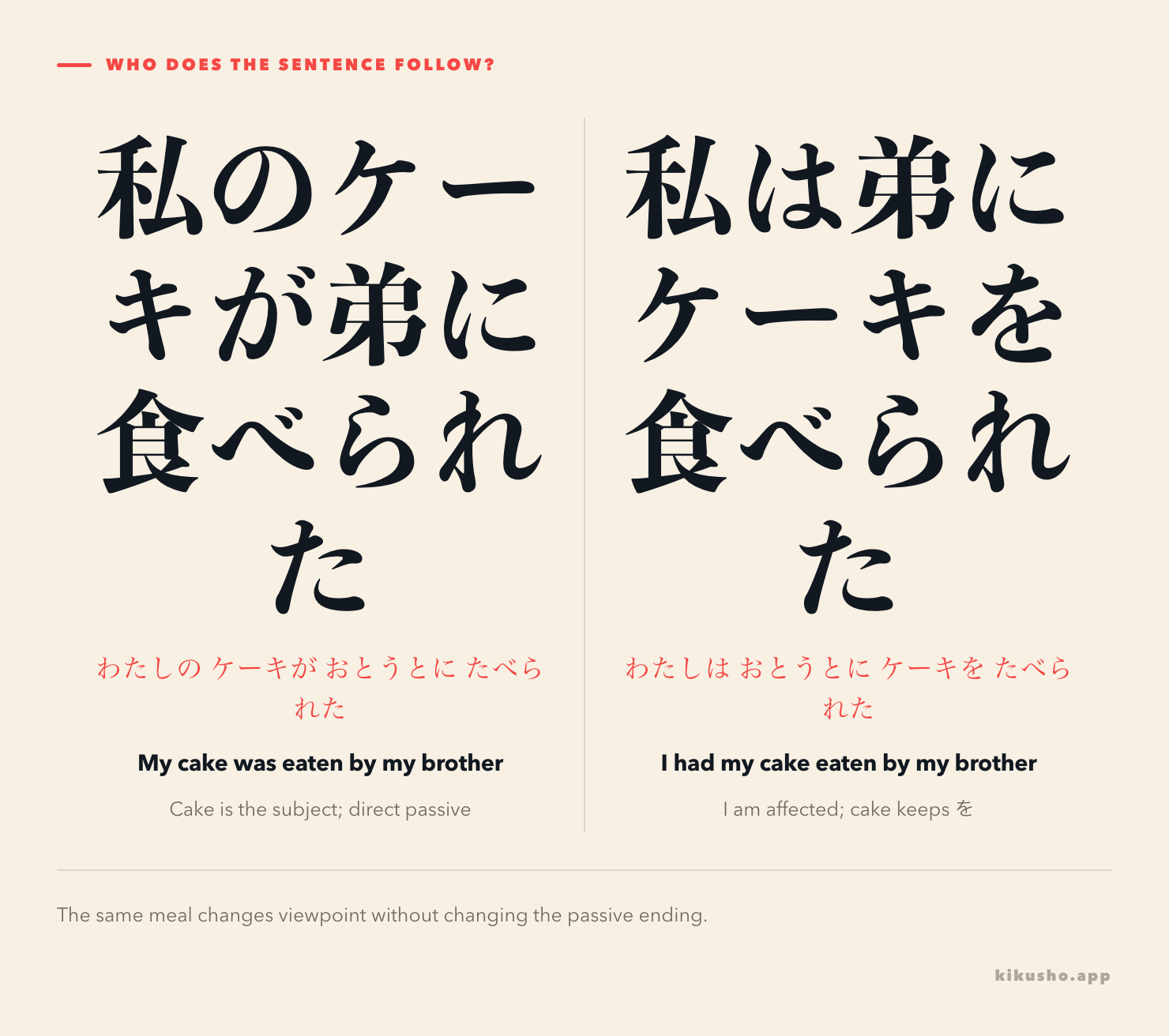
The Japanese passive can center either what receives an action or a person affected by that action. If your brother eats your cake, 私のケーキが弟に食べられた puts the cake in focus; 私は弟にケーキを食べられた says I was affected by what he did. Both use 受身形(うけみけい), but only the second has your loss built into the sentence's viewpoint. The same affected-person pattern can even follow an intransitive action, such as a neighbor making noise.
This N4 lesson teaches the passive ending and three ways a sentence can use it: direct passive, a possessor affected through something they own, and an indirect passive where nobody acts directly on the person. “Suffering passive” is a useful learner label for many unwanted outcomes, not a separate verb ending. The verb-group lesson is the prerequisite for forming each ending.
The passive ending follows the verb group
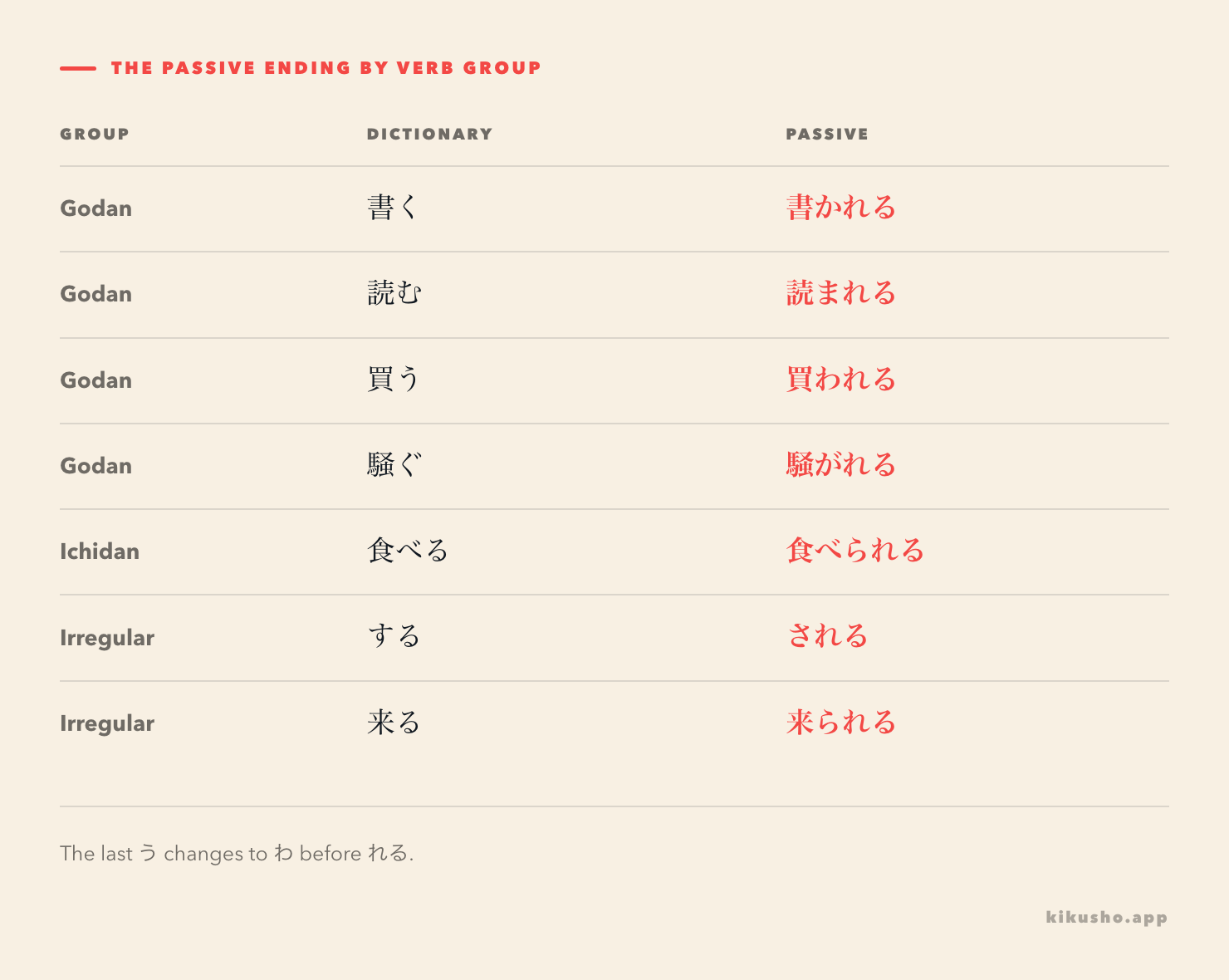
For a godan verb, move the last kana from the う row to the あ row, then add れる. 書く becomes 書かれる(かかれる); 読む becomes 読まれる(よまれる). A verb ending in う uses わ rather than あ: 買う → 買われる(かわれる), never 買あれる. The Japan Foundation's Irodori chart and Tofugu's passive reference independently give these rules.
| Verb group | Dictionary form | Passive | Reading | Change |
|---|---|---|---|---|
| Godan | 書く | 書かれる | かかれる | く → かれる |
| Godan | 読む | 読まれる | よまれる | む → まれる |
| Godan | 買う | 買われる | かわれる | う → われる |
| Godan | 騒ぐ | 騒がれる | さわがれる | ぐ → がれる |
| Ichidan | 食べる | 食べられる | たべられる | remove る, add られる |
| Irregular | する | される | される | learn separately |
| Irregular | 来る | 来られる | こられる | reading changes too |
An ichidan verb drops る and takes られる, so 見る also becomes 見られる(みられる). The irregular forms are する → される and 来る(くる)→ 来られる(こられる). Once formed, a passive verb conjugates like an ichidan verb: 読まれる → 読まれました, “was read”; 読まれない, “is not read.” Do not attach ます to the original dictionary form. Tofugu verifies the forms and their later conjugation.
A direct passive puts the receiver in the subject position
In a direct passive, the action lands on the person or thing the sentence is about. The doer, if named, usually takes に:
| Active event | Direct passive | English |
|---|---|---|
| 店長が私を呼びました。 | 私は店長に呼ばれました。 | The manager called me; I was called by the manager. |
| 弟が私のケーキを食べました。 | 私のケーキが弟に食べられました。 | My cake was eaten by my younger brother. |
Read 店長 as てんちょう (manager), 弟 as おとうと (younger brother), and 呼ばれました as よばれました. The first row keeps the same person at the center when it turns passive. The second makes the cake the subject. Neither passive ending, by itself, says the event was bad: 私は先生に褒められました, “I was praised by the teacher,” is welcome in an ordinary context. The Japan Foundation's teaching notes distinguish direct action from affected ownership and say direct passives need not imply nuisance.
A possessor can be affected while the object keeps を
Now keep the cake as the object ケーキを, but make 私 the sentence's subject:
私は弟にケーキを食べられました。
わたしは おとうとに ケーキを たべられました。
My younger brother ate my cake, and I was affected by it.
The brother still does the eating. The cake is still what he eats, so を remains. What changes is that the speaker, not the cake, becomes the affected person. English may say “I had my cake eaten”; the Japanese tells you more directly whose experience the sentence follows. Mango Languages' possessive-passive explanation and the Japan Foundation notes both show the affected owner with an object that keeps を.
| What is affected | Sentence viewpoint | Object marker |
|---|---|---|
| The cake is eaten | 私のケーキが弟に食べられました。 | No を: the cake is subject |
| I lose my cake | 私は弟にケーキを食べられました。 | ケーキを remains object |
The owner pattern also works with body parts and belongings. 知らない人にかばんを取られました means “someone I did not know took my bag”; the affected speaker can be left unspoken if context makes them obvious. An affected owner may also feel pleased in a different situation. The form presents an experience; it does not mechanically insert “unhappy” into every translation. Mango Languages gives both adverse and beneficial owner readings.
An indirect passive adds a person the active event never mentioned
An intransitive verb has no direct object. 隣の人が騒ぎました, “the person next door made noise,” names an event; it does not mention me. The indirect passive can bring me into the sentence as someone that event affected:
夜、隣の人に騒がれて、眠れませんでした。
よる、となりの ひとに さわがれて、ねむれませんでした。
I could not sleep because the person next door made noise.
Here 隣の人に names who made the noise, 騒がれて is the passive て-form of 騒ぐ, and 眠れませんでした states the consequence. There is no object marked を because 騒ぐ in this use is intransitive. Compare the active 隣の人が騒いだ with the passive 私は隣の人に騒がれた: the latter adds an affected person who was absent from the active event. The Japan Foundation's Marugoto explanation teaches exactly that contrast with 騒ぐ; Tofugu explains the indirect perspective.
Rain supplies a familiar exception to the usual human agent: 帰り道で雨に降られました (かえりみちで あめに ふられました) means “I got caught in the rain on the way home.” It does not make the rain a person who chose to act. It presents the weather as something that happened to me. Tofugu and IMABI independently document 雨に降られる.
The affected reading needs context, and られる has neighbours
An indirect passive often suggests inconvenience, but 受身形 is not a negative mood marker. Positive direct passives remain possible, and an owner can benefit from an action. Nor can you turn any intransitive verb into a natural complaint just by adding れる: the speaker's connection to the event and the verb's ordinary use matter. Weather examples such as 雨に降られる are established expressions, not a license to personify every accident. IMABI cautions that “suffering” is too narrow a name for all of these cases.
食べられる can also mean “can eat,” because the full ichidan potential and passive have the same surface form. The agent 弟に, the object ケーキを, and the surrounding event make the passive reading clear in 私は弟にケーキを食べられた. The potential-form lesson gives the ability reading. A matching ~(ら)れる can also mark light respect, as in 先生はもう帰られました; the politeness guide gives that use. Do not treat either reading as the affected passive merely because the suffix looks familiar. Irodori's form comparison places passive and potential forms side by side.
JLPT Sensei places 受身形 at N4, while the Japan Foundation teaches the basic passive in Irodori Elementary 2 and revisits harder indirect examples in Marugoto Intermediate 2. Those are teaching sequences, not an official JLPT item list. Learn the ending and direct perspective here, then use the owner and noise examples to recognize the broader pattern without claiming that all its subtleties fit one exam label.
If a friend complains 雨に降られた, the useful card is the whole complaint, not a bare 降る. Kikusho can preserve the line you heard, its reading and the context you want to recall. That context is what tells you why this particular passive is about a person affected by the weather.
Practice: keep the receiver and experiencer apart
Work through all six questions before the shared answer block below. No solution appears between questions.
Question 1 — grammar choice. Which is the passive form of 買う?
- A. 買あれる
- B. 買える
- C. 買われる
Question 2 — grammar choice. A manager called you. Which sentence is a direct passive with 私 as the receiver?
- A. 私は店長に呼ばれました。
- B. 私は店長を呼びました。
- C. 店長は私に呼ばれました。
Question 3 — sentence composition. A stranger took your bag. Start with 私は and use 知らない人, かばん, and the passive of 取る to describe your experience.
Question 4 — text grammar. The neighbor made noise all night, and you could not sleep. Complete the sentence with the passive て-form of 騒ぐ: 夜、隣の人に__、眠れませんでした。
Question 5 — sentence composition. Your younger brother ate your cake. Use 弟, ケーキ, and the passive of 食べる to put you, rather than the cake, at the center. Start with 私は.
Question 6 — text grammar. Which sentence puts the affected owner in the subject position and keeps the cake as the object?
- A. 私のケーキが弟に食べられました。
- B. 私は弟にケーキを食べられました。
- C. 弟が私のケーキを食べました。
Answers and explanations
Answer 1. C, 買われる(かわれる). A godan verb ending in う changes that last kana to わ before れる. A invents 買あれる. B is 買える, the potential “can buy,” a different form and meaning.
Answer 2. A, 私は店長に呼ばれました。 私 receives the manager's call, 店長 takes に, and 呼ぶ becomes 呼ばれる. B is active: you call the manager. C reverses the roles: the manager is called by you.
Answer 3. 私は知らない人にかばんを取られました。 取る is godan and becomes 取られる, then 取られました in the polite past. The stranger takes に, while the bag remains the object marked by を. A sentence beginning かばんが取られました would focus on the bag instead of your experience.
Answer 4. 騒がれて: 夜、隣の人に騒がれて、眠れませんでした。 騒ぐ changes ぐ to がれる, then れる takes the て-form. The active 騒いで would need the noisy neighbor as its subject; it would not put the speaker in the affected position.
Answer 5. 私は弟にケーキを食べられました。 食べる is ichidan, so its passive is 食べられる. Keeping 私は and ケーキを tells the reader that your brother ate the cake and you were affected. 私のケーキが弟に食べられました is grammatical but answers the different cake-centered task.
Answer 6. B, 私は弟にケーキを食べられました。 私 is the affected owner and ケーキを stays the object of eating. A is a direct passive with the cake as subject. C is active and does not use the passive at all.
Common questions
How is the Japanese passive form built?
For godan verbs, change the final kana to the あ row and add れる; 買う is special in spelling and becomes 買われる. For ichidan verbs, replace る with られる, as in 食べられる. する becomes される and 来る becomes 来られる(こられる).
Does every Japanese passive sentence mean something bad happened?
No. 私は先生に褒められた is a direct passive with a welcome action. The indirect passive often presents an unwanted effect, but the situation and surrounding words determine how the person feels.
Why can an intransitive verb be passive in Japanese?
An indirect passive adds an affected person to an event that did not directly act on them. 隣の人が騒いだ has no object, but 私は隣の人に騒がれた says that the noise affected me.
Is 食べられる always passive?
No. The full ichidan ending also serves as the potential form, and a matching form can express light respect. A sentence about ability, an agent marked by に, or a superior's action helps select the reading.