On this page
ことにする (koto ni suru) presents a decision as your active choice; ことになる (koto ni naru) presents what has been arranged or what circumstances have led to. The second expression can leave the decision-maker in the background, even when you helped make the decision.
This N4 grammar lesson compares the basic decision and arrangement uses. JLPT Sensei's ことにする lesson and ことになる lesson visibly label them N4; Bunpro places both constructions at N3. The level labels differ across teaching lists. Here the scope stays practical: choosing an action, reporting an arrangement, and separating the time of the decision from the time of the action.
The useful test is how you present the decision
You have two invitations for Saturday. After weighing them, you choose to stay home and finish a book. 家で読むことにした, “I decided to read at home,” foregrounds that choice.
At work, a revised timetable assigns you to another office next month. 来月から別の支店で働くことになった, “It's been arranged that I'll work at another branch from next month,” reports the resulting arrangement. Read 別の支店 as べつのしてん.
The question is not simply “Does the sentence contain 私?” Both expressions can describe your own future action. Ask instead: Am I presenting a choice I made, or reporting the arrangement now in place?
| What your sentence foregrounds | Construction | Typical English rendering |
|---|---|---|
| Your decision to act | Verb + ことにする | Decide to do something |
| Your decision not to act | Plain negative verb + ことにする | Decide not to do something |
| An arrangement or resulting course of events | Verb + ことになる | It is decided / arranged that something will happen |
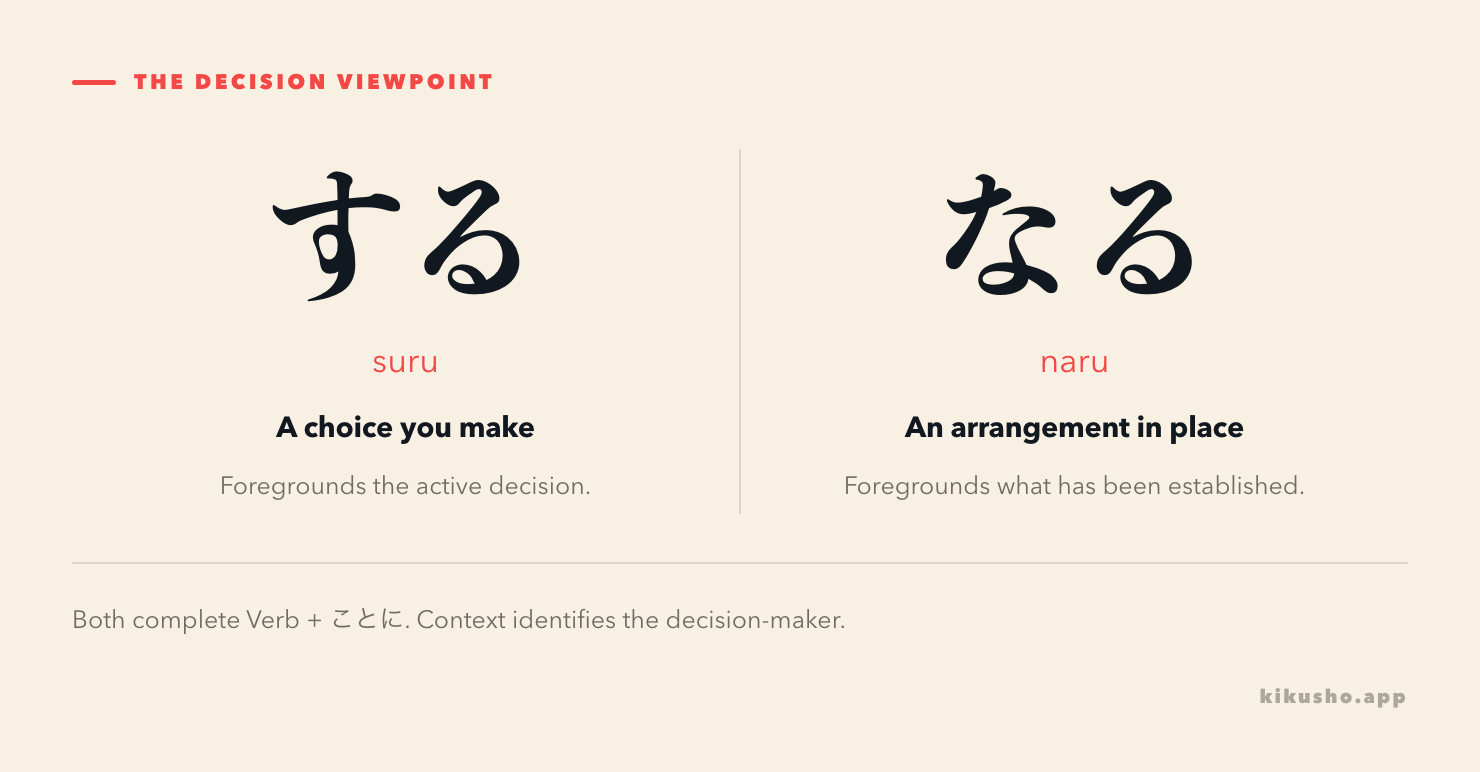
The distinction is a viewpoint, not a reliable detective tool for discovering who signed the paperwork. Context supplies the people involved.
ことにする attaches to the action you choose
Use the dictionary form or plain negative before ことにする. Change the final する for ordinary tense and politeness:
| Form | Example | Meaning |
|---|---|---|
| Plain decision | 行くことにする | Decide to go / I'll choose to go |
| Polite decision | 行くことにします | Decide to go, addressed politely |
| Completed decision, plain | 行くことにした | Decided to go |
| Completed decision, polite | 行くことにしました | Decided to go, addressed politely |
| Negative action, completed decision | 行かないことにしました | Decided not to go |
Read 行く as いく and 行かない as いかない. Bunpro's formation explanation covers affirmative and negative verb phrases and the choice being made. The polite model is 行くことにします, with the plain action before こと. Avoid 行きますことにする.
For a personal choice about tomorrow:
明日はバスで行くことにしました。
あしたはバスでいくことにしました。
I've decided to go by bus tomorrow.
The sentence explains how you will travel. ことにしました places the decision before this report; 明日 keeps the journey in the future. It does not say that you already took the bus.
An individual can make a decision, and a group can make one together. The construction is not reserved for the pronoun “I.” You can foreground a collective choice with 私たちは電車で行くことにしました, “We decided to go by train.” The ordinary distinction between plain verb forms and polite endings still applies.
ことになる reports an arrangement or outcome
In the arrangement use, the action also goes before こと in dictionary or plain negative form. The final なる changes to なった, なります, or なりました:
来週から受付で働くことになりました。
らいしゅうからうけつけではたらくことになりました。
It's been arranged that I'll work at reception from next week.
Perhaps your supervisor assigned you there. Perhaps the team agreed on a new rota. The sentence reports the arrangement without specifying the entire decision process. 受付(うけつけ)means reception; 働く(はたらく)means to work.
Masaru Mito's explanation for Mango Languages illustrates ことになる with a work arrangement made by someone else. JLPT Sensei also notes that the same expression can indirectly describe one's own resolve.
The past なりました says the arrangement has come about. It does not put next week's reception work into the past. Similarly, 行かないことになりました reports an arrangement not to go; the negative action belongs before こと.
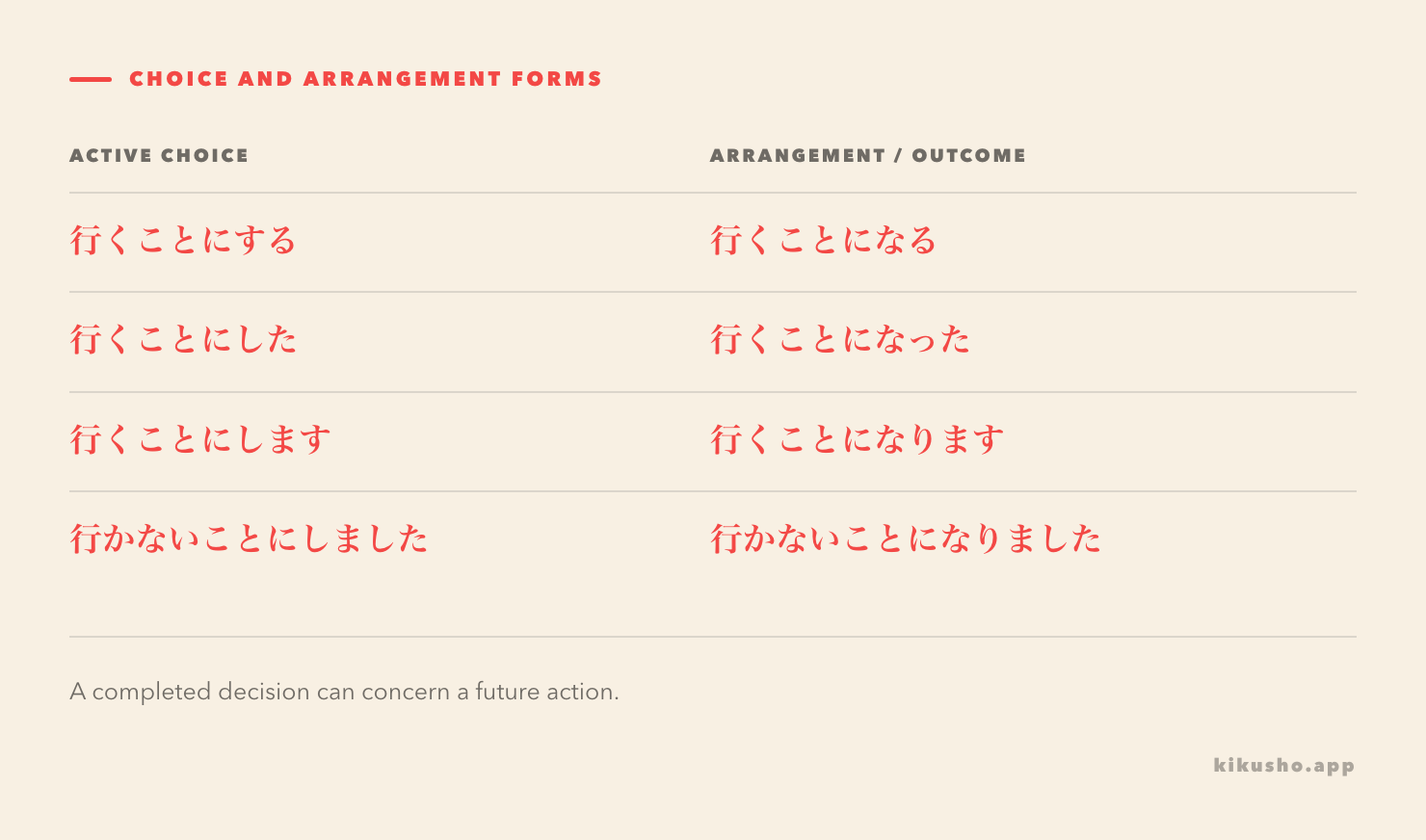
The selectable counterparts are:
| Active choice | Arrangement / outcome |
|---|---|
| 行くことにする | 行くことになる |
| 行くことにした | 行くことになった |
| 行くことにします | 行くことになります |
| 行かないことにしました | 行かないことになりました |
ことになる reports the arrangement without conjugating the action verb into a passive form. For the separate grammar of an affected participant, use the direct and indirect passive lesson.
Either can describe the same plan from a different angle
Suppose you and a friend have chosen where to meet. You can present your joint decision:
図書館で会うことにしました。
としょかんであうことにしました。
We decided to meet at the library.
Or you can announce the arrangement that resulted:
図書館で会うことになりました。
としょかんであうことになりました。
It's been arranged that we'll meet at the library.
Neither sentence proves that an unwilling person was ordered to attend. Maggie Sensei's comparison distinguishes the speaker's choice from reporting the resulting fact; Mango Languages discusses downplaying your own part in a plan.
The second framing can sound less centred on your personal will, but it does not automatically make every statement polite or tactful. しました / なりました address the listener politely. What your sentence implies about responsibility is a separate question.
Put the negative where the meaning needs it
There is a difference between choosing not to go and not choosing to go:
| Sentence | Meaning |
|---|---|
| 行かないことにした | Decided not to go |
| 行くことにしなかった | Did not decide to go |
In the first sentence, the decision is made and its content is non-attendance. In the second, the act of making that decision is negated. The latter alone does not establish a decision to stay home. Bunpro explicitly warns that negating the final する requires attention to the overall structure.
For a straightforward completed choice, use the first pattern:
今回は参加しないことにしました。
こんかいはさんかしないことにしました。
I've decided not to participate this time.
参加する(さんかする)means to participate. If the plain negative still takes effort, the N5 negative-form lesson supplies the prerequisite.
An ongoing policy differs from a single decision
毎晩、日記を書くことにしています means “I make it a practice to write a diary every evening.” Read it as まいばん、にっきをかくことにしています. This is an ongoing personal policy, rather than a new decision announced each evening. JLPT Sensei includes the ことにしている form; Maggie Sensei explains the personal-habit use.
You will also encounter ことになっている for established rules or schedules. Recognise that continuing arrangement as a neighbouring construction; this page does not provide its full lesson. Nor does it cover every logical-consequence use of ことになる, or したことにする when someone treats an event as though it happened. Those are different jobs from deciding whether to take an action.
A plan that remains only possible also needs a different ending. The かもしれない / でしょう comparison distinguishes an unsettled option from a prediction. Making a decision goes beyond merely considering an option.
Practice
Follow the requested viewpoint and meaning. All six questions come before their solutions.
Question 1
You have made your own choice. Select the standard polite sentence meaning “I've decided to go by bus tomorrow.”
A. 明日はバスで行きますことにした。
B. 明日はバスで行くことにしました。
C. 明日はバスで行ったことにしました。
D. 明日はバスで行くことになりました。
Question 2
Select the sentence that explicitly says “I decided not to participate this time.”
A. 今回は参加することにしなかった。
B. 今回は参加しないことになった。
C. 今回は参加することにした。
D. 今回は参加しないことにした。
Question 3
Arrange these chunks into a polite announcement of the work assignment: “It's been arranged that I'll work at reception from next week.” Start with 来週から.
働く / 来週から / ことになりました / 受付で
Question 4
Reconstruct the polite report of your own completed choice: “I've decided not to buy a new bag.” Start with 新しい.
買わない / 新しい / ことにしました / かばんは
Question 5
Read the exchange. B wants to foreground the assignment that resulted from the manager's decision, rather than present it as a personal choice.
A: 来週はどこで働きますか。
B: 店長が決めました。来週は受付で働く( )。
店長(てんちょう)means store manager; 決める(きめる)means to decide. Which ending matches B's stated purpose?
A. ことになりました
B. ことにしました
C. ことにしませんでした
D. かもしれません
Question 6
Read this message. Select the ending that keeps the speaker's completed decision not to attend, rather than merely leaving attendance undecided.
よく考えて決めました。今回は参加しない( )。次の会には参加したいです。
考える(かんがえる)means to think; 会(かい)here means the gathering.
A. かもしれません
B. ことにしませんでした
C. ことにしました
D. ことができます
Pause with your answers before continuing; the explanations compare meanings as well as forms.
Answers and explanations
Answer 1
B: 明日はバスで行くことにしました。 Read あしたはバスでいくことにしました. Plain 行く precedes こと, and しました reports the completed choice politely. A puts polite 行きます before こと. C uses past 行った and suggests treating the journey as already made, rather than choosing a future journey. D is grammatical, but foregrounds an established arrangement rather than the personal-choice viewpoint requested.
Answer 2
D: 今回は参加しないことにした。 Read こんかいはさんかしないことにした. The choice has been made, and its content is not participating. A says the speaker did not decide to participate; it does not itself state a completed decision to decline. B reports an arrangement not to participate. C reports a choice to participate, reversing the requested action.
Answer 3
来週から受付で働くことになりました。 Read らいしゅうからうけつけではたらくことになりました. The order is 来週から / 受付で / 働く / ことになりました. The dictionary verb describes the arranged work, and the final past ending reports the arrangement already established. Nothing says that next week's work has already occurred.
Answer 4
新しいかばんは買わないことにしました。 Read あたらしいかばんはかわないことにしました. The order is 新しい / かばんは / 買わない / ことにしました. The negative 買わない gives the content of the decision. Moving negation to the decision ending would change what is being denied. は marks the new bag as the topic of this choice.
Answer 5
A: ことになりました. B says 来週は受付で働くことになりました, read らいしゅうはうけつけではたらくことになりました. The manager's decision supplies the context for an arrangement being reported. B changes the focus to an active choice; the task explicitly asks for the resulting assignment. C denies making that choice. D says the work remains a possibility, which loses the established assignment being reported.
Answer 6
C: ことにしました. 今回は参加しないことにしました, read こんかいはさんかしないことにしました, preserves the completed choice to decline. A makes non-attendance a possibility. B negates deciding not to attend, so it does not preserve that choice. D expresses ability not to participate, rather than a decision. Wanting to attend the next gathering is compatible with declining this one.
Save what was decided, and when
If your message says 来週から働くことになりました, keep both pieces of timing: the arrangement is already made, and the work starts next week. A card that reduces 働く to “work” loses the part your colleague wanted to announce.
Paste the short notice into Kikusho and inspect the editable explanation before saving the card. You can retain the branch or reception context in its example. On a later review, ask whether you are recalling someone's choice, a reported arrangement, or a decision still waiting to be made.
Common questions
What is the difference between ことにする and ことになる?
ことにする presents a decision as an active choice. ことになる presents an arrangement or outcome as established, often through circumstances or other people. The latter can also downplay your own role; it does not necessarily mean somebody forced you to act.
Can I use a past decision ending for a future action?
Yes. 来週、行くことにしました means you have decided to go next week. The final しました marks the completed decision, while 行く and 来週 describe the future action. It does not mean you already went.
How do I say I decided not to go?
行かないことにした, or polite 行かないことにしました, expresses a decision not to go. The plain negative 行かない identifies the action being rejected. 行くことにしなかった instead negates making the decision to go.
Are ことにする and ことになる N4 or N3 grammar?
Teaching lists differ. JLPT Sensei's visible lesson labels place these basic decision uses at N4, while Bunpro teaches them at N3. This lesson follows the N4 curriculum placement and explains the particular uses; these labels are not an official exhaustive JLPT syllabus.