On this page
ワインはぶどうから作られます means “Wine is made from grapes.” この箱は紙で作りました means “I made this box out of paper.” から presents a starting source; で presents a material, ingredient or means used to make something.
Transformation gives you a useful first clue: grapes no longer look like grapes once they become wine, so から is natural. It is not a mechanical test, however. Japanese can frame the same production process from different angles, and で covers a wider range than many beginner rules suggest.
Put the starting source before から
The core active pattern is:
source + から + product + を + 作る
大豆から豆腐を作ります。
だいずから とうふを つくります。
We make tofu from soybeans.
Here, 大豆 is where the process starts and 豆腐 is what the process produces. The particle から already marks starting points in time and place; this use extends the same basic idea to production. The lesson on から and まで as boundaries gives that broader foundation.
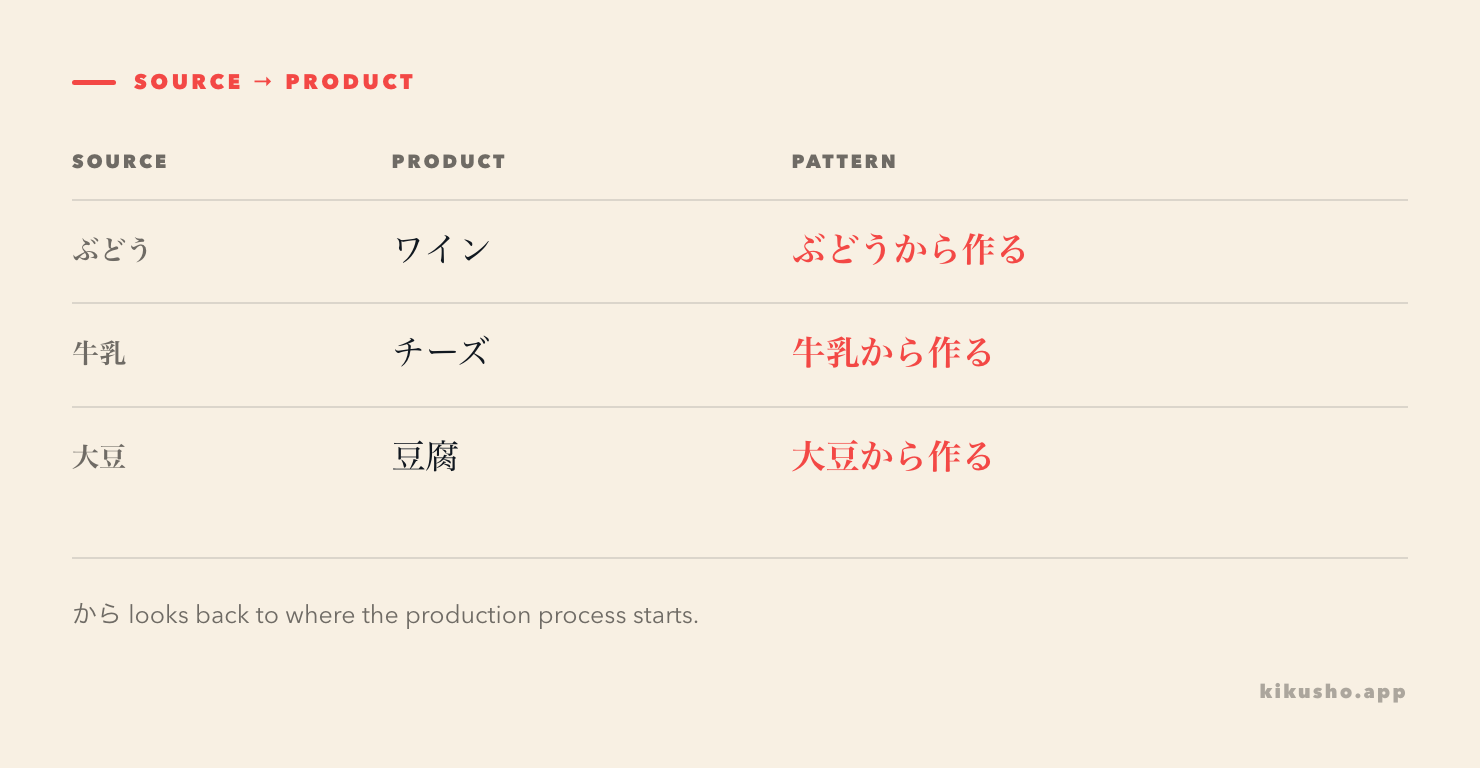
This pattern is particularly natural when the source changes enough that it is no longer plainly present in its original form:
ぶどうからワインを作ります。
ぶどうから ワインを つくります。
We make wine from grapes.
牛乳からチーズを作ります。
ぎゅうにゅうから チーズを つくります。
We make cheese from milk.
大豆から味噌を作ります。
だいずから みそを つくります。
We make miso from soybeans.
The Tofugu guide to から treats the particle's fundamental meaning as a source or origin and includes raw materials in that family. This explains more than memorizing “use から when the material is invisible”: the speaker is tracing the product back to its origin.
Switch the viewpoint in a passive sentence
Descriptions of products commonly make the finished item the topic:
product + は + source + から + 作られる
ワインはぶどうから作られます。
ワインは ぶどうから つくられます。
Wine is made from grapes.
The active and passive versions describe the same production relationship:
| Viewpoint | Japanese | What the sentence foregrounds |
|---|---|---|
| maker or process | 大豆から豆腐を作ります。 | making tofu |
| product as a general fact | 豆腐は大豆から作られます。 | what tofu is made from |
| product in its resulting state | この豆腐は大豆から作られています。 | the composition of this tofu |
作られます is the polite non-past passive of 作る. It works well for a general explanation of how a category of product is made. 作られています literally has the passive in the ている form and often describes the resulting makeup of the product in front of you. In ordinary material descriptions, the two can overlap.
If the passive form itself is unfamiliar, review direct and indirect Japanese passives. In this lesson, the passive does not imply that the product suffered; it simply makes the product the grammatical subject.
Use で for material, ingredients or means
With で, the noun answers “using what?”:
material + で + product + を + 作る
紙で箱を作りました。
かみで はこを つくりました。
I made a box out of paper.
木で机を作ります。
きで つくえを つくります。
We make a desk from wood.
The paper remains recognizably paper in the box, and the wood remains recognizable in the desk. That makes で the expected choice. The same particle can mark tools and other means:
はさみで紙を切ります。
はさみで かみを きります。
I cut the paper with scissors.
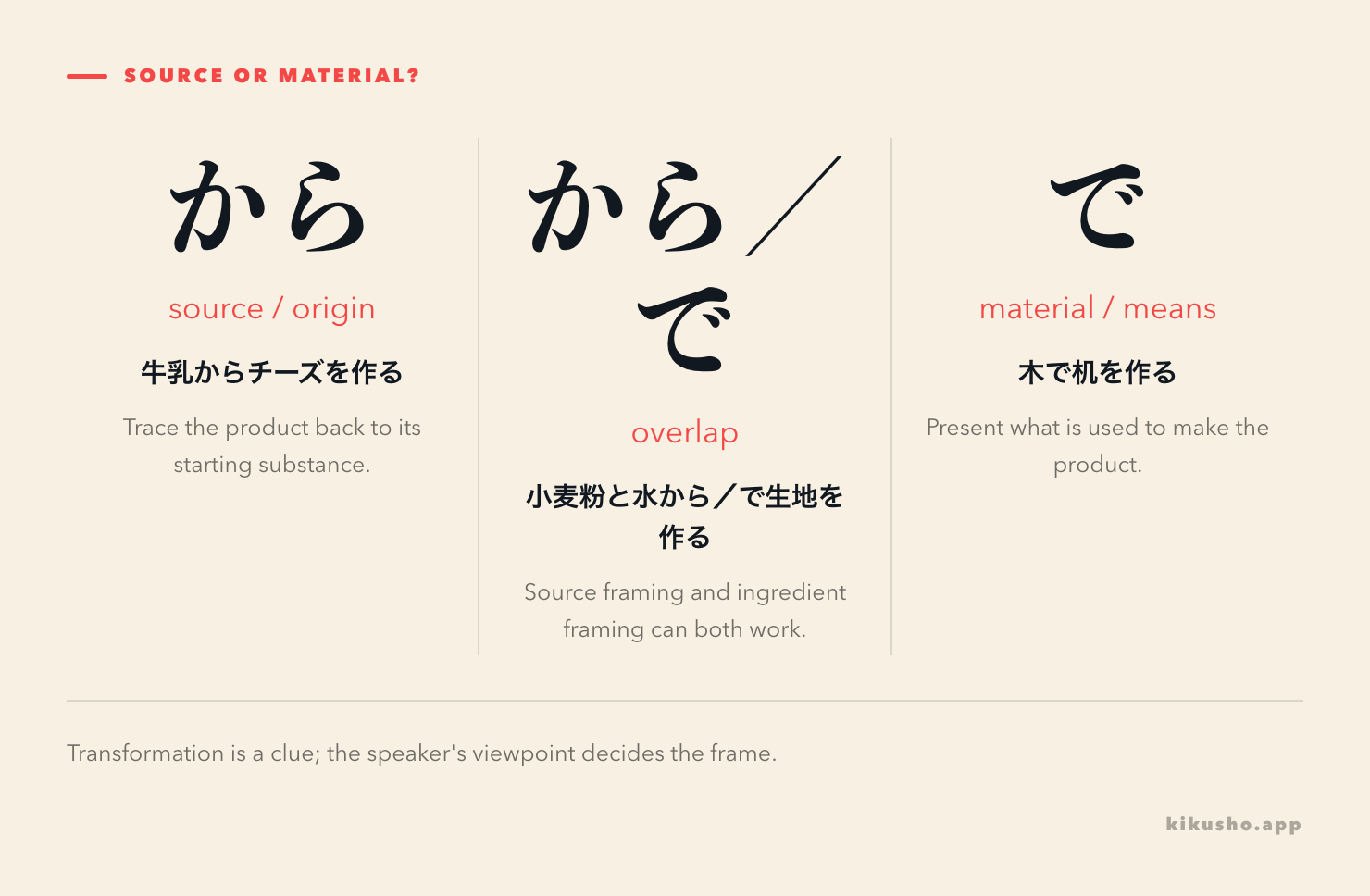
| Particle | Speaker's angle | Strong example |
|---|---|---|
| から | origin, starting source, raw material | 牛乳からチーズを作る |
| で | material, components, ingredients or means | 木で机を作る |
| either can occur | the same process can be framed as source or components | 小麦粉と水から/で生地を作る |
The often-taught shortcut says から for a transformed raw material and で for a visible material. It is useful because it predicts many clear examples. The research article “Kara and De of Ingredient/Material” from the Society for Teaching Japanese as a Foreign Language shows why the shortcut has limits: qualitative transformation favors から, but で has a wider range and can replace から in many production sentences. Strong perceived distance between the source and the result can also encourage から.
That means 小麦粉と水から生地を作ります can present flour and water as the sources from which dough emerges, while 小麦粉と水で生地を作ります presents them as the ingredients used. Both are grammatical. The choice changes the viewpoint more than the physical recipe.
When you save a product label or recipe in Kikusho, keep the full sentence on the card. A card containing only “から = from” loses the contrast. 牛乳からチーズを作る beside 木で机を作る preserves the source-versus-material decision you need to make.
Read the roles before translating
English “from” and “out of” do not reliably choose the Japanese particle. Label each role in the Japanese sentence instead:
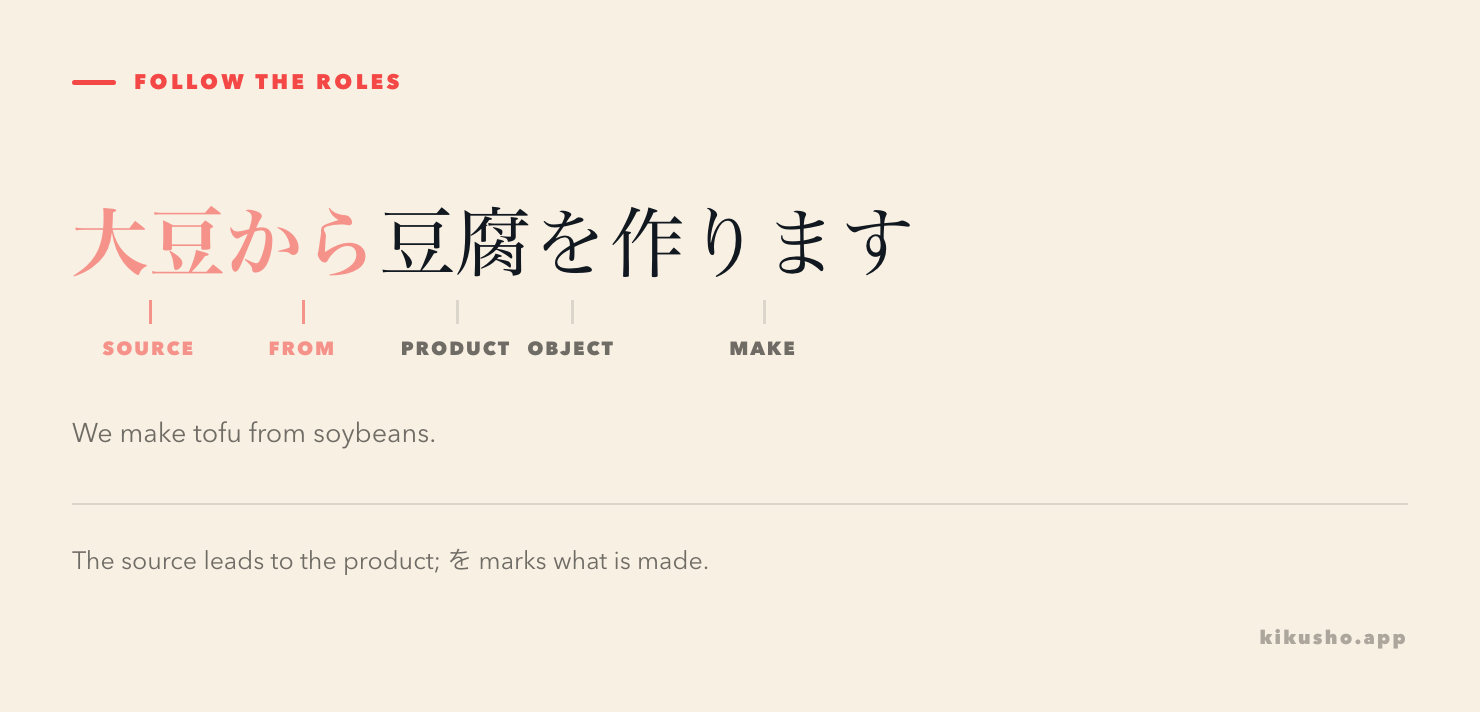
| Part | Role | Meaning here |
|---|---|---|
| 大豆 | source | soybeans |
| から | source marker | from |
| 豆腐 | product | tofu |
| を | object marker | marks what is made |
| 作ります | production verb | make |
With a passive sentence, the product moves to the topic position but から keeps the same source role:
豆腐は大豆から作られています。
とうふは だいずから つくられています。
Tofu is made from soybeans.
Do not add an agent unless it matters. A factory explanation usually cares about the process or composition, so 誰によって is unnecessary.
Keep noun から separate from verb てから
Two sentences can place から near 作る while expressing completely different relationships:
牛乳からチーズを作ります。
We make cheese from milk.
牛乳を買ってから、チーズを作ります。
After buying milk, we make cheese.
In the first sentence, a noun + から marks the material source. In the second, a verb in て-form + から orders two actions. The lesson on Vてから for “after doing” covers that sequence pattern in detail.
Also distinguish the source particle from causal から:
牛乳がないから、チーズを作りません。
Because there is no milk, I will not make cheese.
Here, から follows a clause and gives a reason. Check what comes immediately before から: a source noun, a て-form verb, or a complete reason clause.
Use a three-step decision
When you meet a production sentence, make the choice in this order:
- Identify the starting substance and the finished product.
- If you are tracing a transformed product back to its source, choose から.
- If you are presenting a visible material, a list of components or the means used, choose で.
If both viewpoints make sense, both particles may be possible. Ask what the sentence is trying to foreground. Bunpro's comparison of でできる and からできる makes the same practical distinction while recognizing modern overlap.
JLPT Sensei lists から作る at N4. The JLPT does not publish an exhaustive grammar list, so treat N4 as a useful study estimate rather than an official boundary.
Practice: trace the product back to its source
Work through all seven items before checking the explanations below.
Question 1
Choose the best particle for the standard source-focused statement.
ワインはぶどう__作られます。
- から
- まで
- を
- に
Question 2
Choose the natural particle for a desk whose wood remains the visible material.
この机は木__作られています。
- から
- で
- と
- へ
Question 3
Change the active sentence into a polite passive sentence that makes 豆腐 the topic.
大豆から豆腐を作ります。
Question 4
Write a polite sentence meaning “We make cheese from milk.” Use 牛乳, チーズ, から and 作ります.
Question 5
Explain the viewpoint difference between these two grammatical sentences.
小麦粉と水から生地を作ります。
小麦粉と水で生地を作ります。
Question 6
Choose the sentence that means “After buying paper, I make a box.”
- 紙から箱を作ります。
- 紙で箱を作ります。
- 紙を買ってから、箱を作ります。
- 紙がないから、箱を作りません。
Question 7
Read the factory guide and choose the best interpretation of から.
この工場では、牛乳からチーズを作っています。木の箱は別の工場で作っています。
- から marks the time when cheese production begins.
- から marks milk as the source from which cheese is produced.
- から means that milk is the tool used to cut cheese.
- から gives the reason the wooden boxes are made elsewhere.
Answers and explanations
1
1. から. ワインはぶどうから作られます traces wine back to grapes as its transformed source. まで marks an endpoint, while を and に cannot mark the source in this pattern.
2
2. で. この机は木で作られています presents wood as the material used, and the material remains recognizable in the desk. から is possible in special source-focused framing, but で is the natural unmarked choice for this exercise.
3
豆腐は大豆から作られます。 豆腐 becomes the topic with は, 大豆 remains the source before から, and 作ります becomes the polite passive 作られます. The meaning is “Tofu is made from soybeans.”
4
牛乳からチーズを作ります。 Read ぎゅうにゅうからチーズをつくります. 牛乳 is the starting source, チーズ is the product marked by を, and 作ります is the polite production verb.
5
から frames the flour and water as the sources from which dough emerges; で frames them as the ingredients used. The production process is the same, and both sentences can be natural. The particle directs attention to a different relationship.
6
3. 紙を買ってから、箱を作ります。 Verb て-form + から orders the actions: first buy the paper, then make the box. Option 1 marks paper as a source, option 2 as a material, and option 4 uses clause + から for a reason.
7
2. から marks milk as the source from which cheese is produced. 牛乳 is a noun immediately before から, and チーズ is the product. The second sentence changes the subject to wooden boxes but does not change the first sentence into a time or reason expression.
Follow the transformation without making it a rule
Use grapes becoming wine and milk becoming cheese as strong anchors for から作る. Then keep the underlying idea: から points to a source, while で marks material, components or means. That lets you handle clear exam items and also understand the overlap you will meet in recipes, labels and factory descriptions.
The N4 cooking and taste vocabulary lesson gives you 米, 味噌 and common preparation verbs for building more examples. When a sentence uses an ingredient rather than explaining a production source, the particle choice becomes a meaningful part of what the speaker wants you to notice.
Common questions
What does から作る mean in Japanese?
Noun plus から作る means to make a product from a starting source. It is especially natural when production transforms the source, as in making wine from grapes or cheese from milk.
What is the difference between から作る and で作る?
から presents a material as the source or starting point, while で presents it as the material, ingredients or means used. Transformation is a useful clue, but real usage overlaps and the speaker's framing matters.
How do I say “made from” in Japanese?
Use Noun plus から作られる for a general passive statement, such as ワインはぶどうから作られます. 作られています often describes the composition of a particular product in its resulting state.
Is から作る an N4 grammar point?
Many learner resources place this use around N4. The JLPT does not publish an exhaustive official grammar list, so the level is a study estimate.