On this page
読み方(よみかた) means “a way of reading” or “how to read.” Remove ます from 読みます and add 方(かた): 読みます → 読み方. The same pattern gives 書き方 “how to write,” 食べ方 “how to eat” and 使い方 “how to use.”
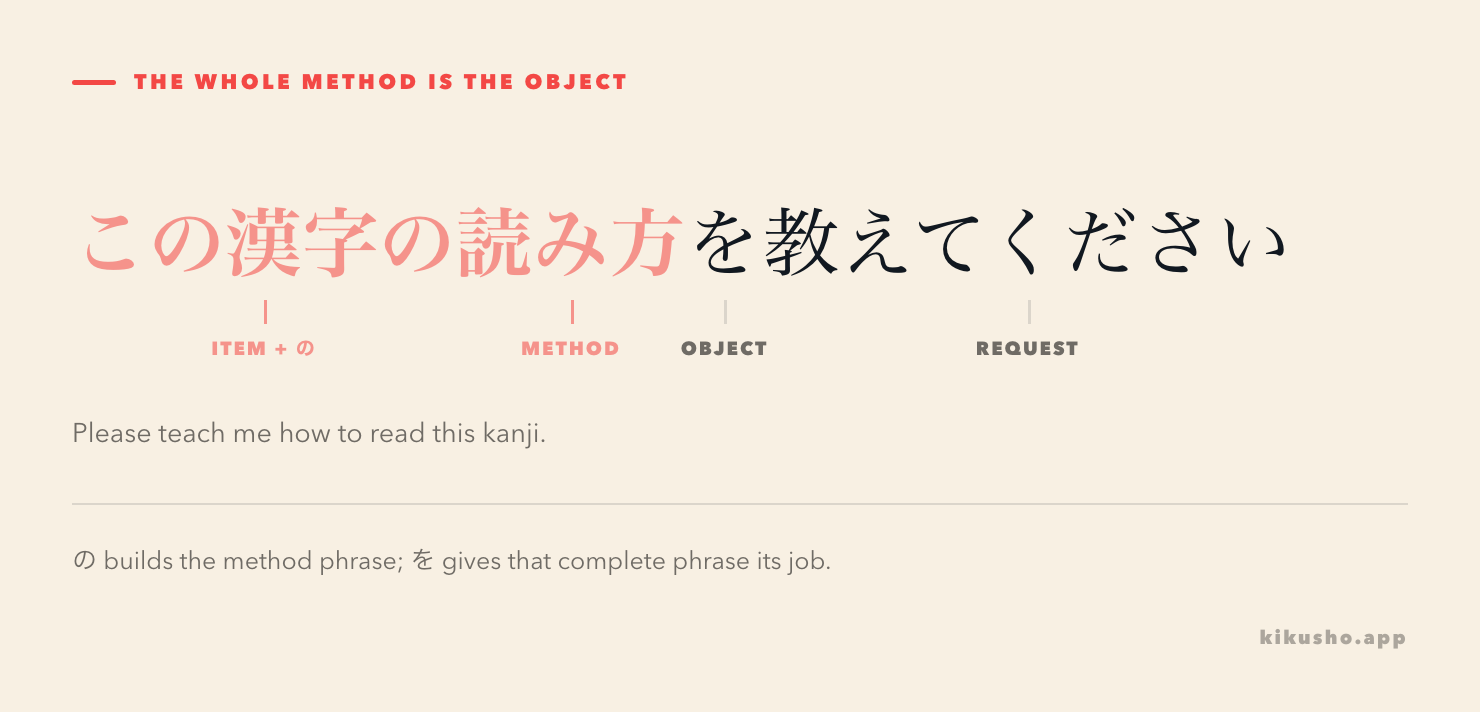
The result is a noun, not a question by itself. That matters twice: it can take particles such as が and を, and the object of the original verb normally moves before it with の. この漢字を読む is “read this kanji”; この漢字の読み方 is “how to read this kanji.”
Build 方 from the ます-stem
Start with the polite form, remove ます, and attach 方(かた) to what remains. That remainder is often called the ます-stem. If you do not yet know how godan, ichidan and irregular verbs reach ます, use the verb-group and ます-form guide first.
| Dictionary form | ます form | Remove ます | Method noun |
|---|---|---|---|
| 読む, to read | 読みます | 読み | 読み方, how to read |
| 書く, to write | 書きます | 書き | 書き方, how to write |
| 使う, to use | 使います | 使い | 使い方, how to use |
| 食べる, to eat | 食べます | 食べ | 食べ方, how to eat |
| 見る, to look | 見ます | 見 | 見方, a way of looking |
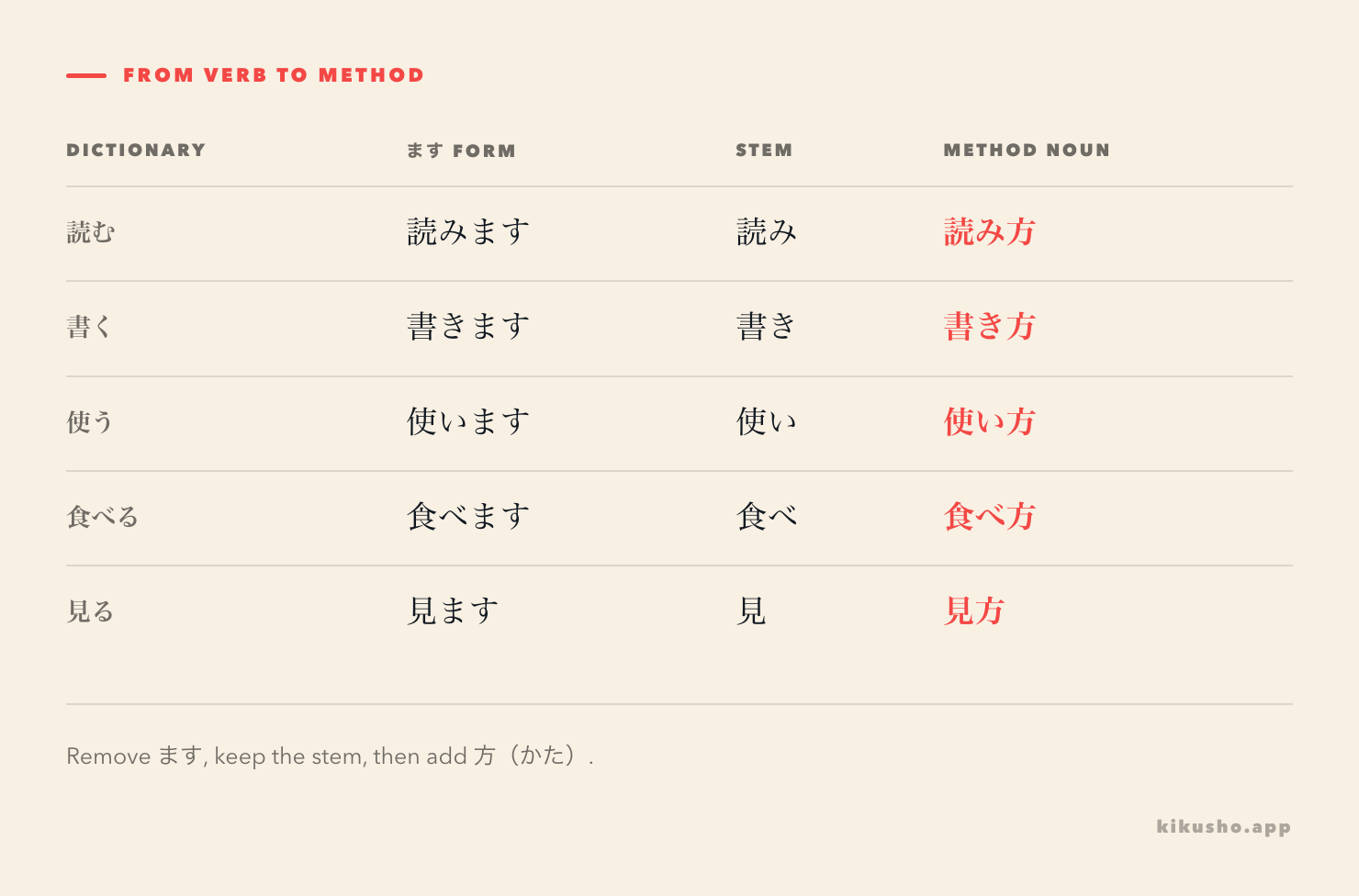
This pattern works across both regular verb groups. 読む is a godan verb, so its ending first changes to 読み. 食べる is an ichidan verb, so dropping る already leaves 食べ, the stem used in 食べます and 食べ方. Do not attach 方 to the dictionary form: 読む方 does not mean “how to read.” With the polite person reading of 方, it can instead suggest “the person who reads,” depending on context.
The method word can name a procedure, a style or an interpretation. 漢字の読み方 asks for a reading; 箸の使い方 names the method for using chopsticks; 問題の見方 can mean a way of looking at a problem. English often translates all three with “how to,” but Japanese has made a noun.
The old object usually changes to の
Compare the clause パソコンを使います, “I use a computer,” with the noun phrase パソコンの使い方, “how to use a computer.” In the clause, パソコン is the direct object of 使う and takes を. Once 使い方 becomes the head noun, パソコン links to that noun with の.
| Verb clause | 方 noun phrase |
|---|---|
| この漢字を読む | この漢字の読み方 |
| 名前を書く | 名前の書き方 |
| 箸を使う | 箸の使い方 |
| この料理を食べる | この料理の食べ方 |
This is a change in structure, not a rule that を turns into の everywhere. The verb clause still needs を: 箸を使います. The method noun normally uses の: 箸の使い方を習います, “I learn how to use chopsticks.” The final を belongs to 習います and marks the whole method noun as what you learn.
The same structure appears in the Japan Foundation’s beginner Irodori lesson 読み方を教えてもらえませんか, which includes この書類の書き方がよくわかりません: “I do not really understand how to fill out/write this document.” The document is inside the method noun with の; 書き方 then takes が as the thing not understood.
A 方 phrase behaves as one noun
Once built, 読み方, 使い方 and 書き方 occupy the same sentence slots as other nouns.
- この漢字の読み方がわかります。 I know how to read this kanji.
- アプリの使い方を教えてください。 Please teach/show me how to use the app.
- 名前の書き方は簡単です。 The way to write the name is simple.
- 箸の使い方を習いました。 I learned how to use chopsticks.
The particle after 方 belongs to the larger sentence. Use が with わかる, を when the method is taught or learned, and は when it is the topic. A beginner can therefore build the method noun first, then decide what job that noun has in the sentence.
どうやって使いますか and 使い方を教えてください are related but not identical. The first asks, “How do you use it?” as a full question. The second makes “the way to use it” the object of a request: “Please show me how to use it.” 使い方がわかりません makes the same method noun the subject of what the speaker does not understand.
Instructions are a good place to capture 方 phrases whole. If a manual says このボタンの使い方 or a form says 名前の書き方, saving the complete phrase in Kikusho keeps the item before の, the かた reading and the surrounding action together. That context prevents a card for 方 alone from mixing up “method,” “direction” and the polite word for a person.
する activities usually use 仕方
The mechanical stem of する → します is し, but 勉強し方 is not the dependable beginner expression for “how to study.” Use 勉強の仕方: the activity noun 勉強 links with の to 仕方(しかた), “way of doing.” Likewise, 説明の仕方 is a way of explaining and 仕事の仕方 is a way of working.
やり方 is also common when “the way to do it” is broad enough that やる fits: このゲームのやり方がわかりません, “I don’t know how to play/do this game.” Which noun sounds best depends on the activity, so treating every する verb as an automatic し方 production rule creates unnatural forms. Bunpro’s 方 reference likewise notes noun + の + 仕方 for many する compounds.
Do not learn 仕方がない by translating each part as “there is no how-to.” It is a fixed expression meaning “it cannot be helped” or “there is nothing that can be done.” Its words are related to method, but the phrase has its own function.
Three readings, three jobs
The kanji 方 is easy to recognize and easy to misread because several beginner patterns use it.
| Form | Reading | Job |
|---|---|---|
| 読み方 | かた | method: how to read |
| あの方 | かた | polite noun: that person |
| 電車のほうが速い | ほう | comparison: the train is faster |
| 休んだほうがいい | ほう | advice: it would be better to rest |
The method reading comes directly after a verb stem. The person reading follows a demonstrative or another modifier, as in あの方. The comparison and advice reading is ほう; the より・ほうが comparison lesson and たほうがいい advice lesson teach those two structures. Spelling alone does not select the reading. The grammar around 方 does.
References disagree on the JLPT label
JLPT Sensei’s 方 page labels verb-stem + 方 as N5, while Bunpro labels its 方 lesson N4. The Japan Foundation teaches the pattern in its elementary Irodori course. These are teaching placements, not official exam guarantees: the JLPT organizers say that they do not publish an exhaustive vocabulary, kanji and grammar list. This curriculum places the construction at N5 because it reuses the beginner ます-stem and appears in basic requests for instructions, while recording the N4 disagreement rather than hiding it.
Practice: build the method before the sentence
Question 1
Which method noun means “how to read”?
- A. 読む方
- B. 読み方
- C. 読んで方
- D. 読みます方
Question 2
Build the method noun for 食べる, “to eat.” Show the ます form, the stem and the final 方 form.
Question 3
Turn この漢字を読む, “read this kanji,” into the noun phrase “how to read this kanji.”
Question 4
Complete the request: このアプリ__使い方を教えてください。
- A. を
- B. が
- C. の
- D. に
Question 5
You want to say “I don’t know how to study.” Which sentence uses the dependable beginner expression?
- A. 勉強し方がわかりません。
- B. 勉強の仕方がわかりません。
- C. 勉強を方がわかりません。
- D. 勉強する方がわかりません。
Question 6
In 電車のほうが速いです, should 方 be read かた or ほう? Explain what clue separates it from 読み方.
Question 7
A visitor points to a form and says:
この名前の書き方がわかりません。
What do they not understand: the person named on the form, the way to write the name, or whether the name is correct?
Answers and explanations
Answer 1
B, 読み方(よみかた). 読む becomes 読みます; remove ます and add 方. 読む方 can describe a person who reads when 方 has its polite person sense, while 読んで方 and 読みます方 do not follow the method-noun pattern.
Answer 2
食べる → 食べます → 食べ → 食べ方. 食べる is an ichidan verb, so る drops before ます. Removing ます leaves the same stem, 食べ, and 方 attaches to it.
Answer 3
この漢字の読み方. 読む becomes 読み方, and the former object この漢字 links to that noun with の. この漢字を読み方 incorrectly keeps the clause particle inside the noun phrase.
Answer 4
C, の: このアプリの使い方を教えてください. の joins the app to the method noun. The later を marks the complete phrase このアプリの使い方 as the thing the speaker asks to be taught.
Answer 5
B, 勉強の仕方がわかりません. 勉強 is the activity noun and の joins it to 仕方. The other choices apply the ordinary stem rule mechanically or use a particle that does not build this method noun.
Answer 6
It is ほう. The Xのほうが… frame makes a comparison, here choosing the train as the faster option. 読み方 puts 方 directly after the ます-stem 読み and reads it かた to name a method.
Answer 7
They do not understand the way to write the name. 名前 is linked by の to 書き方, the method noun, and that complete phrase is what わかりません describes. Nothing in the sentence questions the identity or correctness of the person.
When 方 follows a verb stem, first read it かた and treat the result as a noun. That two-step check makes the particles predictable: the item belongs before the method with の, and the whole method phrase takes whichever particle its new sentence requires.
Common questions
How do you say “how to” with a Japanese verb?
Put 方(かた) after the verb’s ます-stem: 読みます becomes 読み方, “how to read,” and 使います becomes 使い方, “how to use.” The result behaves as a noun.
Why is it パソコンの使い方 rather than パソコンを使い方?
使い方 is a noun meaning a way of using. The thing used is normally linked inside that noun phrase with の: パソコンを使う becomes パソコンの使い方.
Is 方 read かた or ほう?
In a verb-stem compound meaning a method, it is かた: 読み方. 方 is read ほう in comparison patterns such as Aのほうがいい, and かた can separately be a polite word for a person.
Can I say 勉強し方 for “how to study”?
Use 勉強の仕方 as the dependable beginner form. Many する activities name their method with noun + の + 仕方; やり方 is another common word for a way of doing something.