On this page
~ましょう (mashō, also written mashou) proposes “Let's do it”; ~ませんか (masenka) invites someone with “Would you like to join me?” Both are polite, but the negative question asks about the listener's willingness more explicitly, while ~ましょう presents the action more confidently.
This N5 grammar lesson teaches those two endings and ~ましょうか (mashō ka), which asks “Shall I?” or “Shall we?” depending on who is acting. You need the ます stem and verb groups first. Bunpro's comparison lists all three as N5, matching the JLPT Sensei entries for ませんか, ましょう and ましょうか. These are reference estimates, since the JLPT does not publish an exhaustive grammar syllabus.
Ask whether you are inviting, proposing, or offering
Before choosing an ending, identify your job in the conversation:
| Your immediate purpose | Useful pattern | What it puts forward |
|---|---|---|
| Invite someone to join an activity | stem + ませんか | “Would you like to…?” Their willingness is still a question. |
| Suggest that you do something together, or accept that suggestion | stem + ましょう | “Let's…” You are putting the action forward. |
| Offer to act, or ask about a shared next step | stem + ましょうか | “Shall I…?” / “Shall we…?” You seek a response to your proposal. |
These are useful starting points, rather than exclusive meanings. Tokyo University of Foreign Studies explains that ~ましょう can invite, accept an invitation, express the speaker's will, or soften an instruction. A form's English label cannot settle every scene.
The stem stays fixed across all three endings
Take the ordinary polite ます form and replace ます with the chosen ending. The replacement is the same for every verb group; building the stem is the part that depends on the group.
| Dictionary form | ます form | Invitation | Suggestion | Question or offer |
|---|---|---|---|---|
| 飲む(のむ), drink | 飲みます | 飲みませんか | 飲みましょう | 飲みましょうか |
| 帰る(かえる), go home | 帰ります | 帰りませんか | 帰りましょう | 帰りましょうか |
| 食べる(たべる), eat | 食べます | 食べませんか | 食べましょう | 食べましょうか |
| 見る(みる), watch | 見ます | 見ませんか | 見ましょう | 見ましょうか |
| する, do | します | しませんか | しましょう | しましょうか |
| 来る(くる), come | 来ます(きます) | 来ませんか(きませんか) | 来ましょう(きましょう) | 来ましょうか(きましょうか) |
Godan 飲む uses 飲み, and godan 帰る uses 帰り even though it ends in -eru. Ichidan 食べる and 見る use 食べ and 見. The irregular stems are し and き. Marugoto's conjugation chart supplies the group patterns; its offer-of-help explanation confirms the stem attachment.
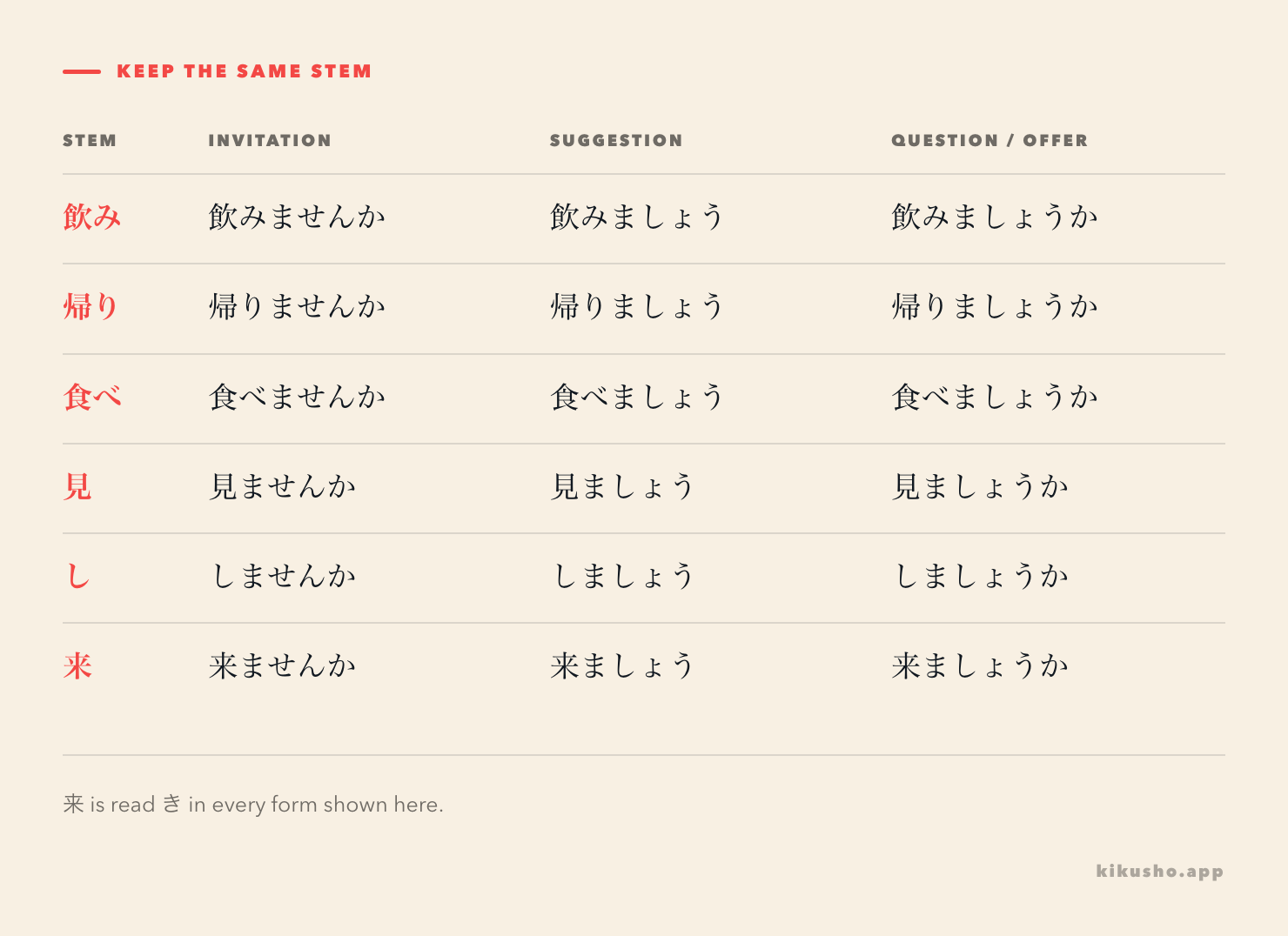
There is no 飲むましょう, 食べるませんか, or するましょうか in this construction. For a する compound, retain the noun and use し: 勉強する → 勉強しませんか (べんきょうする → べんきょうしませんか), “Would you like to study together?”
~ませんか invites while leaving the answer open
Imagine asking a classmate you have not made plans with:
明日、一緒に図書館で勉強しませんか。
あした、いっしょに としょかんで べんきょうしませんか。
Would you like to study at the library with me tomorrow?
一緒に (いっしょに, together) makes the shared activity explicit. The question can be accepted or declined. ません supplies the negative question form, but the invitation is positive in purpose: you hope they will study with you. TUFS's invitation lesson describes both the question about willingness and the speaker's hope that the listener will act.
It is also possible to invite someone to have something, such as food, without making joint participation explicit. Do not turn “with me” into a rule requiring both people to perform every action. For this lesson's shared invitations, 一緒に keeps the intended reading clear.
Nor should you translate every ませんか as an invitation. TUFS's account of polite questions notes other uses involving expectation or concern. The verb, situation and surrounding words still decide the function.
~ましょう proposes an action and can accept an invitation
When a study group is assembled and ready, you can say:
では、練習を始めましょう。
では、れんしゅうを はじめましょう。
Well then, let's start the practice.
始める (はじめる, start something) is ichidan: 始めます → 始めましょう. The speaker moves the group toward an action. ~ましょう remains polite; it can sound encouraging or directive according to the relationship. A teacher's “Let's…” may guide what students should do, even when the teacher is not doing precisely the same task.
The ending is especially useful as an affirmative reply:
A:日曜日、一緒に泳ぎませんか。
A:にちようび、いっしょに およぎませんか。
Would you like to swim together on Sunday?
B:いいですね。泳ぎましょう。
B:いいですね。およぎましょう。
That sounds good. Let's swim.
泳ぐ → 泳ぎます → 泳ぎましょう follows the godan stem rule. B accepts the proposed activity rather than asking A to make the invitation again. TUFS's reply lesson teaches this invitation-to-acceptance sequence.
For familiar speech, 見よう can replace polite 見ましょう. The plain volitional lesson handles that formation and intentions with ~ようと思う; those separate N4 patterns are outside this page's teaching scope.
~ましょうか asks about your offer or the next move
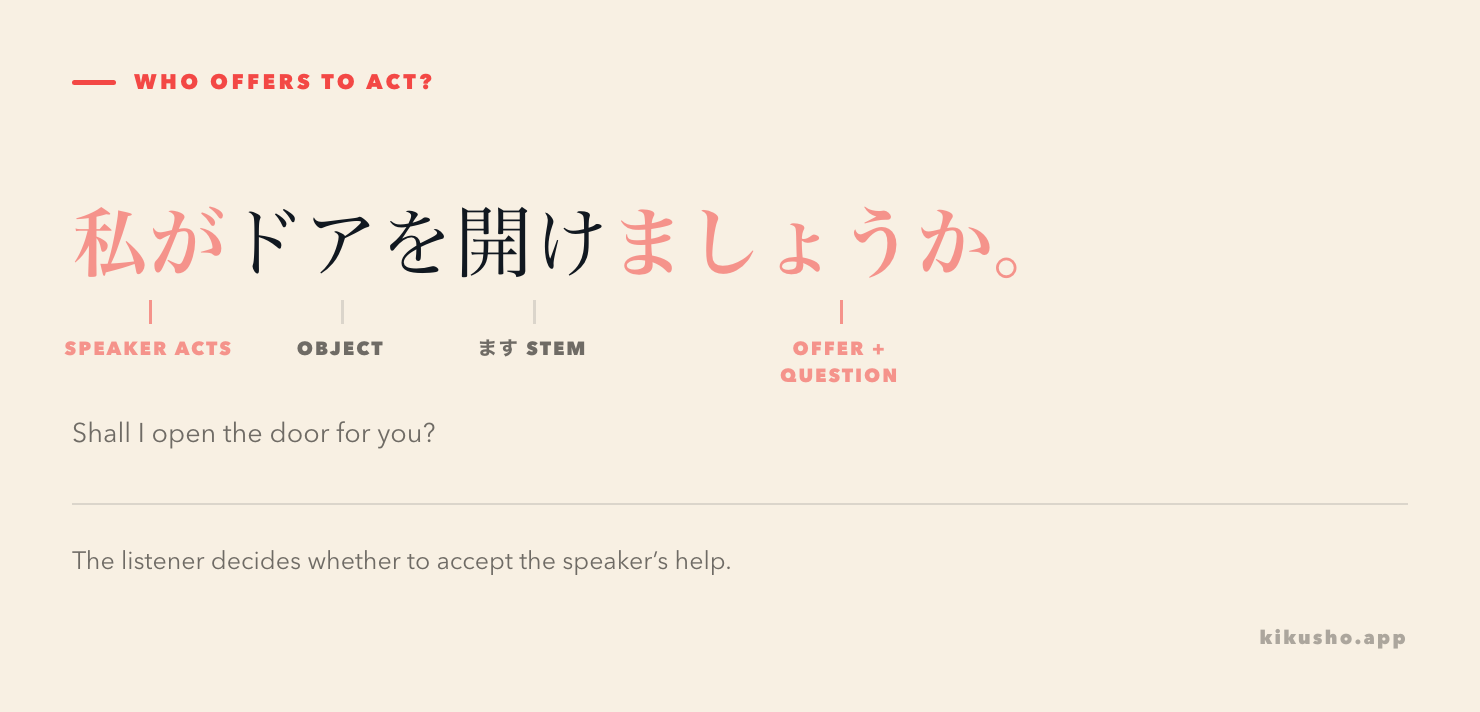
Someone is struggling to open a door with their hands full. You offer:
私がドアを開けましょうか。
わたしが ドアを あけましょうか。
Shall I open the door for you?
私が identifies the person offering to act. 開ける (あける, open something) gives 開けます → 開けましょうか. This is an offer of your help, not a request that the listener open the door. The Japan Foundation's Marugoto lesson teaches ~ましょうか for offering assistance.
The same ending also works between companions considering their next move: もう九時ですね。帰りましょうか (もう くじですね。かえりましょうか), “It's nine already. Shall we go home?” Here the proposal concerns both of you. Bunpro and Coto Academy describe shared suggestions as well as offers.
か makes this an explicit question. It does not automatically make “I” become “we”. Japanese often omits the subject, so reconstruct the actor from the situation. An invitation to participate and an offer to help may concern the same verb while asking different things of the listener.
Both invitations can work, with a different stance
金曜日、一緒にお茶を飲みませんか (きんようび、いっしょに おちゃを のみませんか) asks, “Would you like to have tea together on Friday?” 金曜日、一緒にお茶を飲みましょう (きんようび、いっしょに おちゃを のみましょう) puts it as “Let's have tea together on Friday.” Neither is a grammatical mistake.
~ませんか often feels less presumptive because willingness is a question. ~ましょう may fit better when you expect agreement or are confirming a shared plan. Rapport Voice's interview with a Japanese teacher contrasts the energetic proposal with the invitation that leaves a choice. Tone, timing and the burden of the activity affect how either sounds.
Polite endings alone do not give you permission to direct anyone. Likewise, ~たいですか asks about a desire; it need not perform the same conversational job as an invitation. The ~たい lesson separates those uses.
When a useful invitation arrives in a message, paste it into Kikusho and check the drafted card before keeping it. Edit the example or register note to preserve who invited whom and what they were proposing. That scene makes a saved phrase more useful than an isolated “let's”; your kept cards and audio remain available for offline review.
Practice
Attempt all seven questions before going to the answer block. The situations are original; choose according to the stated meaning, rather than assuming one polite invitation is always better.
Question 1. Choose the correctly formed polite invitation using 飲む(のむ), “drink”: “Would you like to have tea together?”
- A. 一緒にお茶を飲むませんか。
- B. 一緒にお茶を飲みませんか。
- C. 一緒にお茶を飲まませんか。
- D. 一緒にお茶を飲みません。
Question 2. Someone is carrying several boxes. You offer to open the door yourself. Which sentence has the intended meaning?
- A. 私がドアを開けました。
- B. 私がドアを開けません。
- C. 私がドアを開けましょうか。
- D. 私がドアを開けたいです。
Question 3. A group agrees to take a short break. Use 休む(やすむ), “rest”, to write the polite suggestion “Let's rest a little” without making it a question: 少し__。
Question 4. Put every chunk in order to invite someone: “Would you like to come to my house tomorrow?”
来ませんか / 明日 / 私の家に
Read 私の家 as わたしの いえ. Supply the reading of the completed sentence too.
Question 5. Complete B's reply so that B accepts A's invitation and says “Let's do it”, rather than asking a fresh question.
A:土曜日、一緒に料理をしませんか。
A:どようび、いっしょに りょうりを しませんか。
B:いいですね。__。
- A. しましょう
- B. しません
- C. しました
- D. しませんか
Question 6. Two classmates discuss a plan. Choose the continuation that explicitly declines it with a reason.
A:明日、一緒に図書館で勉強しませんか。
B:すみません。明日は__。
- A. 一緒に勉強しましょう
- B. 時間があります。行きましょう
- C. 仕事があります。行けません
- D. 図書館に行きましょうか
仕事(しごと)is “work”; 時間(じかん)is “time”; 行けません means “cannot go”. Its potential-form construction is supplied here, not tested.
Question 7. Which account of 一緒に帰りませんか and 一緒に帰りましょう is correct?
- A. Only the first sentence is grammatical.
- B. Both are grammatical; the first asks about willingness, and the second proposes the action more confidently.
- C. Both are grammatical; the first declines going home together.
- D. Only the second sentence is grammatical.
Answers and explanations
Answer 1. B: 一緒にお茶を飲みませんか (いっしょに おちゃを のみませんか). 飲む has the polite form 飲みます; replace ます with ませんか. A retains the dictionary ending, and C uses the godan negative base 飲ま where this ending requires 飲み. D means “We/I won't drink tea together” in an ordinary statement; it lacks the invitation question.
Answer 2. C: 私がドアを開けましょうか (わたしが ドアを あけましょうか), “Shall I open the door?” The speaker proposes their own help. A reports a completed action, B states that the speaker will not open the door, and D states a wish. None of those three makes the requested offer.
Answer 3. 少し休みましょう (すこし やすみましょう). 休む gives 休みます, then 休みましょう. 休みましょうか would ask “Shall we rest a little?”; 休みませんか could invite a break. Both alternatives are grammatical, but the task specifically asks for a suggestion without a question.
Answer 4. 明日、私の家に来ませんか (あした、わたしの いえに きませんか). Put the time and destination before the final invitation. 私の家に、明日来ませんか is also a possible order: Japanese permits those two modifiers to switch. 来 uses き, from 来ます, here; くませんか and こませんか are not its readings. The invitation is to come to the speaker's house.
Answer 5. A: いいですね。しましょう (いいですね。しましょう), “That sounds good. Let's do it.” The action 料理をする is recoverable from A's line. B declines the action, C says it was done, and D repeats an invitation question. D is grammatical but does not explicitly accept in the manner requested.
Answer 6. C: すみません。明日は仕事があります。行けません (すみません。あしたは しごとが あります。いけません), “Sorry. I have work tomorrow. I can't go.” The reason and inability clearly decline tomorrow's plan. A and B accept or advance it; D asks about going. In conversation, a reply such as 明日はちょっと… can also decline indirectly, as TUFS's reply lesson explains, but the exercise asks for an explicit reason.
Answer 7. B. Both forms are grammatical, which rules out A and D. 一緒に帰りませんか (いっしょに かえりませんか) invites the listener to go home together and explicitly asks about willingness; it does not decline the activity as C claims. 一緒に帰りましょう (いっしょに かえりましょう) proposes “Let's go home together” more confidently. The latter can also accept an earlier invitation; it does not prove the listener has already agreed.
Common questions
What is the difference between mashou and masenka?
Both are polite. Verb stem plus ましょう proposes an action as “Let's do it”; stem plus ませんか invites the listener and asks whether they will join. ませんか usually leaves their willingness more openly in question. ましょう can also accept an invitation. Context and tone still matter.
Does mashouka mean shall I or shall we?
Either reading is possible. In 私がドアを開けましょうか, the speaker offers to open the door: “Shall I open it?” When companions ask 帰りましょうか, it can mean “Shall we go home?” Work out who will perform the action from the subject and the situation.
How do you form masenka with suru and kuru?
Start with します and 来ます(きます), remove ます, and add ませんか. The results are しませんか and 来ませんか(きませんか). The same stems give しましょう and 来ましょう(きましょう). Do not add these endings directly to the dictionary forms する and 来る.