On this page
At lunch, もう食べました means “I have already eaten,” while まだ食べていません means “I have not eaten yet.” The decision is whether the expected change has happened: もう places you after it, and まだ keeps you before it or inside a state that continues.
That one timeline also explains まだ食べています, “I am still eating.” まだ does not itself mean “not yet.” The predicate tells you whether the earlier situation continues positively or the expected action remains unrealized.
Put the expected change in the middle
Imagine one event: finishing lunch. Before the first bite, eating has not happened. During the meal, the activity continues. After the meal, completion has been reached.
| Where things stand now | Japanese | Natural English |
|---|---|---|
| completion has been reached | もう食べました | have already eaten |
| the activity continues | まだ食べています | am still eating |
| completion remains pending | まだ食べていません | have not eaten yet |
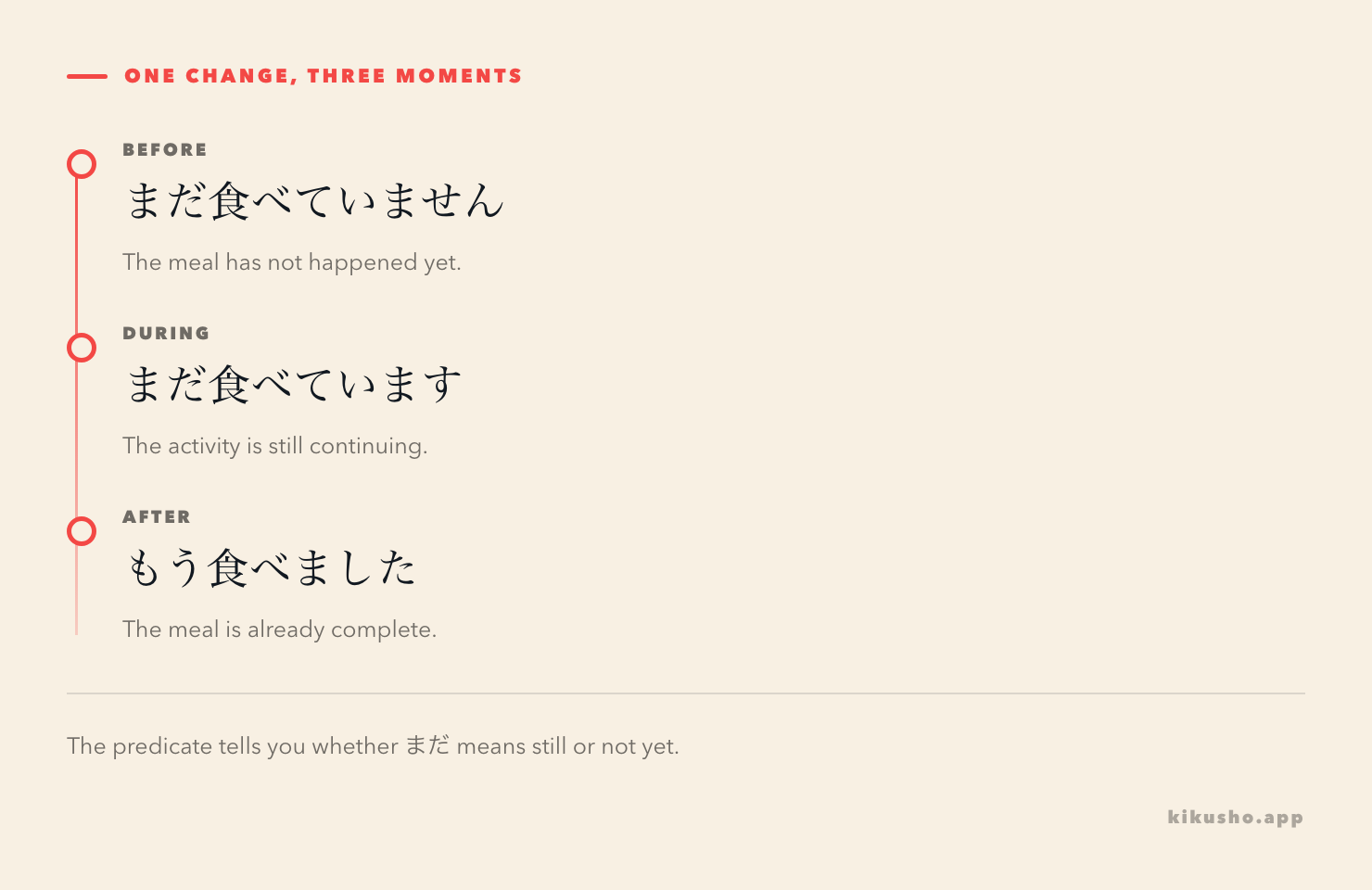
The Japan Foundation’s Irodori grammar notes give the same contrast: もう + affirmative presents an action as completed, まだ + negative presents it as incomplete, and まだ + affirmative shows that a state continues. Its teaching-material page on もう and まだ describes the pair as movement from the state before a change to the state after it.
This is more reliable than assigning one English word to each adverb. English asks “Have you eaten yet?” Japanese normally asks もう食べましたか, using the word associated with the reached change.
もう marks a reached change
For the basic completion pattern, place もう before an affirmative past verb:
宿題はもう終わりました。
しゅくだいは もう おわりました。
The homework is already finished.
The speaker treats finishing as the expected change and says that the change has occurred. The same viewpoint works with a current state:
もう十時です。
もう じゅうじです。
It is already ten o’clock.
Nothing in もう makes a verb past. 終わりました carries past completion; 十時です names the state now. もう adds the speaker’s placement of that state after an expected boundary, sometimes with a sense of “so soon” or “by now.”
The Nihon Kokugo Daijiten entry for もう records this core sense as having reached a state through the passage of time. Bunpro’s N5 entry likewise treats もう as an adverb and contrasts affirmative completion with its negative use.
That negative use means no longer or not anymore:
この店にはもうパンがありません。
このみせには もう パンが ありません。
This shop no longer has any bread.
The change has still happened: bread existed before, and now the shop has none. This is different from まだパンがありません, which says the bread is not there yet and may arrive later.
まだ keeps the earlier state in force
With an affirmative predicate, まだ means “still.” It says the expected change has not displaced the earlier state.
先生はまだ教室にいます。
せんせいは まだ きょうしつに います。
The teacher is still in the classroom.
この部屋はまだ暑いです。
このへやは まだ あついです。
This room is still hot.
The predicate need not be a verb in ~ている. The Japan Foundation’s teaching page confirms まだ + verb, まだ + adjective and まだ + noun, including まだ高校生です, “is still a high school student.” What stays true can be an action, an existence, a quality or a classification.
With a negative predicate, the same continuity becomes “still not” or “not yet”:
電車はまだ来ていません。
でんしゃは まだ きていません。
The train has not arrived yet.
The train’s arrival is treated as expected but unrealized up to now. まだ often leaves the future open. It does not promise that the train will arrive; it frames arrival as the relevant next change.
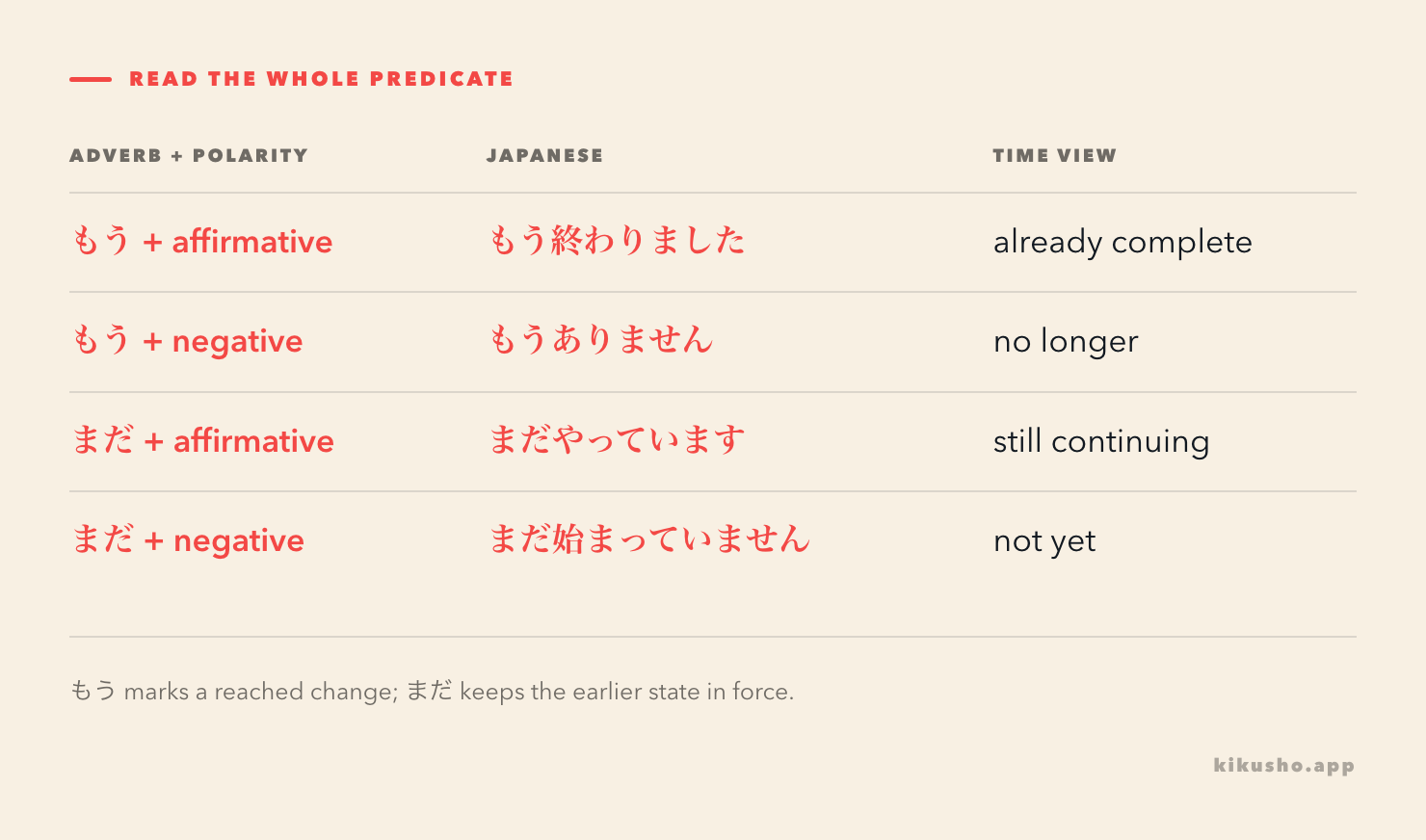
Build まだ~ていません from the verb’s て-form
The polite pattern is:
まだ + verb て-form + いません
| Dictionary form | て-form | Not yet, polite |
|---|---|---|
| 食べる | 食べて | まだ食べていません |
| 書く | 書いて | まだ書いていません |
| 読む | 読んで | まだ読んでいません |
| する | して | まだしていません |
| 来る | 来て(きて) | まだ来ていません(きていません) |
The negative belongs to いる: います → いません. Do not make the lexical verb negative first. 食べないでいません and 書かないでいません are not the target construction.
Plain style changes only the final register: まだ食べていない, まだ書いていない, まだ来ていない. Conversation often contracts ている forms, but the uncontracted shapes make the structure clearest and are dependable in beginner exercises.
The Japan Foundation’s grammar discussion of ~ている describes negative ~ていない as an unrealized or incomplete situation. Its Irodori notes specifically prescribe V-ていません inside the beginner まだ + negative pattern. This is why まだ始まっていません answers whether an event has begun.
Not every “still not” sentence requires ~ていません. まだわかりません naturally means “I still do not know,” and まだできません can mean “I cannot do it yet.” Those predicates already describe the current negative state. Use まだ~ていません when you need to present an action or change as not realized up to now.
Ask with もう, answer on either side of the change
The standard completion exchange begins with もう + past + か:
A:もうレポートを書きましたか。
B:はい、もう書きました。
A: Have you written the report yet?
B: Yes, I have already written it.
If the report is still pending, change both the adverb and the predicate:
A:もうレポートを書きましたか。
B:いいえ、まだ書いていません。
A: Have you written the report yet?
B: No, I have not written it yet.
The short answer いいえ、まだです is also complete when the missing action is clear. The Japan Foundation explicitly gives both まだです and the expanded まだV-ていません as answers to a completion question.
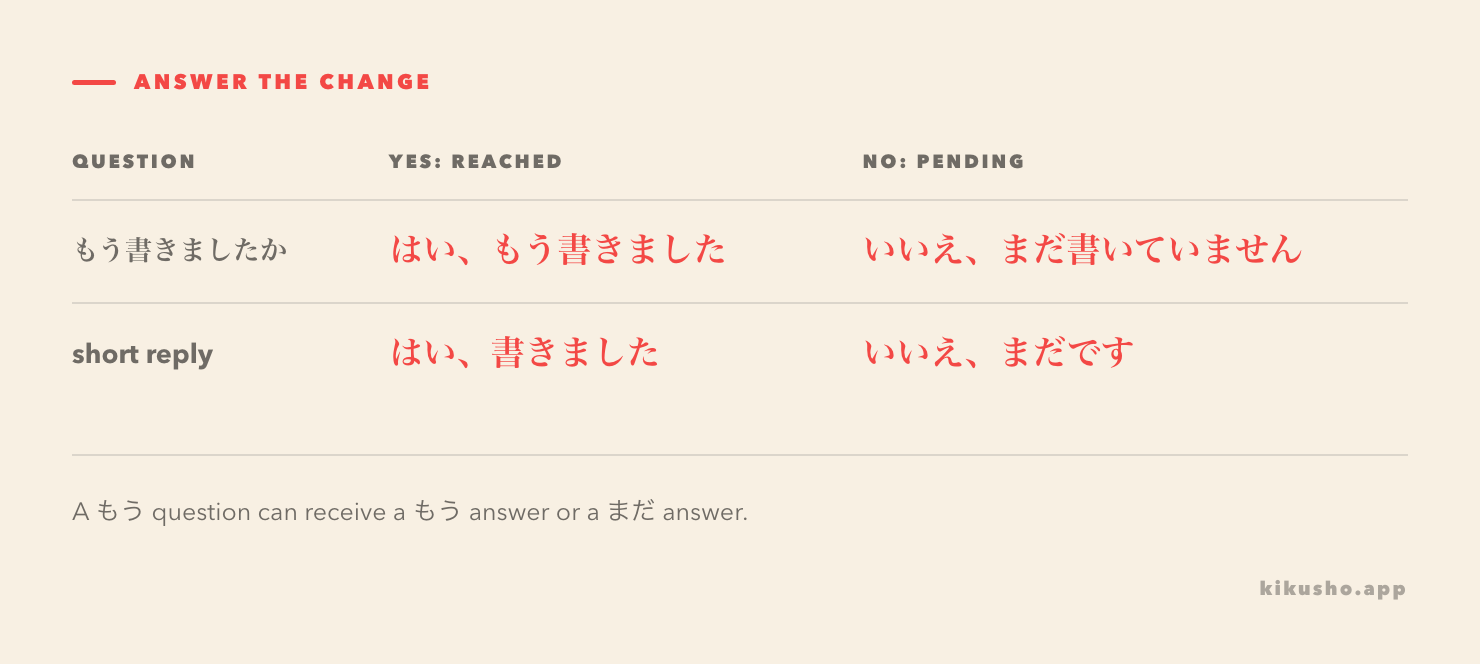
Do not answer いいえ、もう書きません if you mean “not yet.” That says “I will not write it anymore” or “I no longer write it,” depending on context. The negative predicate changes もう from already to no longer.
Pending now is not the same as a finished past negative
Compare two replies:
| Sentence | Time view |
|---|---|
| まだ昼ご飯を食べていません。 | Up to now, lunch remains uneaten. |
| 昨日は昼ご飯を食べませんでした。 | In the finished period yesterday, lunch was not eaten. |
まだ食べていません keeps the event open at the present reference point. 食べませんでした closes a past interval and reports what did not happen there. Adding まだ to the past negative does not automatically create the ordinary “not yet” answer.
There is also a useful contrast with nonpast まだ食べません. In a suitable context it can mean “I will not eat yet,” expressing a present decision to delay eating. まだ食べていません reports the current completion state: eating has not happened up to now. The lesson on ない, ません and past negatives develops those tense and register forms before this timeline distinction is added.
When you save a real exchange in Kikusho, keep the question and its answer together. A card containing only まだです loses the action that is pending; もう予約しましたか。いいえ、まだです preserves the exact change the speakers are tracking. You can check that context before saving the card.
Keep the nearby meanings outside this decision test
The adverbs have other common uses. もう一つ means “one more,” and もう少し means “a little more.” まだまだ strengthens まだ and can mean “still a long way to go,” as in 日本語はまだまだです. These phrases do not ask whether one specific expected action has been completed.
For the N5 completion pattern, keep the narrower test: identify the expected change, decide whether it has happened, and then read the polarity of the predicate. Both JLPT Sensei and Bunpro place the core forms at N5, while the Japan Foundation labels its earlier もう/まだ material as old JLPT level 4, the predecessor band that included beginner content. These are teaching estimates because the JLPT does not publish an exhaustive grammar list.
Practice: locate the change before choosing the word
Complete every question before reading the shared answer section.
Question 1
Your friend finished the book earlier than expected. Choose the sentence meaning “I have already read that book.”
- A. その本はまだ読んでいます。
- B. その本はもう読みました。
- C. その本はまだ読んでいません。
- D. その本はもう読みません。
Question 2
The event continues now. Complete イベントは__やっています with the adverb meaning “still.”
- A. もう
- B. まだ
- C. いつ
- D. まで
Question 3
Complete the polite sentence meaning “The train has not arrived yet.”
電車はまだ__。
- A. 来ませんでした
- B. 来ていません
- C. 来ました
- D. 来ません
Question 4
Answer もう宿題をしましたか in two ways: first say that it is complete, then say that it is still pending. Use full polite sentences rather than the short answer まだです.
Question 5
Which sentence reports a finished event yesterday rather than an action still pending now?
- A. まだ昼ご飯を食べていません。
- B. まだ昼ご飯を食べています。
- C. 昨日は昼ご飯を食べませんでした。
- D. もう昼ご飯を食べました。
Question 6
The bakery shelf is empty. Supply B's reply in this exchange.
A:パンはまだありますか。
B:いいえ、__。
- A. まだあります
- B. もうありません
- C. まだ食べていません
- D. もうありましたか
Question 7
Change まだ手紙を書いていません to plain style without changing its time view.
Answers and explanations
Answer 1
B: その本はもう読みました。 もう places reading after the completion boundary, and 読みました states the completed action politely. A says the reading continues, C says it has not happened yet, and D says the speaker will not read it anymore.
Answer 2
B: まだ. イベントはまだやっています means the event is still running. The predicate is affirmative, so まだ marks continuation. もうやっています would instead suggest that the event has already started.
Answer 3
B: 来ていません. The complete sentence is 電車はまだ来ていません(でんしゃは まだ きていません). 来る becomes 来て, then polite negative いません marks arrival as unrealized up to now. A closes a past period; C says the train came; D can describe a current or future non-arrival but does not form the assigned completion-state pattern.
Answer 4
はい、もう宿題をしました。 and いいえ、まだ宿題をしていません。 The first answer confirms that the change has occurred. The second moves to まだ and ~ていません because the action remains pending. いいえ、まだです would be a natural short version of the second answer.
Answer 5
C: 昨日は昼ご飯を食べませんでした。 昨日 names a completed past interval, and ませんでした reports a negative event inside it. A remains open up to now, B says eating continues, and D says lunch is already complete.
Answer 6
B: もうありません. The shelf used to have bread and now has none, so もう with a negative predicate means “no longer” or “none left.” A contradicts the empty shelf. C changes the subject to eating, and D turns the line into a past question instead of answering A.
Answer 7
まだ手紙を書いていない。 Keep 書いて and change polite いません to plain いない. The adverb and the completion viewpoint remain the same; only the register changes.
One adverb does not answer the timeline by itself. Pair もう or まだ with the predicate, and the sentence shows whether the change is reached, continuing or still pending.
Common questions
What is the difference between もう and まだ?
もう presents a change as reached: もう食べました means the person has already eaten. まだ presents the earlier state as continuing: まだ食べています means the person is still eating, while まだ食べていません means they have not eaten yet.
How do you answer もう食べましたか?
Answer はい、もう食べました if the meal is complete. If it is still pending, answer いいえ、まだです or いいえ、まだ食べていません. English often translates the question with yet even though Japanese uses もう.
Why is it まだ食べていません instead of まだ食べませんでした?
まだ食べていません views eating as unrealized up to now, with the possibility still open. 食べませんでした reports that eating did not happen in a finished past period. The two forms therefore answer different timeline questions.
Does まだ always require a negative verb?
No. With a positive predicate, まだ means that a state continues: まだ暑いです is “it is still hot,” and まだ学生です is “I am still a student.” With a negative predicate, it commonly means not yet or still not.