On this page
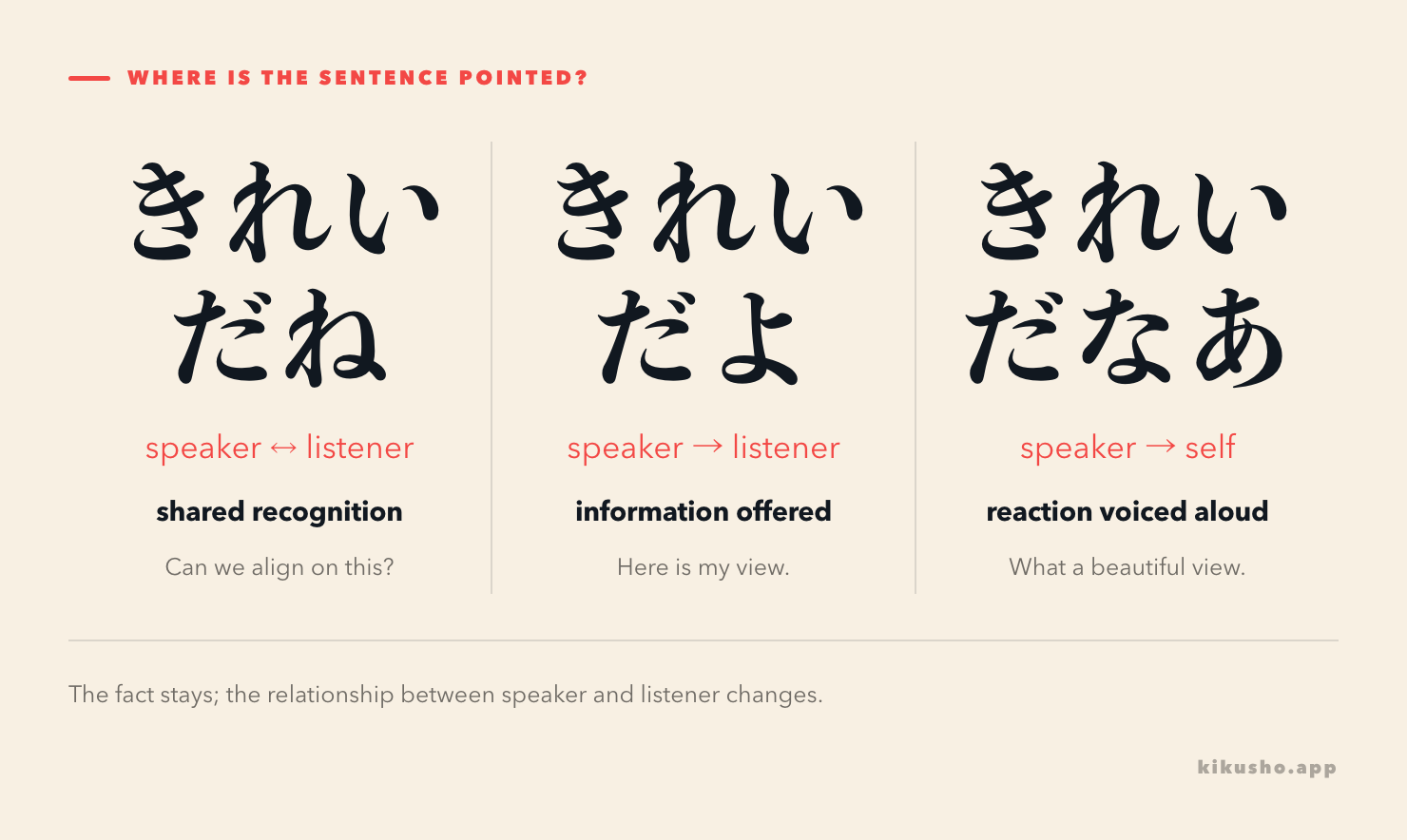
ね reaches toward the listener for alignment, よ directs information toward the listener, and なあ gives voice to the speaker’s own reaction. None has one fixed English translation: the same fact can become shared recognition, an alert or a private impression depending on its ending.
Compare a view of the evening sky. きれいだね invites another person to see the beauty with you. きれいだよ tells or assures them that it is beautiful. きれいだなあ lingers on your own feeling: “It really is beautiful.”
Track where the sentence is pointed
The three endings differ less in factual content than in conversational direction.
| Ending | Main direction | A useful first question |
|---|---|---|
| ね | speaker ↔ listener | Can we align on this? |
| よ | speaker → listener | Do you need this information or viewpoint? |
| なあ | speaker → speaker’s own reaction | What am I noticing or feeling? |
The Japan Foundation’s research overview on Japanese sentence-final particles warns that these endings are not optional decoration in every context. Omitting one can sound unnatural, while adding one in the wrong information setting can also sound odd. The surrounding relationship, style and intonation all matter.
This is why translating ね as “right?” and よ as an exclamation mark only gets you started. A statement can contain neither a question nor excitement and still need one of them to show what the speaker is doing with the information.
ね builds or checks common ground
Use ね when the sentence is offered as something speaker and listener can share:
今日は寒いですね。
きょうは さむいですね。
It is cold today, isn’t it?
Both people can feel the weather. The speaker is not merely requesting a fact-check; the turn creates agreement. A natural reply is そうですね, “It is / Yes, indeed.” The Japan Foundation notes that ね appears naturally in both the observation and the agreeing response.
ね can also confirm information the listener knows better:
会議は三時からですね。
かいぎは さんじからですね。
The meeting starts at three, right?
Here the speaker presents an understanding for confirmation. The listener can answer はい、そうです without ね because the reply supplies the requested confirmation rather than asking to share the same impression.
Do not attach ね automatically to any friendly statement. If you alone know who made a cake, これ、私が作りましたね can sound misplaced: it treats your private fact as though it were already shared or under joint consideration. The Japan Foundation uses this kind of error to show that “softening” is not a complete rule.
よ delivers something to the listener
Use よ when you offer information, an alert, a correction or a viewpoint that matters to the other person:
電車が来ましたよ。
でんしゃが きましたよ。
The train is here.
The listener may not have noticed. よ directs attention to the arrival. Tofugu’s particle よ guide describes this as an informative movement from speaker to listener, which covers alerts more accurately than “emphasis.”
The same direction can make reassurance helpful:
この料理は辛くないですよ。
このりょうりは からくないですよ。
This dish is not spicy, you know.
Perhaps the listener is hesitating. The speaker supplies a relevant fact. In another tone, however, よ can sound corrective or pushy. If someone has just said 暑いですね, replying 暑いですよ may feel as if you are informing them of what they already know. そうですね aligns with their observation instead.
Status matters too. The Japan Foundation notes that よ can be easy to hear as dissatisfaction in replies such as わかりましたよ, especially toward a superior. Polite morphology does not erase the information pressure. Use よ because the listener benefits from what you are presenting, rather than as a general friendliness marker.
なあ lets a reaction remain with the speaker
なあ often accompanies admiration, longing, realization or reflective self-talk:
この景色はきれいだなあ。
このけしきは きれいだなあ。
What a beautiful view.
The speaker may be addressing nobody. The drawn-out vowel gives the reaction room to linger. In writing, you may see なあ, なぁ or なー representing that sound; the standard lesson form here is なあ.
日本へ行きたいなあ。
にほんへ いきたいなあ。
I would really like to go to Japan.
This voices a wish rather than requesting the listener’s agreement. If you say 行きたいね to a friend, the sentence more readily invites a shared “We would like to go, wouldn’t we?” Context can still turn なあ outward, but self-directed reaction is the safest first distinction.
Mango Languages’ comparison independently places なあ with plain-form, self-directed reflection while treating ね and よ as listener-oriented. JLPT Sensei’s なあ entry also records admiration, hope, uncertainty and emphasis under this broader expressive role.
なあ is casual and expressive. The shorter な can sound firmer or carry social coloring depending on the speaker and context, but it is not a “men only” grammar rule. Learn whole lines from real speakers rather than assigning a gender to one kana.
Attach the ending after a complete predicate
Verbs and い-adjectives take the ending directly. In neutral plain statements, nouns and な-adjectives usually keep だ. Polite predicates keep です/ます before ね or よ.
| Predicate | Plain with ね | Plain with よ | Reflective なあ |
|---|---|---|---|
| verb: 行く | 行くね | 行くよ | 行くなあ |
| い-adjective: 高い | 高いね | 高いよ | 高いなあ |
| な-adjective: 静か | 静かだね | 静かだよ | 静かだなあ |
| noun: 学生 | 学生だね | 学生だよ | 学生だなあ |
| polite verb: 行きます | 行きますね | 行きますよ | usually choose a different polite phrasing |
| polite な-adjective | 静かですね | 静かですよ | usually choose a different polite phrasing |
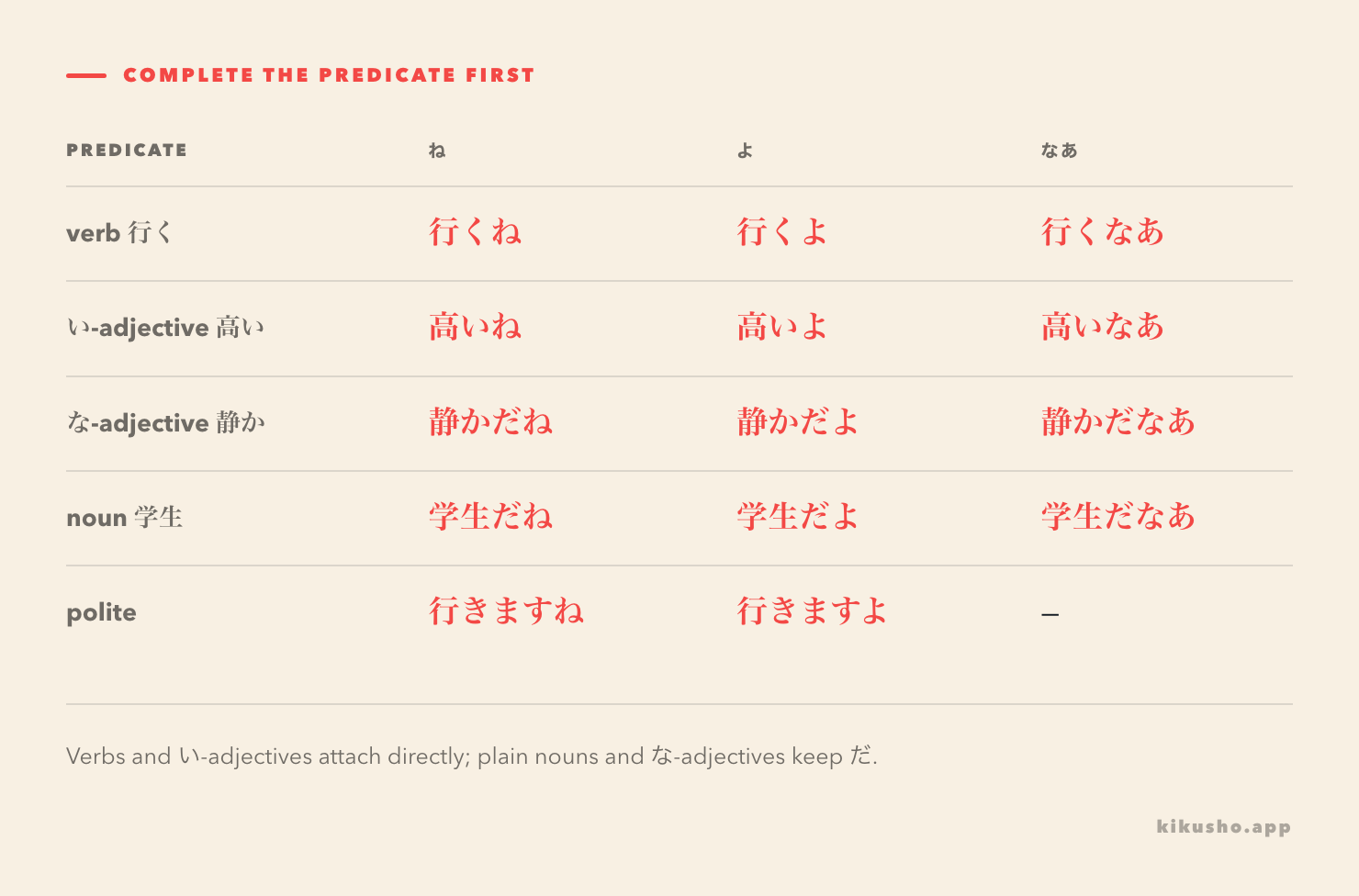
Japanese also has styles that omit だ before sentence-final particles, and their nuance varies. The dependable beginner pattern is 学生だね/学生だよ and 静かだね/静かだよ in plain neutral speech. The です and だ lesson gives the predicate base that these endings build on.
One warning matters immediately: verb dictionary form + な can be a strong prohibition.
- 行くな。 — Don’t go.
- 行きたいなあ。 — I would like to go.
- きれいだなあ。 — How beautiful.
The first is not a shortened reflective なあ. It attaches to the plain verb as a negative command. The other two present a completed statement or feeling before the expressive ending. Situation and delivery make the contrast even clearer.
Intonation can reverse the social effect
The written particle does not record the whole performance. The Japan Foundation contrasts a rising そうですね↑, which can sound like active agreement, with a drawn-out level そうですねえ→, which can signal hesitation. It also contrasts upbeat and falling deliveries of がんばれよ, where encouragement can turn toward blame.
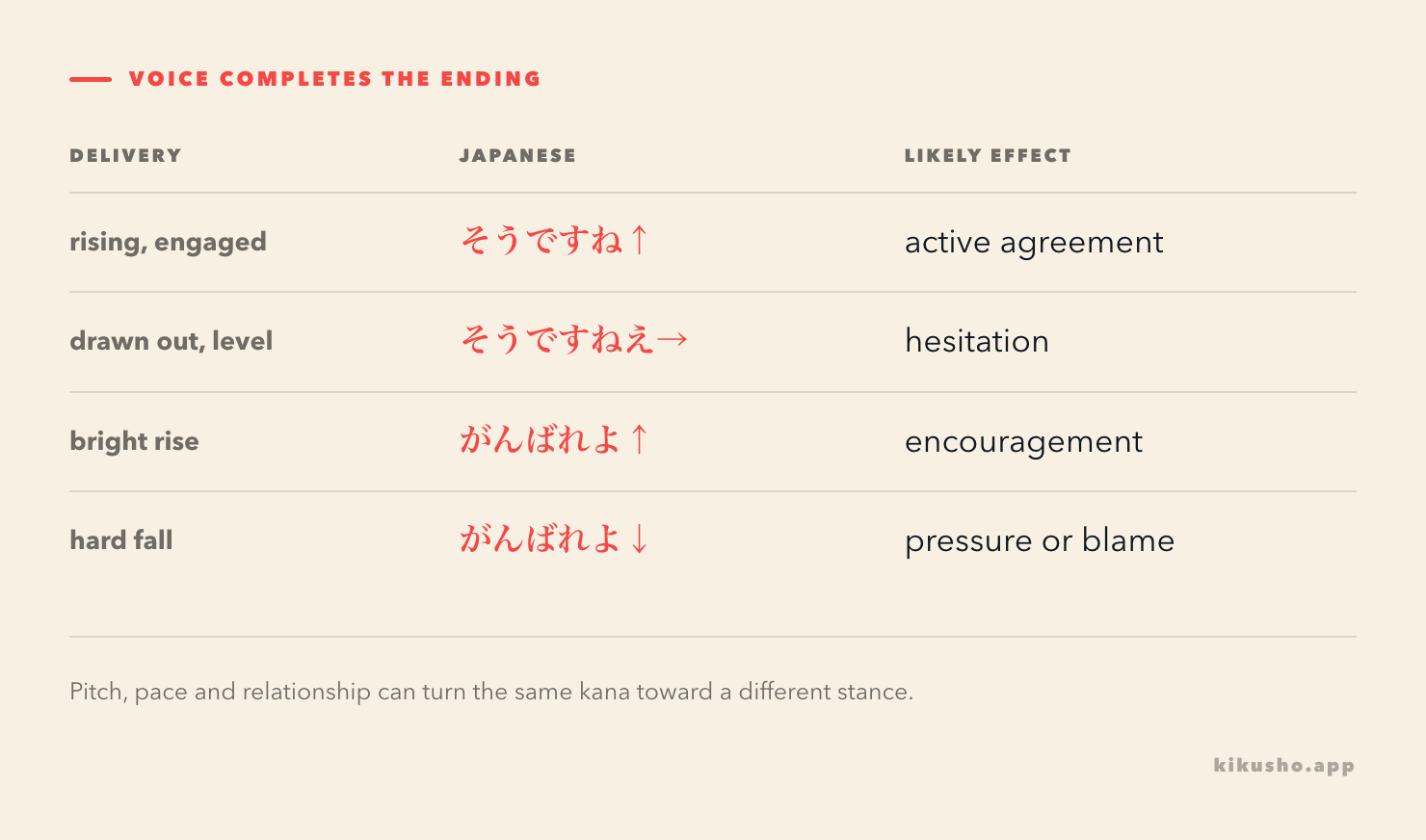
Do not turn those arrows into punctuation rules. Rising ね does not always mean a question, and falling よ does not always sound harsh. Listen for pace, pitch movement, facial expression, relationship and the preceding turn.
The combination よね is a useful boundary case. It presents a stance and asks the listener to align with it: この店、おいしいよね can mean “This place is good, isn’t it?” The speaker is not neutral, but still seeks shared recognition. This lesson keeps practice on the three assigned endings rather than treating every combination as a fourth interchangeable answer.
Sentence endings are easiest to remember inside an exchange. In Kikusho, keep 電車が来ましたよ with the scene in which one person alerts another, or record the full 寒いですね/そうですね pair. The card can retain the register note and audio, so the particle is learned as a turn between people instead of a dictionary gloss.
The N5 label is a study estimate, not a complete map
JLPT Sensei places all three assigned endings at N5, and Bunpro independently lists ね and よ at N5. The curriculum brief records no level disagreement. These labels describe a practical beginner sequence; the JLPT does not publish an exhaustive grammar list.
At N5, recognize the main conversational direction, the standard attachment and the effect of plain versus polite style. Native use grows beyond three boxes because knowledge, relationship and intonation keep changing from turn to turn.
Practice: identify the direction of the turn
Complete every question before opening the shared answer section.
Question 1
Two friends step outside and both feel the cold. Choose the ending that invites shared agreement.
今日は寒い__。
- あ: ね
- い: よ
- う: なあ
- え: か
Question 2
Your friend has not noticed that the bus is here. Choose the most useful ending for the alert.
バスが来た__。
- あ: ね
- い: よ
- う: なあ
- え: まで
Question 3
You are alone looking at a mountain and voice your own admiration. Complete きれいだ__.
- あ: よ
- い: ね
- う: なあ
- え: です
Question 4
Attach ね to 静か, first in neutral plain speech and then in polite speech.
Question 5
Read the exchange. A knows the cake’s ingredients; B does not.
B:このケーキ、辛いですか。
A:いいえ、辛くない__。
Choose the ending that presents helpful information to B.
- あ: ね
- い: よ
- う: なあ
- え: かな
Question 6
Explain the difference between 行くな and 行きたいなあ. Identify which one is a prohibition.
Question 7
Choose the reply that naturally aligns with 今日は暑いですね.
- あ: はい、暑いですよ。
- い: そうですね。
- う: 暑いなあです。
- え: 今日は暑いな。
Answers and explanations
Answer 1
あ: ね. 今日は寒いね treats the cold as mutually available and invites alignment. よ would present the cold toward the listener as information, while なあ would foreground the speaker’s own reaction. か makes a question.
Answer 2
い: よ. バスが来たよ alerts the friend to a change they have not noticed. ね would imply shared noticing or seek confirmation; なあ would sound more like the speaker reflecting on the arrival. まで is not a sentence-final stance particle here.
Answer 3
う: なあ. きれいだなあ voices admiration that can remain with the speaker. ね reaches toward another person, while よ presents the evaluation to them. です would make きれいだです, which incorrectly stacks two copulas.
Answer 4
静かだね and 静かですね. The plain な-adjective predicate uses だ before ね. The polite predicate uses です. 静かなね wrongly uses the noun-modifying な even though no noun follows.
Answer 5
い: よ. 辛くないですよ gives B information that A is in a position to know and that helps B decide about the cake. ね would frame the fact as shared or seek alignment. なあ turns inward, while かな expresses wondering rather than an answer.
Answer 6
行くな is the prohibition “Don’t go”: plain dictionary-form verb plus prohibitive な. 行きたいなあ expresses the speaker’s wish or reflection, “I would really like to go.” Its なあ follows the completed desire predicate 行きたい and carries a drawn-out expressive reaction.
Answer 7
い: そうですね. A speaker has invited agreement about mutually felt weather, and そうですね accepts that shared frame. Choice あ can sound as though the respondent is informing or correcting the first speaker. Choice う stacks forms incorrectly. Choice え is possible as a separate inward reaction, but it does not directly align with the invitation as clearly as い.
The final kana does not change the weather, the bus or the view. It tells the listener whether the sentence is being shared, delivered or felt aloud.
Common questions
What is the difference between ね and よ?
ね treats the sentence as something the speaker wants to align or check with the listener, while よ presents information or a viewpoint toward the listener. Context and intonation decide whether either one sounds warm, insistent or hesitant.
What does なあ mean at the end of a Japanese sentence?
なあ voices the speaker’s own reaction or thought, often admiration, longing or reflection. きれいだなあ can be an inward “That is beautiful,” while きれいだね turns toward the listener for shared recognition.
Do ね and よ only follow casual Japanese?
No. They can follow plain or polite predicates: 行くね and 行きますね, or 静かだよ and 静かですよ. なあ is strongly associated with casual, expressive speech, so beginners should first learn it after plain predicates.
Is sentence-final な the same as the command in 行くな?
No. Expressive な or なあ follows a completed statement, as in きれいだなあ. Verb dictionary form plus prohibitive な makes a strong negative command: 行くな means “Don’t go.” The attachment and situation separate the two.