On this page
Use なる when the subject reaches a new state: 部屋が静かになりました means “The room became quiet.” Use にする/くする when someone chooses an option or acts on something to produce the result: 部屋を静かにしました means “I made the room quiet.”
The endings often share the same noun or adjective, but the sentence changes its viewpoint. なる follows the thing that changes; する follows the person whose choice or action shapes the result.
One result, two views
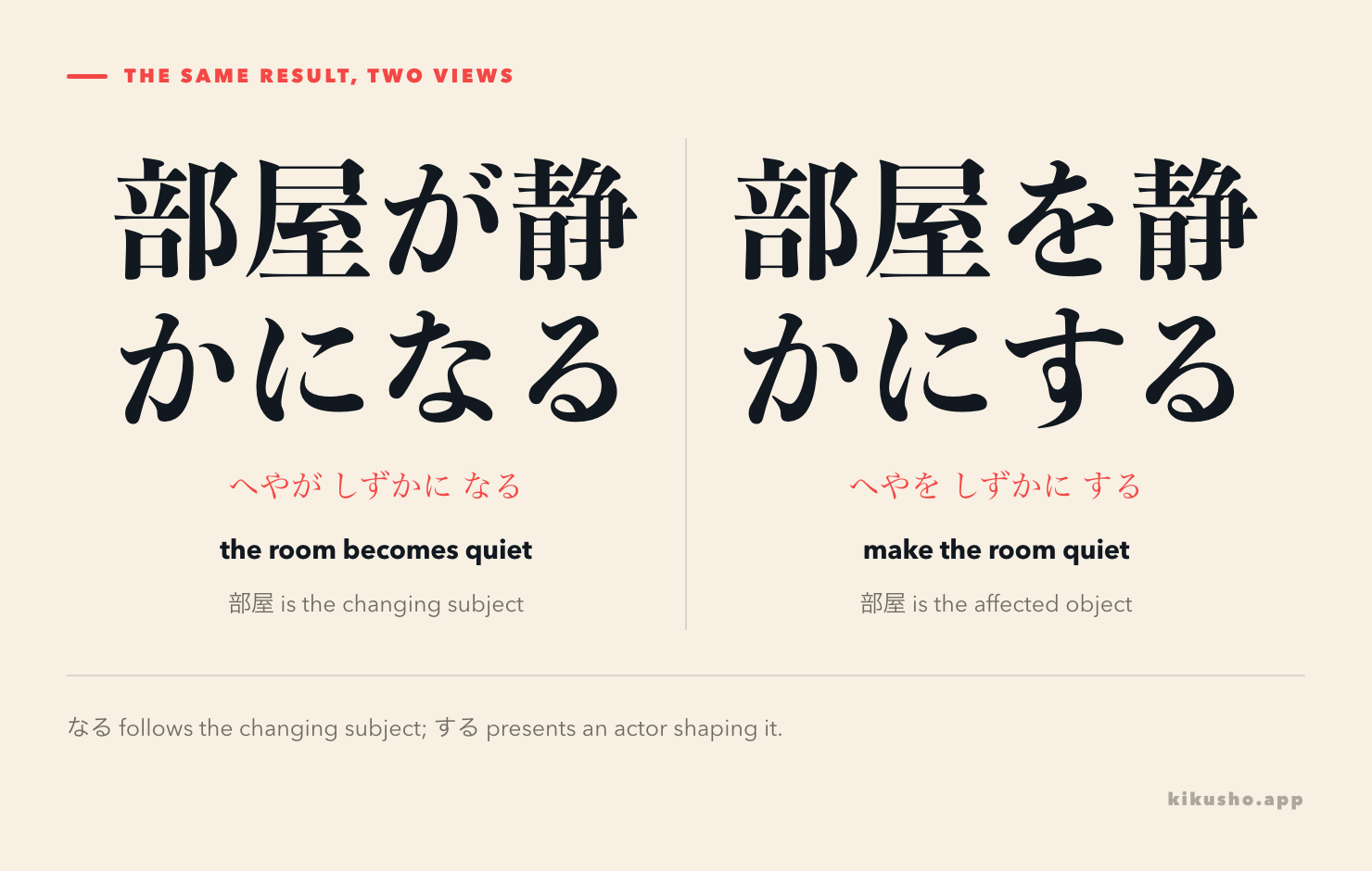
Compare what happens to the room:
部屋が静かになりました。
へやが しずかに なりました。
The room became quiet.
部屋を静かにしました。
へやを しずかに しました。
I made the room quiet.
The first sentence marks 部屋 with が. The room is the subject that reaches the state 静か. The second marks 部屋 with を. Someone acts on the room to make it quiet; Japanese can leave that person unspoken when context identifies them.
| View | Basic frame | What the sentence presents |
|---|---|---|
| change | X が + result + なる | X reaches the result |
| caused change | person は + X を + result + する | the person makes X reach the result |
| choice | option + にする | the speaker selects the option |
The English words become and make are useful starting points. The particles provide a stronger check: look for the changing が subject with なる, or an affected を object with する.
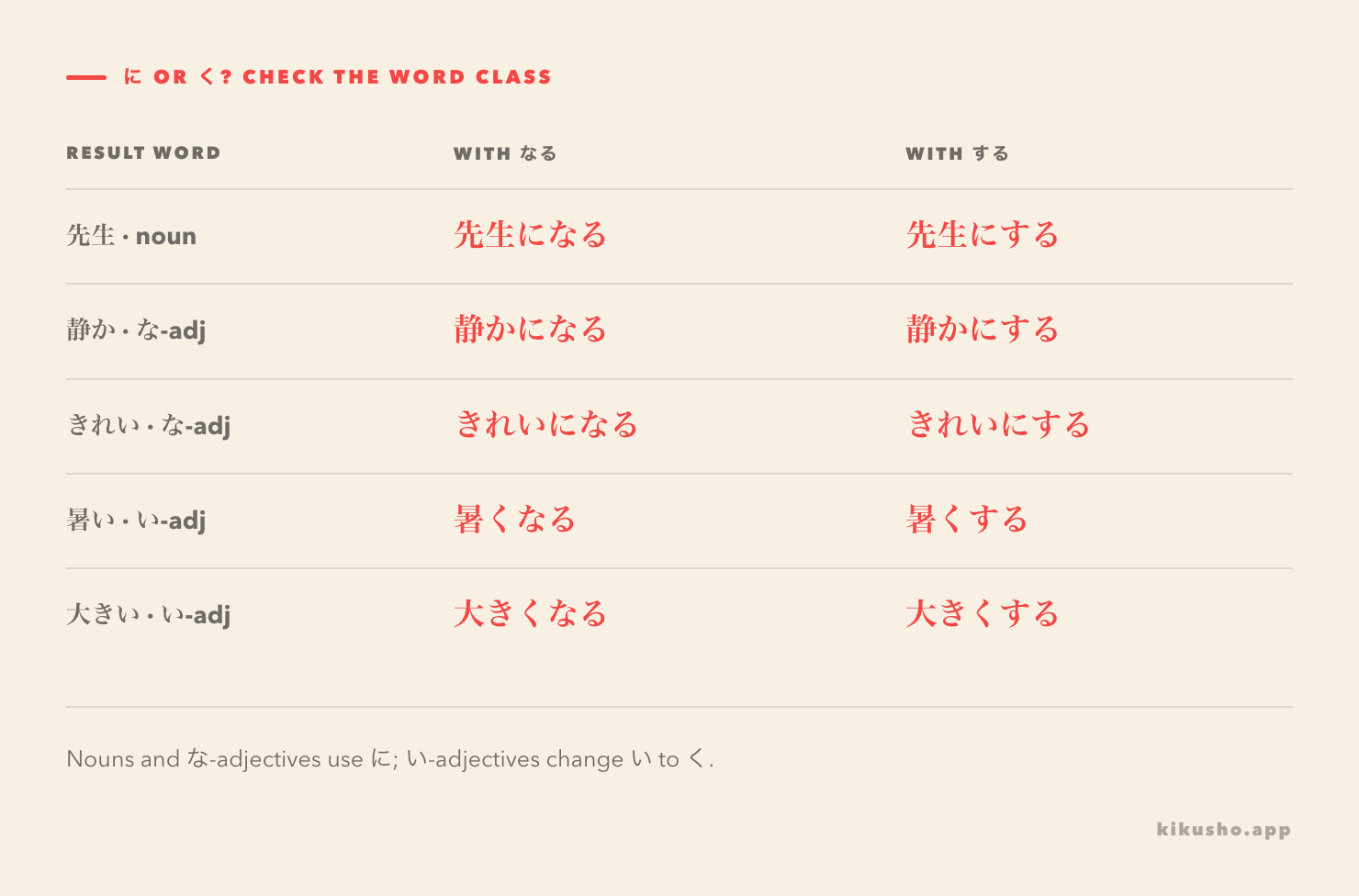
Nouns and な-adjectives use に
With a noun or な-adjective, place に before either verb. Do not carry the attributive な into this position.
| Result word | With なる | With する |
|---|---|---|
| 先生, teacher | 先生になる | 子どもを先生にする |
| 元気, healthy / well | 元気になる | 人を元気にする |
| 静か, quiet | 静かになる | 部屋を静かにする |
| きれい, clean / beautiful | きれいになる | 机をきれいにする |
静かな部屋 uses な because 静か directly modifies the noun 部屋. 部屋が静かになる instead turns the adjective into the endpoint of a change, so it uses に. Forms such as × 静かななる and × 静かくなる mix the two adjective classes.
来年、兄は先生になります。
らいねん、あには せんせいに なります。
Next year, my older brother will become a teacher.
この音楽を聞くと、元気になります。
この おんがくを きくと、げんきに なります。
When I listen to this music, I feel better.
JLPT Sensei's なる reference classifies the grammar as N5 and gives noun/な-adjective + になる. Tofugu's independently written なる guide explains that に marks the endpoint reached by a noun or な-adjective change.
い-adjectives change い to く
An い-adjective does not take に here. Remove its final い, add く, and then use なる or する.
| Dictionary adjective | Change | Caused change |
|---|---|---|
| 暑い(あつい) | 暑くなる | 部屋を暑くする |
| 安い(やすい) | 安くなる | 値段を安くする |
| 明るい(あかるい) | 明るくなる | 部屋を明るくする |
| 大きい(おおきい) | 大きくなる | 写真を大きくする |
午後は暑くなりました。
ごごは あつく なりました。
It became hot in the afternoon.
写真をもう少し大きくしてください。
しゃしんを もうすこし おおきく してください。
Please make the photo a little bigger.
The い-adjective く-form reference from Tofugu checks both routes. Its なる discussion presents a change whose causer is unclear or unimportant; its する discussion presents a willful change. The visible endings match, but なる and する choose the viewpoint.
なる does not prove the change was accidental
It is tempting to memorize “なる = natural” and “する = intentional.” That shortcut predicts many beginner examples but overstates the difference.
毎日勉強して、医者になりました。
まいにち べんきょうして、いしゃに なりました。
I studied every day and became a doctor.
Becoming a doctor may involve years of deliberate effort. なる still fits because the sentence presents the person's resulting role. It does not need to say that the change happened by accident.
Likewise, 部屋が静かになりました may follow someone's intentional decision to turn off the television. The sentence simply does not make that actor part of its grammatical frame. If the action itself matters, テレビを消して、部屋を静かにしました presents the person making the room quiet.
Read なる as “the subject reaches a new state.” Then let context tell you whether nature, time, effort, another person or a deliberate plan caused it.
にする selects an option
With a menu item, colour, date or other alternative, noun + にする marks the option the speaker chooses.
飲み物は何にしますか。
のみものは なにに しますか。
What will you have to drink?
コーヒーにします。
コーヒーに します。
I'll have coffee.
No object needs to change shape. The set of possible drinks supplies the contrast, and the speaker settles on coffee. これにします, “I'll choose this one,” works the same way when pointing to an item.
JLPT Sensei's にする lesson labels the noun choice pattern N5 and distinguishes casual にする from polite にします. Bunpro's N5 entry connects choice with the speaker's control over the outcome. Tofugu's する reference independently gives どれにする and a menu answer as ordinary selection language.
The same する can produce a state rather than merely select an item:
会議は金曜日にします。
かいぎは きんようびに します。
We'll set the meeting for Friday.
会議室をきれいにします。
かいぎしつを きれいに します。
I'll make the meeting room clean.
Friday is the chosen setting for the meeting. In the second sentence, the room is an object whose condition someone changes. The shared idea is an actor determining the outcome.
Conjugate the final verb
なる and する carry the tense, negation and politeness of the whole expression. Keep the result word in its connecting form.
| Meaning | なる route | する route |
|---|---|---|
| plain non-past | 静かになる | 静かにする |
| polite non-past | 静かになります | 静かにします |
| plain past | 静かになった | 静かにした |
| polite past | 静かになりました | 静かにしました |
| plain negative | 静かにならない | 静かにしない |
Do not make the noun or adjective polite in the middle. 先生になります is polite because なる becomes なります; × 先生ですになる inserts a finished copular sentence where the result slot belongs.
Keep verbs outside this N5 attachment pattern
The direct patterns in this lesson take a noun or adjective result. When the chosen content is an action, nominalize it with こと:
電車で行くことにしました。
でんしゃで いくことに しました。
I decided to go by train.
× 行くにしました does not express that decision in the standard pattern. The separate ことにする and ことになる comparison distinguishes a person's decision from an arrangement or outcome.
Similarly, an ability or habit change uses ようになる, as in 日本語が読めるようになりました, “I became able to read Japanese.” The ようになる lesson covers that verb attachment. This N5 lesson stays with direct noun and adjective results.
Both inventory entries and Bunpro place the assigned patterns at N5. The official JLPT FAQ says that the test no longer publishes an exhaustive vocabulary, kanji or grammar specification, so N5 is a study placement rather than a guaranteed list of test items.
If you capture 会議室が静かになりました in Kikusho, keep the particle and the final verb on the card. A card that stores only 静か loses whether the room changed, someone changed it, or it was simply quiet. The complete sentence preserves the viewpoint you need to retrieve later.
Practice: identify the changing subject and the chooser
Answer all seven questions before reading the explanations. Check the word class, the particle and the final verb each time.
Question 1
Choose the sentence that means “The room became clean.”
- た: 部屋がきれいになりました。
- ち: 部屋をきれいにしました。
- つ: 部屋がきれいにしました。
- て: 部屋をきれいになりました。
Question 2
Complete “It got cold at night.”
夜、__。
- た: 寒いになりました
- ち: 寒くなりました
- つ: 寒いにしました
- て: 寒くにしました
Question 3
At a café, choose the natural polite reply meaning “I'll have tea.”
- た: お茶になります
- ち: お茶にします
- つ: お茶をなります
- て: お茶がします
Question 4
Arrange every chunk once to say “Please make the text a little bigger.”
少し / 文字を / 大きくしてください
Question 5
Read the situation and choose the sentence that reports the result without naming a person who caused it.
雨がやみました。公園は__。
- た: 静かになりました
- ち: 静かにしました
- つ: 静かなりました
- て: 静かくなりました
Question 6
Which sentence correctly says “I decided to go by bus” and keeps a verb action outside the direct noun choice pattern?
- た: バスで行くにしました。
- ち: バスで行くことにしました。
- つ: バスで行きにしました。
- て: バスで行くになりました。
Question 7
Explain how the viewpoint differs in these two sentences.
子どもが元気になりました。
音楽が子どもを元気にしました。
Answers and explanations
Answer 1
た: 部屋がきれいになりました. が + result + なる presents the room reaching a clean state. Choice ち means someone made it clean. Choices つ and て cross the subject or object frame with the wrong final verb.
Answer 2
ち: 寒くなりました. 寒い is an い-adjective, so its final い changes to く before なる. It does not take に. The sentence reports the weather reaching a colder state.
Answer 3
ち: お茶にします. The speaker chooses tea from the café's options. お茶になります would say that something becomes tea, which is not the intended order.
Answer 4
文字を少し大きくしてください is the complete sentence. 文字 is the object to be changed, 少し gives the degree, and 大きい becomes 大きく before する. してください turns that caused-change expression into a polite request.
Answer 5
た: 静かになりました. The park is the understood subject that became quiet after the rain stopped. Choice ち requires an actor who made something quiet, while choices つ and て use the wrong adjective attachment.
Answer 6
ち: バスで行くことにしました. A plain verb action takes ことにする when the speaker decides to perform it. Direct noun choice can use バスにしました in a suitable context, but 行くにしました does not attach the assigned pattern correctly.
Answer 7
子どもが元気になりました presents the child reaching a healthy or cheerful state. 音楽が子どもを元気にしました names music as the cause and marks the affected child with を. The result 元気 is the same; the final verb determines whether the sentence views the change through the child or through its cause.
Common questions
What is the difference between なる and にする?
なる reports that the subject reaches a new state: 部屋が静かになる means the room becomes quiet. する presents someone choosing or causing the result: 部屋を静かにする means someone makes the room quiet. A noun choice such as コーヒーにする means “I'll choose coffee.”
Do い-adjectives take に before なる and する?
No. Remove the final い and add く: 寒い becomes 寒くなる, “get cold,” and 安い becomes 安くする, “make it cheaper.” Nouns and な-adjectives use に, as in 先生になる, 元気になる and 部屋をきれいにする.
Does なる always describe an accidental or natural change?
No. なる presents the new state without naming a causer in the grammar, but the change can still follow effort or intention. 医者になりました can describe a goal someone deliberately achieved. Use the sentence and context to identify the cause.
Can にする follow a verb directly?
The N5 choice pattern taught here follows a noun, as in お茶にします. To say that you decide to perform an action, use a plain verb plus ことにする, such as 行くことにする. That is a separate construction; 行くにする is not its standard replacement.