On this page
You have probably learned that の is Japanese for the possessive 's: 私の本 (わたしのほん) is my book, 田中さんの車 is Tanaka's car. That rule holds right up until 日本語の先生, which is not "Japanese's teacher," and 東京の店, which nobody owns. の joins one noun to another, and possession is only the most famous of the relationships that join can carry.
What the particle marks is broader: the noun on the right belongs with, comes from, is made of, or is described by the noun on the left. English reaches for a different word each time; Japanese uses の for all of them. So getting の right is mostly a matter of seeing past the "'s" you were handed first.
How の attaches, and which noun comes first
の sits between two nouns and never changes shape. No conjugation, no agreement, no plural: 私の本, 猫の名前 (the cat's name), 学校の先生 (the school's teacher) are the same one-kana join every time. The only thing you have to get right is the order.
The possessor, or more broadly the describer, comes first: N1 の N2 means "the N2 of N1," not the reverse. 私の本 is my book, never "the book's owner." That lines up with English possession (my book, the cat's name), which makes the order easy to trust until you hit a phrase where English would use "of" and flip it: 会社の社長 is "the president of the company," with 会社 still in front.
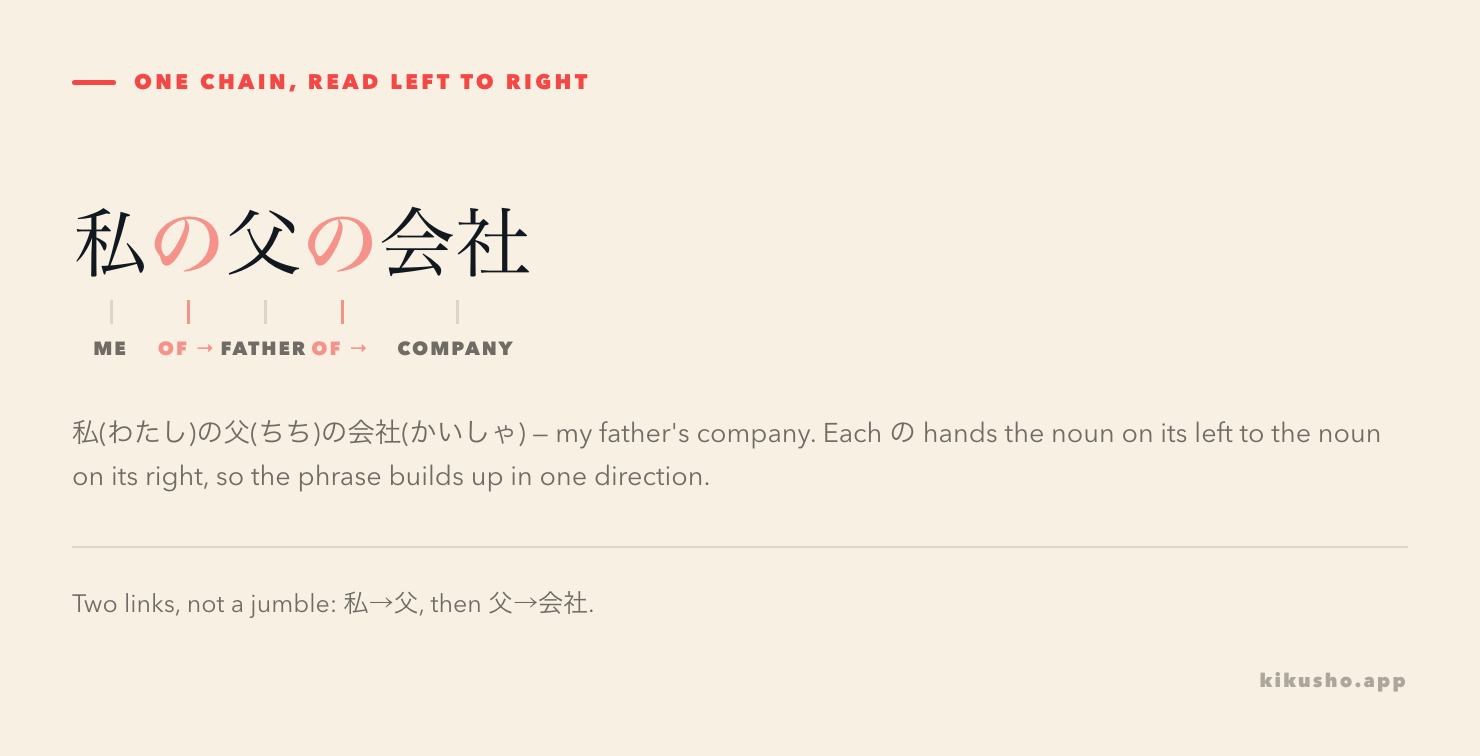
の also chains. 私の父の会社 is my father's company, and you read it left to right, each の handing the noun before it to the noun after: 私 to 父, then 父 to 会社.
Possession is the famous job, not the definition
Line the relationships up and possession turns out to be one entry on a longer list.
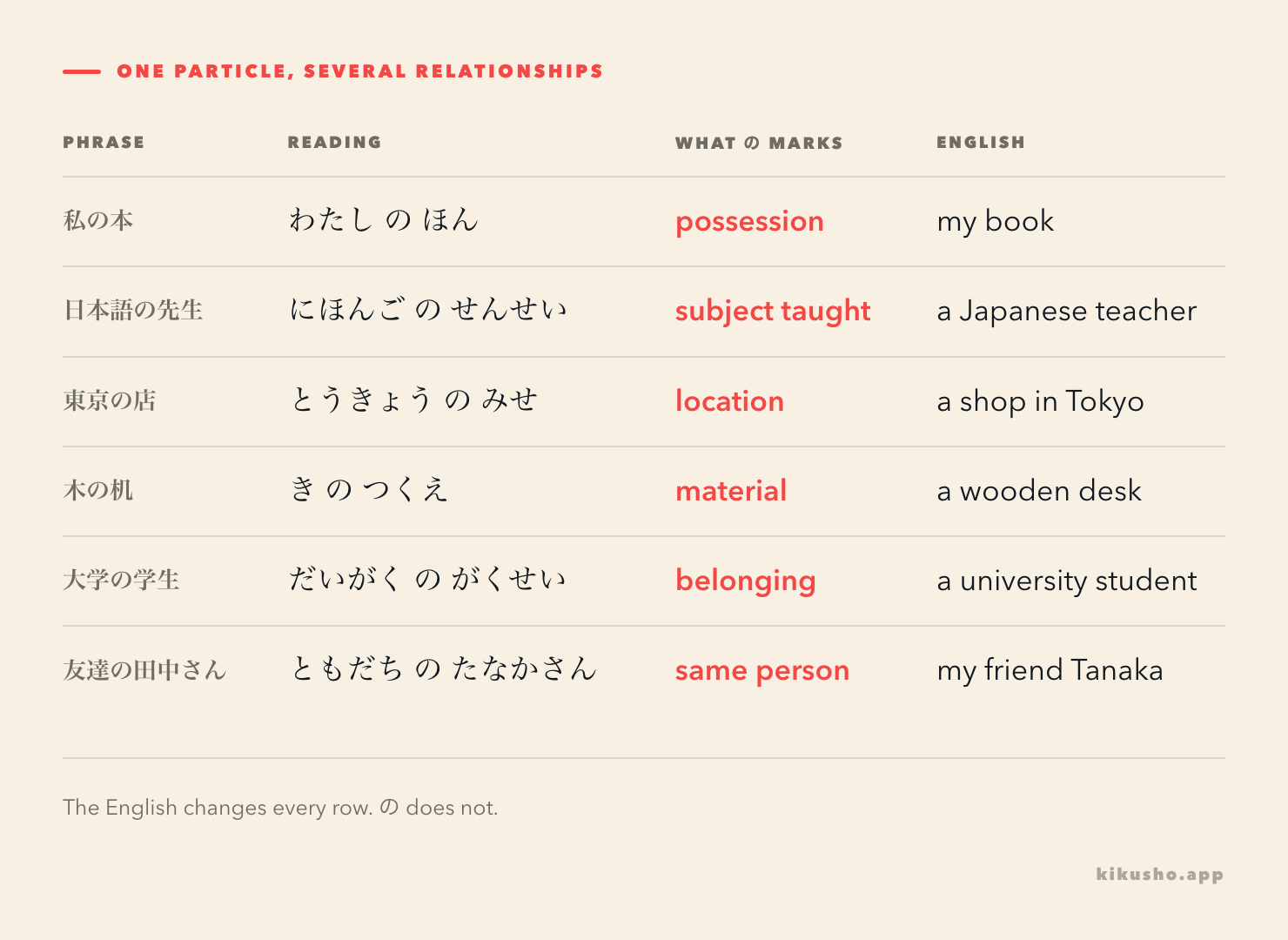
- 私の本 is ownership in the plain sense: the book is mine.
- 日本語の先生 is not. The teacher does not own Japanese; 日本語 says what they teach. の here means "of the subject," the way "a history book" works.
- 東京の店 is location: a shop in Tokyo.
- 木の机 is material: a desk made of wood.
- 大学の学生 is belonging: a student of the university.
- 友達の田中さん is apposition, the one people miss: 友達 and 田中さん are the same person, "my friend Tanaka," not "the Tanaka my friend owns."
You never have to name which relationship you are using, and that is the whole convenience of の: one particle spares you the choice English forces between 's, of, in, from and made of. When you read 本日のスープ (today's soup) on a menu, you are not parsing "today's" as ownership; you are reading の doing what it always does, gluing 本日 to スープ.
The phrases where の does this connecting work are the ones you read straight past on a sign or a menu: 本日のスープ, 東京の店, 駅の前 (in front of the station). Photograph one, or paste the text, and Kikusho returns the whole phrase as a card with its reading and a spoken example, then files it into a review schedule that runs with no signal at all. The free plan meters only new captures, five a day; anything you have already saved stays reviewable for good.
の joins nouns, so an adjective never takes it
Here is the line that stops の from being a general-purpose describing particle: it connects nouns, and only nouns. A describing word that is an adjective joins its noun a different way.
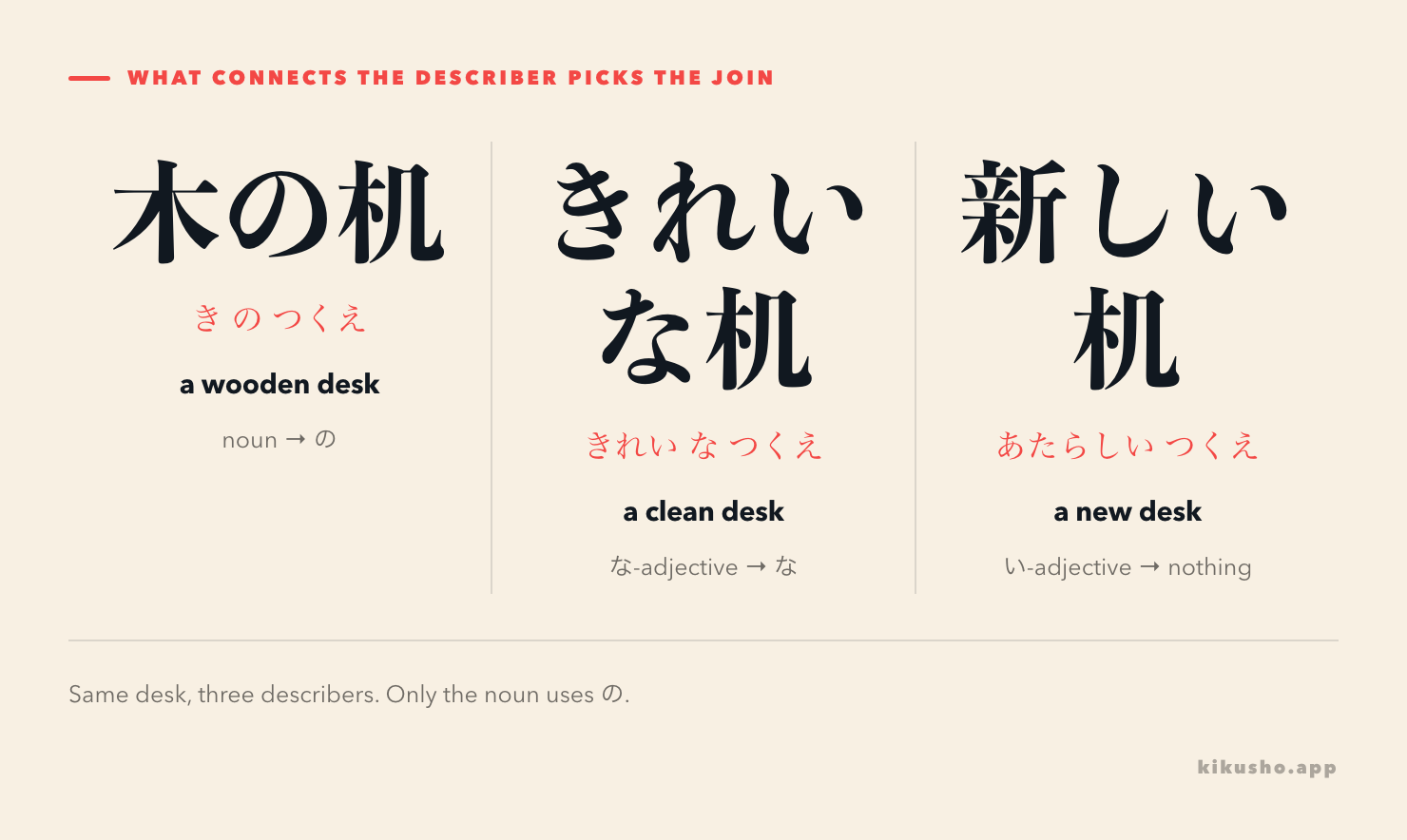
A な-adjective attaches with な, not の: きれいな机 (a clean desk), 静かな部屋 (a quiet room), 有名な人 (a famous person). An い-adjective attaches with nothing at all: 新しい机 (a new desk), 高い山 (a tall mountain), おいしい寿司 (good sushi). Put の in either slot, きれいの机 or おいしいの寿司, and it is wrong in a way a native ear catches on the spot.
The catch is that some words translate into English adjectives but are grammatically nouns. 病気 means "illness," so "a sick person" is 病気の人 — の, because 病気 is a noun. 元気 looks parallel in English ("well," "energetic") but is a な-adjective, so "a healthy child" is 元気な子, never 元気の子. English gives you no way to tell 病気 and 元気 apart. The Japanese part of speech does, and it is worth a dictionary check for any word you are unsure of.
When the second noun disappears, の stays behind
Drop the noun after の and の keeps its place. これは私の本です (this is my book) shortens to これは私のです, "this one's mine," once 本 is understood. の now stands in for the noun it used to attach to, and 私の on its own means "mine."
This is also the one place a describing word sits directly in front of の. 赤いの means "the red one"; 大きいの, "the big one." The い-adjective still attaches to nothing; の is not joining it to a noun, it is replacing the noun that would have followed. That is why 赤い花 (a red flower) and 赤いの (the red one) are both fine while 赤いの花 stays wrong: の is the noun's stand-in or it is absent, never an extra link. A な-adjective does the same, keeping its な: きれいなの, "a pretty one."
The mistake that gives a beginner away
The error runs in two directions, and each points at a different gap. Reaching for の after a describing word, 有名の人 or おいしいの寿司, means you have taken an adjective for a noun, and the fix is to check the word's type rather than memorise the phrase. Dropping の between two nouns, 私本 for 私の本, is rarer and lands as a non-word, the join simply gone. Both are audible the instant they are said, because の is not a particle you can be approximately right about: the join is there or it is not.
Three sentences to test the rule
Question 1. Which fills the blank in 静か__部屋 (a quiet room)?
a) な b) の c) い d) を
Answer 1: な. 静か is a な-adjective, so it attaches with な: 静かな部屋. (b) の is the trap this lesson is about, treating 静か as if it were a noun. (c) い would only belong to an い-adjective, and 静か is not one. (d) を is the object particle, a different job entirely.
Question 2. Put the four pieces in order to mean "This is my Japanese teacher," then say which piece lands on ★.
これは __ __ _★_ __ です。
先生 ・ 日本語 ・ の ・ 私の
Answer 2: の. The order is 私の → 日本語 → の → 先生, giving これは私の日本語の先生です。私の modifies the whole phrase, and the second の (the ★ slot) joins 日本語 to 先生. Putting 先生 or 日本語 on ★ breaks the chain into a non-phrase.
Question 3. Fill blanks ①②③ in this passage with の, な or nothing.
田中さんは日本語_①_先生です。有名_②_人で、東京_③_大学で教えています。 (Tanaka is a Japanese teacher. He's a famous person, and teaches at a university in Tokyo.)
Answer 3: の, な, の. ① 日本語 and 先生 are both nouns, so の joins them: a teacher of the subject Japanese, not possession. ② 有名 is a な-adjective, so it takes な, not の; 有名の人 is the classic slip. ③ 東京 and 大学 are nouns, so の again, this time marking location: a university in Tokyo.
Once の stops reading as "'s" and starts reading as "the noun on the left belongs with the noun on the right," the harder particle questions get easier, because they are the same kind of question: not what a word means, but what job it is doing. That is the ground は and が fight over, and, alongside the verb groups, it is where most of N5 grammar actually lives.
Common questions
Does the particle の always mean possession?
No. の joins two nouns, and possession is only one of the relationships that join can carry. 日本語の先生 is "a Japanese teacher," where 日本語 is what is taught, not something the teacher owns; 東京の店 is a shop in Tokyo (location); 木の机 is a desk made of wood (material). One particle covers what English splits between 's, of, in, from and made of.
Why is 元気の人 wrong but 病気の人 right?
Because 病気 (illness) is a noun and 元気 (well, energetic) is a な-adjective. の joins nouns, so 病気の人, "a sick person," is correct, while a な-adjective takes な: 元気な人. Both words translate as English adjectives, so the only reliable guide is the Japanese part of speech, which a dictionary marks directly.
Can you use の more than once in one phrase?
Yes. の chains: 私の父の会社 is "my father's company." Read it left to right, each の handing the noun on its left to the noun on its right. Two or three links is everyday; past four the phrase gets heavy and a speaker breaks it up.
What does 赤いの mean if の can't follow an adjective?
In 赤いの, の is not joining two nouns — it is standing in for a missing one. 赤いの means "the red one," where the noun (say 花) has been dropped and の holds its place. That is why 赤い花 and 赤いの are both correct, but 赤いの花 is not.