On this page
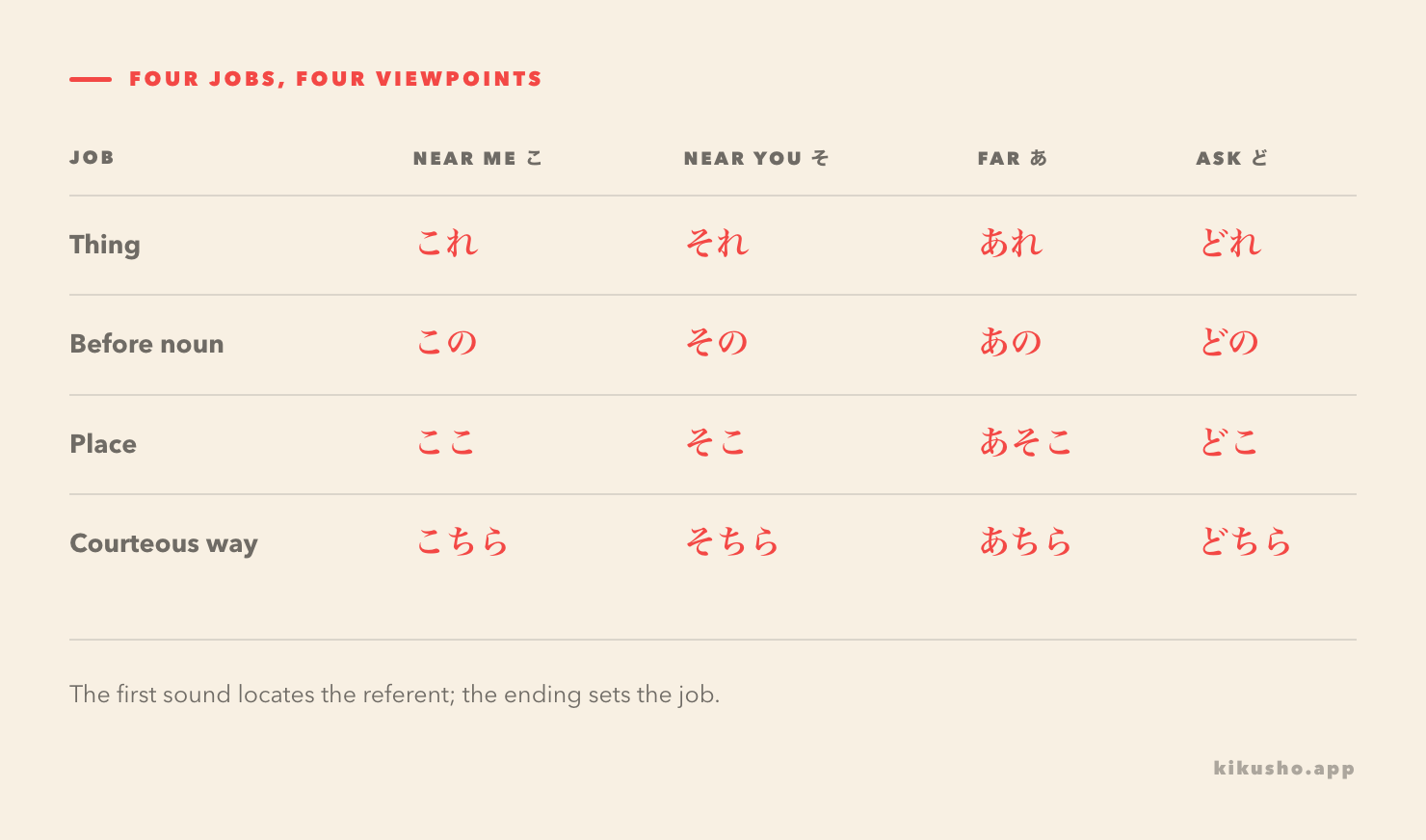
これ is “this one” near the speaker, それ is “that one” by the listener, あれ is “that one” away from both, and どれ asks “which one?” The first sound changes with the viewpoint; the ending changes the job. That same four-way pattern gives この・その・あの・どの before a noun, ここ・そこ・あそこ・どこ for places, and こちら・そちら・あちら・どちら for direction and courteous reference.
Why these sixteen words belong together
At N5, memorize the set as a grid with two decisions. First ask whose side the thing is on: こ near me, そ near you, あ away from us, ど for a question. Then ask what kind of word the sentence needs: a thing on its own, a word before a noun, a place, or a direction. The Japan Foundation's original demonstrative teaching chart lays out precisely these four rows. An independently authored guide at Tofugu confirms the patterns and the extensions.
English has one “that” for both それ and あれ; Japanese asks whether the referent belongs to the listener's area or sits outside both people's area. When people switch speaking roles, the same object can change words. If I hold a pen and ask これはいくらですか, the person looking at my pen may answer それは千円です. The pen did not move; the speaker changed. Mango Languages' Japanese demonstrative guide uses a store scene to check that shift. These spatial rules are the dependable first pass; in a story, その can pick up something newly mentioned and あの can recall something both people already know.
The set itself
| Job | Near speaker: こ | Near listener: そ | Away from both: あ | Question: ど |
|---|---|---|---|---|
| Thing on its own | これ | それ | あれ | どれ |
| Before a noun | この | その | あの | どの |
| Place | ここ | そこ | あそこ | どこ |
| Direction / courteous | こちら | そちら | あちら | どちら |
The sixteen assigned words all use hiragana as their ordinary written form. Readings match the spelling. Their class matters because two words with the same English gloss cannot always fill the same position. The short phrases below are collocations you can retrieve, not extra definitions.
| Word / reading | Class | Sense in this set | Short phrase |
|---|---|---|---|
| これ(これ) | thing pronoun | this one | これは本です: this is a book |
| それ(それ) | thing pronoun | that one by you | それは本です: that is a book |
| あれ(あれ) | thing pronoun | that one over there | あれは本です: that over there is a book |
| どれ(どれ) | thing question pronoun | which one? | どれが本ですか: which one is the book? |
| この(この) | noun modifier | this … | この本: this book |
| その(その) | noun modifier | that … by you / mentioned | その本: that book |
| あの(あの) | noun modifier | that … over there / shared | あの本: that book over there |
| どの(どの) | question noun modifier | which …? | どの本: which book? |
| ここ(ここ) | place pronoun | here | ここにあります: it is here |
| そこ(そこ) | place pronoun | there by you | そこにあります: it is there |
| あそこ(あそこ) | place pronoun | over there | あそこにあります: it is over there |
| どこ(どこ) | place question pronoun | where? | 本はどこですか: where is the book? |
| こちら(こちら) | direction / courteous pronoun | this way; here; this person | こちらへどうぞ: this way, please |
| そちら(そちら) | direction / courteous pronoun | that way; there by you | そちらへ行きます: go that way |
| あちら(あちら) | direction / courteous pronoun | that way over there | あちらにあります: it is over there |
| どちら(どちら) | direction / courteous question | which way?; polite where? | トイレはどちらですか: where is the bathroom? |
The full four-row chart and the courteous-person use are documented by the Japan Foundation; the MLC Japanese Language School N5 page independently labels the thing and noun rows N5. Tofugu's こちら-series guide confirms the direction and courteous senses.
The pattern that runs through the rows
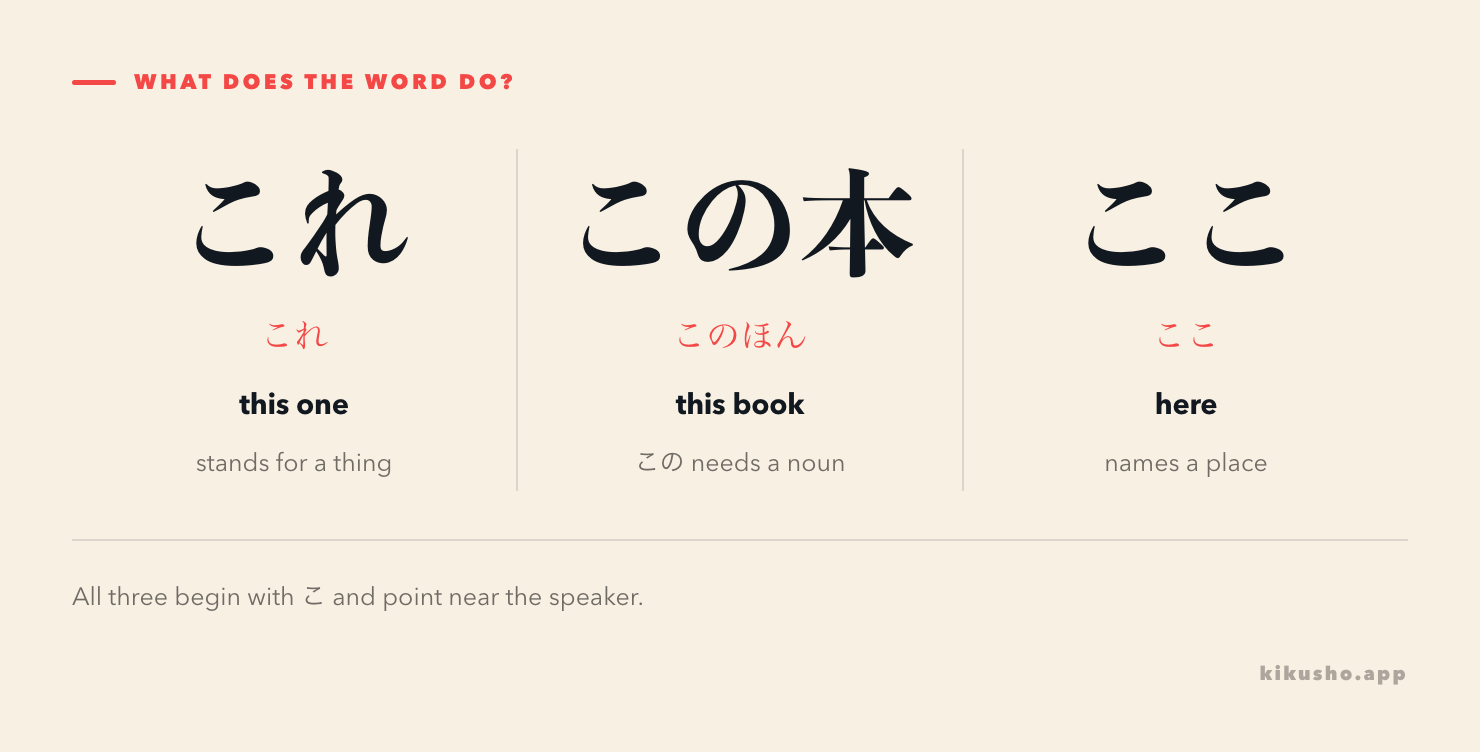
これ and この share こ because both point near the speaker. Their endings decide how they attach. これは本です stands alone as the topic; この本は新しいです puts この immediately before 本. The same is true of それ/その and あれ/あの. どれがいいですか asks which one, whereas どの本がいいですか asks which book. The question form どれ usually appears with が when it identifies one of a set; どれは is not the normal way to pose that selection question. MLC's N5 examples and St. Olaf College's Genki teaching page independently give the standalone forms and the question pattern.
Place words answer a different question: 本はどこですか asks where, so an answer can be ここです, そこです or あそこです, depending on where the speaker stands. あそこ names a location; あれ names a thing. Telling a visitor こちらへどうぞ chooses a courteous direction rather than simply naming a spot. The Japan Foundation's chart separates location and direction, and Tofugu's fuller lesson describes how the direction row also points to a person, group or object.
The words that break a simple distance rule
The そ series does more than mark physical nearness to the listener. If I tell you about a book you have not seen, その本 can mean “the book I just mentioned,” even though it is not beside either of us. If we both remember a trip, あの場所 can mean “that place we both know” without a point in front of us. Mango's original examples distinguish the listener-new その reference from shared あの memory. Begin with physical position for visible objects and add this conversational use after the grid is secure.
どちら changes its English gloss with the question. トイレはどちらですか is a courteous “where is the bathroom?”; 右と左、どちらですか asks “which way, right or left?” It can also choose between two things. どれ ordinarily chooses an item among several, while どちら is the natural two-choice form. Tofugu's original こちら-series guide makes those boundaries explicit. The informal こっち・そっち・あっち・どっち are related contractions; this N5 set teaches the full forms first.
The written あの can also be a hesitation before speaking, like “um…”; that is a different use from あの本. そこ can mean the bottom of something in another context. A beginner's demonstrative grid teaches the pointing uses assigned here, not every dictionary sense of identical hiragana.
Which ones you will meet this month
On a menu, これ is useful when you point to an item without saying its name; この料理 works when you do say the noun. At a station, どこ asks for a location and こちら is what a staff member may say to direct you. A screenshot of a message containing その本 carries the earlier mention that made その meaningful; saving only the isolated word would lose it. Kikusho lets you keep a phrase you encounter, check its reading and revise its card before it enters your review. The N5 question-word lesson helps with the ど forms once you know what each row asks.
Check yourself
Question 1: situation. You are speaking. A pen is beside your listener, away from you. Which standalone thing word points to it?
- A. これ
- B. それ
- C. あれ
- D. どれ
Question 2: word class. A book is in your hand. Complete __本は新しいです with the pointing word that goes immediately before 本.
- A. これ
- B. この
- C. ここ
- D. こちら
Question 3: question form. Three pens are on a desk. Complete __があなたのペンですか to ask “Which one is your pen?”
- A. どこ
- B. どの
- C. どれ
- D. どちら
Question 4: place. The station is visible far from both you and your listener. Reply to 駅はどこですか with one short Japanese sentence meaning “It is over there.”
Question 5: courteous direction. A staff member points a visitor toward the counter on the staff member's side. Complete the courteous direction phrase __へどうぞ.
Question 6: reference in a conversation. You mention a book that your listener has not seen. In the next sentence, which modifier means “that book I mentioned”? Write the two-word Japanese phrase.
Answers and explanations
Answer 1. B, それ. The pen is on the listener's side. これ would be near the current speaker; あれ would be away from both; どれ asks which one.
Answer 2. B, この: この本は新しいです. この sits before a noun. これは stands alone; ここ names a place; こちら primarily points to a direction or politely to a referent.
Answer 3. C, どれ: どれがあなたのペンですか. The question asks which one among three things. どの needs a following noun, どこ asks where, and どちら is the usual two-choice form.
Answer 4. あそこです。 The question asks for a place, and the station is far from both people. あれ would point to a thing rather than to a location.
Answer 5. こちら: こちらへどうぞ. The counter is on the current speaker's side, and the full こちら form gives a courteous “this way.” こっち is a casual relative, outside the polite phrase asked for.
Answer 6. その本. The book has just entered the conversation as new information for the listener; その picks it up before the noun. あの本 is more natural when both people already share the remembered referent.
The next time “that” appears in an English translation, locate both people first, then decide whether the Japanese sentence needs a thing, a noun modifier, a place or a direction. The answer lies in the two parts of the word.
Common questions
What is the difference between それ and あれ?
それ points toward the listener's side or to something just mentioned; あれ points away from both people, or to something both already know. For visible objects, begin with near-listener versus far-from-both.
Can この stand alone like これ?
No. これ can stand for a thing; この must come immediately before a noun, as in この本. The same distinction holds for それ/その and あれ/あの.
Does どちら mean where or which?
Both are possible. It politely asks where or which way in location and direction questions; with two choices, it can mean which one.