On this page
鍵はテーブルの上にあります(かぎは テーブルの うえに あります) means “The key is on the table.” This ten-word N5 home vocabulary set lets you name the building, follow its stairs and corridor, and identify the doors, furniture, lights and refrigerator you use inside it.
The building and the things inside it form one route
Start with 建物, the structure. 階段 connects different heights; 廊下 connects rooms. At a 戸, you may need a 鍵. Inside, a テーブル, 時計, ベッド and 冷蔵庫 are things you can locate, while 電気 acquires its useful everyday sense from what you do with it.
These words extend the home and classroom set, which already covers 家, 部屋, 机, ドア and other foundations. Here those earlier words supply context. The new list does not replace that lesson or claim to teach every noun associated with a Japanese home.
The independently authored TUFS basic-vocabulary module places かぎ with home words, 電気 and 時計 with room words, and テーブル, ベッド and 冷蔵庫 with tools and furniture. Its learning guide treats recognising a word and using its collocations as related tasks. The phrases below give each noun something to do.
Ten nouns keep their reading and their phrase
All ten assigned headwords are nouns in the uses taught here. The kana column records pronunciation, including for the two words normally written in katakana.
| Headword | Reading | Sense in this set | Useful phrase |
|---|---|---|---|
| 階段 | かいだん | Stairs; a staircase | 階段を上がる(かいだんをあがる): go up the stairs |
| 鍵 | かぎ | Key; also a lock | 鍵をかける(かぎをかける): lock up |
| 建物 | たてもの | Building; a structure for living, work or storage | この建物(このたてもの): this building |
| テーブル | てーぶる | Table as furniture | テーブルの上(テーブルのうえ): on the table |
| 電気 | でんき | Electricity or electric power; an electric light | 電気をつける(でんきをつける): switch on the light |
| 戸 | と | Door; a fitting that opens and closes | 戸を閉める(とをしめる): close the door |
| 時計 | とけい | Timepiece: clock or watch | 時計を見る(とけいをみる): look at the clock or watch |
| ベッド | べっど | Bed | ベッドで寝る(ベッドでねる): sleep in a bed |
| 冷蔵庫 | れいぞうこ | Refrigerator | 冷蔵庫に入れる(れいぞうこにいれる): put in the refrigerator |
| 廊下 | ろうか | Corridor; hallway connecting rooms | 廊下を歩く(ろうかをあるく): walk along the corridor |
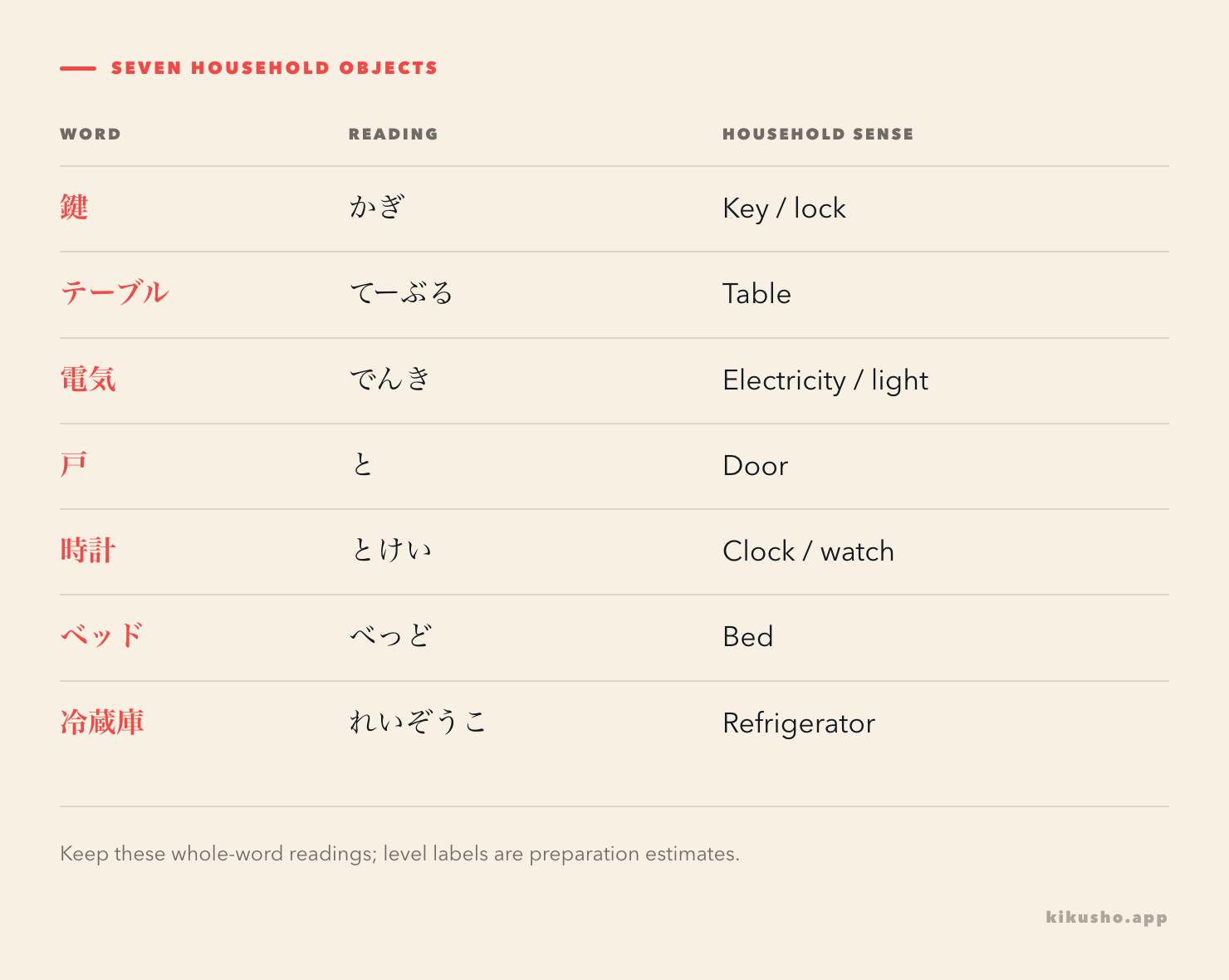
The inventory places these ten spelling-and-reading entries at N5. Its original and adapted Waller lists repeat a single source lineage; counting two files does not give two separately researched level judgements. 鍵 has N5/N3 observations; the current JapaneseTest4You N3 page also gives かぎ and key/lock meanings. The N5 page could not be retrieved in this check. Dictionaries and beginner materials verify usage, rather than an official exhaustive JLPT word syllabus.
A corridor connects rooms; stairs connect heights
建物 is broader than “house.” It can be a school, an office or an apartment building. Daijisen includes structures used for living, work and keeping things; it does not restrict the noun to a family home.
この建物には長い廊下があります。
この たてものには ながい ろうかが あります。
This building has a long corridor.
廊下 names the passage linking rooms inside a building. 階段 names a stepped passage linking different heights. Daijisen's corridor entry and staircase entry make that difference explicit; Kanjipedia independently confirms the staircase reading and sense.
階段を上がってください。
かいだんを あがって ください。
Please go up the stairs.
In 廊下を歩く and 階段を上がる, を marks a route travelled. The staircase is not an object you lift. These are short phrase partners, rather than a full lesson on verb types.
Take the readings as whole words: かいだん, with voiced だ, and ろうか, with the long first vowel. Neither final character licenses a guess such as ろうげ. Recognising a building sign means retrieving the word you learned.
Closing a door and locking it are different actions
戸 is read と for the door noun here. Some beginner lists propose “Japanese-style door,” but that gloss is narrower than the dictionary definition. Daijisen includes both sliding and hinged fittings; Kanjipedia's 戸 entry separately confirms と and the door/opening sense. Learning 戸 does not require pretending that every hinged door must be called ドア instead.
戸を閉めてください。
とを しめて ください。
Please close the door.
That request does not, by itself, ask you to lock it. 鍵をかける supplies the locking action.
出かける前に、戸に鍵をかけます。
でかける まえに、とに かぎを かけます。
I lock the door before going out.
In this sentence 戸に identifies what is locked. 鍵 can name the separate key or the lock itself, as both Daijisen and independently edited Kanjipedia record. With 鍵はテーブルの上にあります, it is the key you can pick up. With 鍵をかける, the whole phrase tells you to lock up. Translating every occurrence as a loose metal key misses that action.
電気 names a light when the action switches it
A request to 電気をつける normally means switching on an electric light. 電気を消す is switching it off. 電気 also means electricity or electric power; it has not lost those senses.
暗いので、電気をつけます。
くらいので、でんきを つけます。
It is dark, so I switch on the light.
Daijisen's 電気 entry distinguishes light from electricity and power. TUFS's room group pairs 電気 with つけます and 消します. Save one of those phrases rather than an English label that can only say “electricity.”
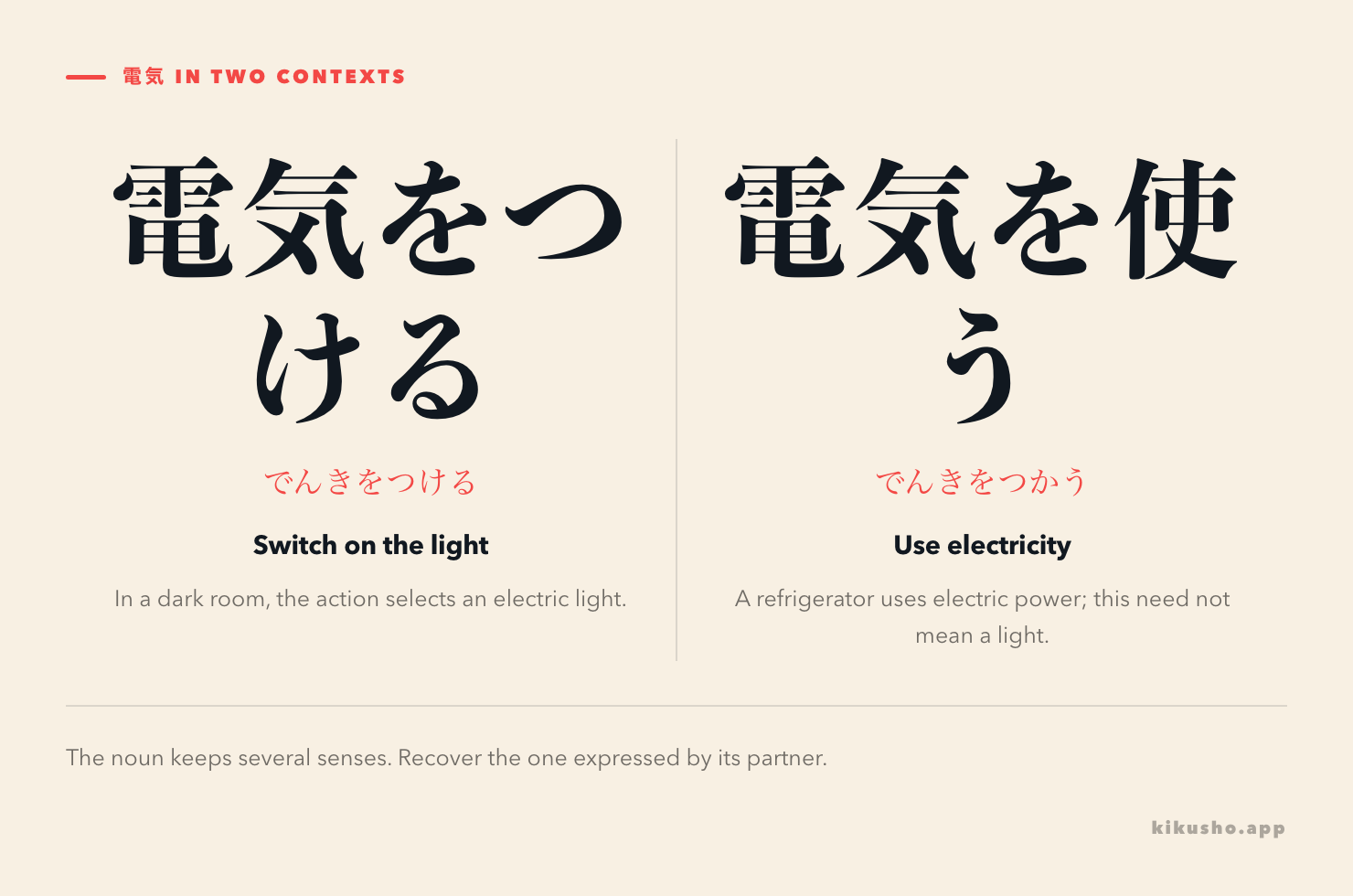
電気を使う(でんきをつかう), “use electricity,” need not be about a light: この冷蔵庫は電気を使います, “This refrigerator uses electricity.” 使う describes use of power; つける in the dark-room example describes lighting the room.
Furniture can be a place without changing its noun
テーブル supplies a table, often a dining or meeting table. 机 from the earlier lesson is a useful starting word for a desk. Those are common contexts, not a ban on studying at a テーブル: Daijisen's table entry gives overlapping furniture vocabulary.
A table can hold an object; a refrigerator can contain one.
牛乳は冷蔵庫の中にあります。
ぎゅうにゅうは れいぞうこの なかに あります。
The milk is in the refrigerator.
For putting it there, use 牛乳を冷蔵庫に入れます(ぎゅうにゅうを れいぞうこに いれます), “I put the milk in the refrigerator.” 牛乳を is what you put away; 冷蔵庫に is the destination. The TUFS refrigerator entry independently confirms れいぞうこ, “refrigerator,” and its container context; Daijisen identifies cold storage.
時計 names a timepiece. It is not limited to a large wall clock: the particular object may be a clock or a watch. テーブルの上に時計があります(テーブルの うえに とけいが あります) means “There is a clock on the table” in a room description. Daijisen checks とけい and the time-measuring sense.
Finally, ベッドで寝ます(ベッドで ねます) says “I sleep in a bed.” ベッド is the furniture noun, confirmed by Daijisen; で identifies where sleeping happens. In the loanword spelling, retain the long vowel in テーブル and the small ッ and voiced ド in ベッド.
The location-word lesson develops reference+の+position. In テーブルの上に and 冷蔵庫の中に, 上 and 中 locate something relative to the furniture. The new nouns give that familiar pattern concrete reference points.
Keep the action from the next household instruction
If you hear 戸を閉めて and then 鍵をかけて, keep the two actions separate. If you encounter 電気をつけて, keep つけて with 電気 so the light sense returns with it. A room description containing 冷蔵庫 can become 冷蔵庫の中, rather than leaving you to recall a disconnected appliance name.
In Kikusho, paste the instruction you encountered and inspect the editable reading, meaning and example before saving. For 鍵をかける, a card whose example actually locks a door is more useful than one showing a key merely lying on a table. Later, test the phrase from the situation: a door that is closed still needs a different instruction if you want it locked.
Practice questions
Attempt these eight items before opening the shared explanations. They sample kanji reading, spelling, context and paraphrase for N5 vocabulary preparation.
Question 1
How is 廊下 read in a building description?
- A. ろか
- B. ろうげ
- C. どうか
- D. ろうか
Question 2
The staircase noun is written 階段. Which pronunciation fits the marked route in 階段を上がります?
- A. かいたん
- B. かいだん
- C. かいどう
- D. かいでん
Question 3
Which written word supplies れいぞうこ, the appliance that keeps the milk cold?
- A. 冷蔵庫
- B. 時計
- C. 電気
- D. 建物
Question 4
Choose the usual katakana spelling corresponding to べっど, the bed in this set.
- A. ベト
- B. ベード
- C. ベッド
- D. ペッド
Question 5
Select the appliance intended in this instruction to put away milk.
牛乳を( )に入れてください。
- A. 時計
- B. 冷蔵庫
- C. 階段
- D. 廊下
Question 6
The request is to close a door, without adding a locking instruction. Which noun completes it?
( )を閉めてください。
- A. 鍵
- B. 廊下
- C. 電気
- D. 戸
Question 7
Which phrase preserves the light-switching action in 電気を消します?
- A. 明かりを消します。
- B. 明かりをつけます。
- C. 時計を見ます。
- D. 戸を閉めます。
Here 明かり(あかり) means a light or illumination.
Question 8
鍵はテーブルの上にあります locates the key. Which English sentence preserves that relationship?
- A. The key is inside the refrigerator.
- B. The clock is on the table.
- C. The key is on the table.
- D. The table is on top of the key.
Answers and explanations
Answer 1: D. 廊下(ろうか) names the corridor. A shortens the first vowel; B replaces か with げ; C replaces ろう with どう. Read the established word, rather than assigning an isolated character a different reading.
Answer 2: B. 階段(かいだん) has voiced だ. A removes that voicing; C and D supply different endings. The example says going up the stairs, with 上がります(あがります).
Answer 3: A. 冷蔵庫 is れいぞうこ, refrigerator. 時計 is とけい, clock or watch; 電気 is でんき, electricity or an electric light; 建物 is たてもの, building. Only A matches the requested appliance and reading.
Answer 4: C. ベッド represents べっど: the small ッ marks the consonant closure and ド retains the voiced sound. A lacks the closure and changes the ending; B adds a long vowel instead; D replaces ベ with ペ. This item checks the spelling used in this set, rather than every historical spelling of the English loan.
Answer 5: B. 牛乳を冷蔵庫に入れてください, “Please put the milk in the refrigerator.” The instruction targets storage in an appliance. A is a timepiece; C a staircase; D a corridor. Those nouns do not identify the intended cold-storage appliance.
Answer 6: D. 戸を閉めてください requests closing the door. 鍵 belongs to the separate locking phrase, 鍵をかける. 廊下 names a passage rather than its door, and 電気 takes 消す for switching off the light. The noun and action must describe the requested event together.
Answer 7: A. 明かりを消します preserves switching off the light. B switches it on; C checks a timepiece; D closes a door. The original 電気 phrase selects the light sense, without restricting every use of 電気 to illumination.
Answer 8: C. The subject named is 鍵, and its location is テーブルの上. A changes the location, B changes the thing located, and D reverses what is above what. With あります, に identifies where the key is.
Common questions
Does 電気 always mean electricity?
No. 電気(でんき)can mean electricity or electric power, but in 電気をつける and 電気を消す it normally refers to an electric light. Keep the action beside the noun to recover that sense.
Is 戸 only a Japanese sliding door?
No. 戸(と)names a door or an opening-and-closing fitting, and its dictionary sense includes both sliding and hinged doors. The beginner gloss “Japanese-style door” is a teaching cue, not an exclusive restriction.
Does 時計 mean a clock or a watch?
時計(とけい)is a general word for a timepiece, so the English translation can be clock or watch. A clock on a table and a watch you carry can both be 時計; the surroundings identify the particular object.
Why is 鍵 in this N5 lesson when a source places it at N3?
The dated inventory assigns 鍵(かぎ)to N5 and records an N3 comparison placement. Current dictionaries verify key and lock meanings, and TUFS includes かぎ in basic home vocabulary. They do not settle an official exclusive JLPT level.