
On this page
A teacher assigns a book; a parent hands over one a child asked to read. Both can say 読ませる(よませる) for “make someone read” or “let someone read.” The Japanese causative says that one person or thing causes another to act; the surrounding situation tells you whether that action was imposed, permitted, or simply brought about.
This N4 grammar lesson teaches 使役形(しえきけい), especially ~せる/~させる: how the ending attaches, how a sentence marks the actor, and what the particles cannot decide. If godan and ichidan are unfamiliar, start with the verb-group lesson. Tofugu's causative guide and the Japan Foundation's Irodori form chart independently describe the formation.
One sentence can have a causer and an actor
In 先生は生徒に作文を書かせました (せんせいは せいとに さくぶんを かかせました), the teacher is the causer. The student is the actor, the one who writes. 作文を is what the student writes. The teacher did not write the composition; the causative makes the teacher responsible for having the writing happen.
| Role | Japanese | Job in the event |
|---|---|---|
| Causer | 先生は | has the student do the action |
| Actor | 生徒に | does the writing |
| Object | 作文を | is written |
| Causative action | 書かせました | have or let someone write |
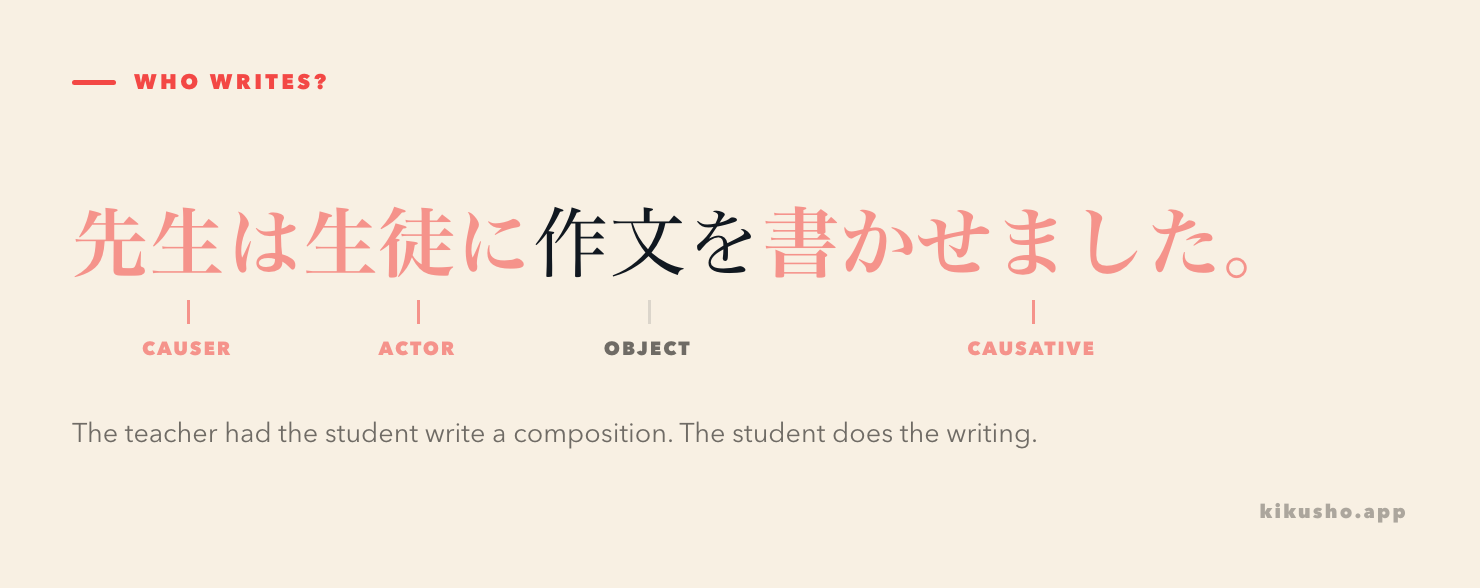
“The teacher had the student write a composition” fits, but the bare Japanese sentence does not tell us how willing the student was. Mango Languages' independently authored guide identifies the same three roles and distinguishes coercion, permission, and other causes.
How ~せる and ~させる attach
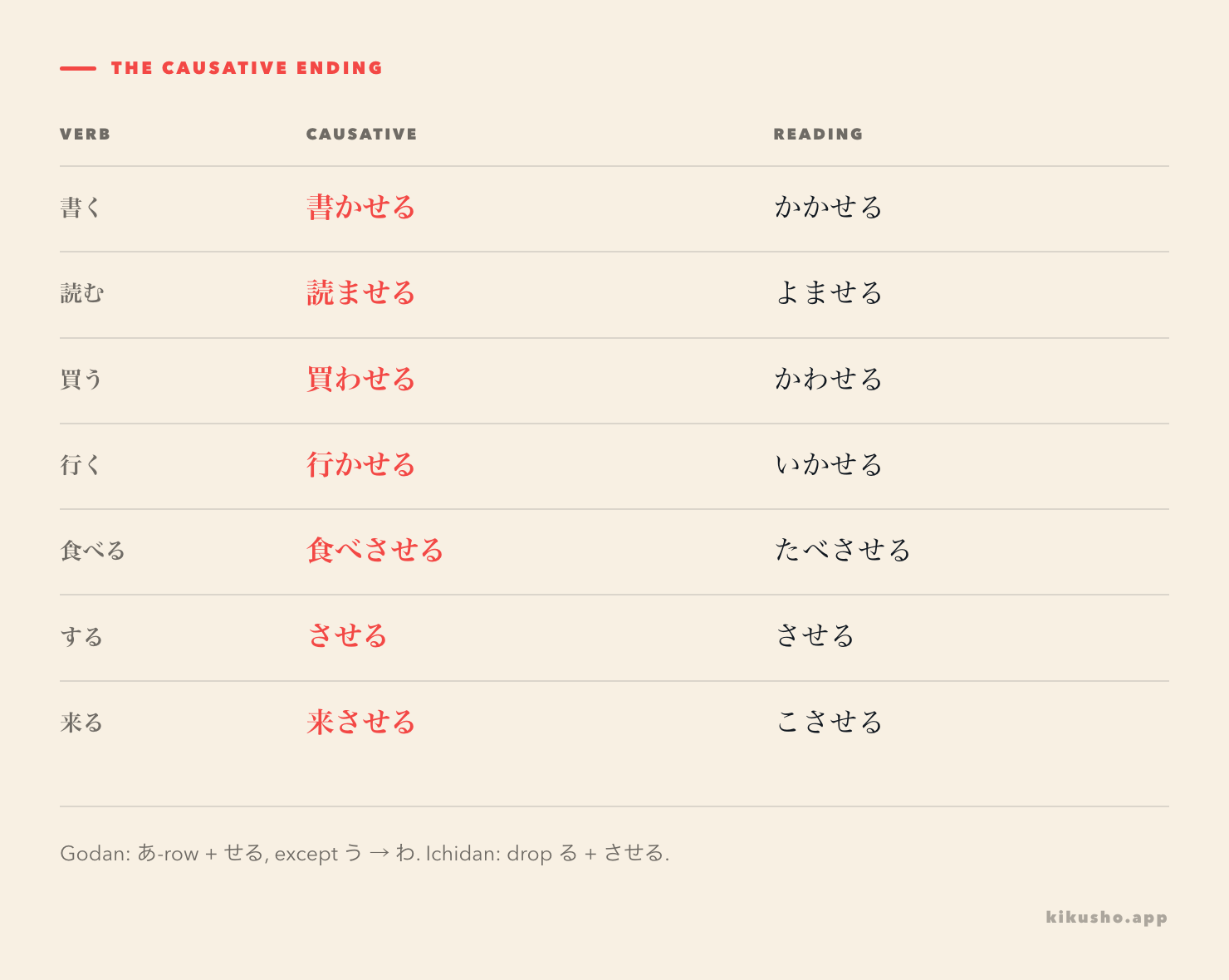
For a godan verb, replace the last う-row kana with its あ-row partner, then add せる. 書く → 書かせる(かかせる) and 読む → 読ませる(よませる) follow that rule. A final う uses わ: 買う → 買わせる(かわせる), not 買あせる. For an ichidan verb, remove る and add させる: 食べる → 食べさせる(たべさせる). The common irregular verbs are する → させる and 来る(くる)→ 来させる(こさせる). The Japan Foundation's Irodori chart and Tofugu verify the forms and the changed reading of 来る.
| Group | Dictionary form | Causative | Reading | Change |
|---|---|---|---|---|
| Godan | 書く | 書かせる | かかせる | く → かせる |
| Godan | 読む | 読ませる | よませる | む → ませる |
| Godan | 買う | 買わせる | かわせる | う → わせる |
| Godan | 行く | 行かせる | いかせる | く → かせる |
| Ichidan | 食べる | 食べさせる | たべさせる | drop る, add させる |
| Irregular | する | させる | させる | learn separately |
| Irregular | 来る | 来させる | こさせる | reading changes too |
Once formed, the causative verb conjugates like an ichidan verb: 書かせる → 書かせます, 書かせない, 書かせて. The past polite form is 書かせました, not 書くさせました. Mango Languages confirms this second-stage conjugation. These longer forms are standard for writing and JLPT-style practice. Shorter ~さす forms such as 書かす and 食べさす occur in casual speech or dialect, but should not replace the standard forms in this lesson. Tofugu describes that register difference.
JLPT Sensei classifies ~させる as N4 grammar, while the Japan Foundation introduces the form in Irodori Pre-Intermediate. These are teaching placements, not an exhaustive official JLPT syllabus. This lesson expects the N5 verb-group distinction before asking you to form the causative.
Making, letting, and causing a reaction
Making is clear when the actor resisted. 子どもは嫌がったが、母は子どもに野菜を食べさせました means “The child resisted, but the mother made the child eat vegetables.” 嫌がった(いやがった) supplies the unwillingness; 食べさせました alone would not. Tofugu explains why actor willingness and context matter more than the ending.
Letting is clear when the actor wanted to do it. 娘が読みたがっていたので、父は娘に本を読ませました means “His daughter wanted to read, so her father let her read a book.” Read 娘 as むすめ. The actor is still marked に, just as in the vegetable sentence. The “made” to “let” change came from 読みたがっていたので, not a new particle. You can also ask permission: もう少し読ませてください means “Please let me read a little longer.” Tofugu documents the causative て-form in such requests.
Causing a reaction does not require an order or permission. その話はみんなを笑わせました means “That story made everyone laugh.” The story is the cause; everyone laughs. The Japan Foundation's Irodori emotion examples and Mango Languages' guide cover events that bring about a feeling. With intransitive 笑う(わらう), the people affected here take を.
に and を mark roles before they hint at intent
The safe starting pattern for a transitive action is causer は/が + actor に + object を + causative verb. 父は娘に本を読ませました has 娘に for who reads and 本を for what is read. It can describe an assignment or permission. に does not mean “let.” It marks the actor while the object already has を. The Japan Foundation, Tofugu, and Mango Languages agree on the basic transitive pattern.
With an intransitive action, there is usually no object. A familiar basic pattern marks the actor with を: 先生は生徒を立たせました means “The teacher made the student stand.” But に can also mark a willing actor in some intransitive sentences, and it is useful when a route already takes を. 監督は選手にグラウンドを走らせました means “The coach had the players run around the ground”: 選手に marks the runners while グラウンドを marks the area they ran through. Read 監督 as かんとく and 選手 as せんしゅ. Tofugu's particle discussion and Mango Languages' movement example explain these qualifications to the beginner rule.
Even を does not guarantee force: 父は子どもを好きなだけ公園で遊ばせました means “The father let the child play in the park as much as they wanted.” 好きなだけ makes permission clear while the actor keeps を. Conversely, a transitive sentence keeps に when someone is made to act. You must read the sentence, not just the actor marker.
Where the causative is a poor fit
~させる puts the causer's influence in the foreground. If a colleague kindly helps you, 手伝ってもらいました (“I received their help”) describes the favour more naturally than presenting yourself as the person who made them help. Mango Languages' section on asking for help distinguishes that favour from causative control.
Nor is every English “make” a reason to form a causative. ドアを開けました already says “I opened the door”; 開く and 開ける are an intransitive/transitive pair. Use the causative when the distinct actor matters, as in a teacher causing a student to write. Mango Languages makes the same point with 壊れる/壊す and 閉まる/閉める.
Do not confuse causative 読ませる with passive 読まれる. The former makes an actor read; the latter changes whose experience the sentence follows. The passive lesson takes up that second viewpoint. A later causative-passive combines the endings to describe being made to act; this lesson stops at the causative so the roles remain easy to identify.
When you hear 読ませてくれた, the added くれた tells you permission came toward the speaker's side. A useful Kikusho card keeps the whole phrase, its reading, and the situation in which you heard it. A bare card for 読ませる cannot preserve why one occurrence meant “made” and another meant “let.”
Practice: form the verb, then read the event
Work through all six questions before opening the answers below.
Question 1 — grammar choice. Which is the standard causative form of 買う?
- A. 買あせる
- B. 買える
- C. 買わせる
Question 2 — grammar choice. Which sentence explicitly says a father let his child play freely, rather than forced them or leaves their wishes unclear?
- A. 父は子どもを無理に公園で遊ばせました。
- B. 父は子どもを好きなだけ公園で遊ばせました。
- C. 父は子どもを公園で遊ばせました。
Question 3 — sentence composition. A teacher had a student write a composition. Use 先生, 生徒, 作文, and the causative of 書く. Make the sentence polite and put the actor and object in their usual places.
Question 4 — sentence composition. Ask someone politely to let you read a little longer. Use もう少し, the causative of 読む, and ください. You may leave 私 unspoken.
Question 5 — text grammar. The coach had the players run around the ground. Complete 監督は選手にグラウンドを__。 with the past polite causative of 走る.
Question 6 — text grammar. A daughter wanted to read a book. Complete the second sentence with the past polite causative of 読む: 娘は本を読みたがっていました。父は娘に好きなだけ本を__。
Answers and explanations
Answer 1. The form is C, 買わせる(かわせる). The last kana in 買う shifts from う to わ before せる attaches. A invents 買あせる by choosing あ; B, 買える, is the potential “can buy,” not the causative.
Answer 2. B. 好きなだけ means “as much as they wanted” and makes permission explicit. A uses 無理に, “against their will,” so it is coercive. C supplies no clue about the child's wishes; を by itself cannot settle the interpretation.
Answer 3. One model is 先生は生徒に作文を書かせました。 先生 is the causer; 生徒に marks who writes; 作文を is what they write. 書く → 書かせる → 書かせました produces the past polite form. 生徒を作文を書かせました gives two を-marked phrases in the same clause and is not the usual transitive pattern.
Answer 4. もう少し読ませてください。 読む → 読ませる → 読ませて makes the causative て-form; ください asks the listener to allow the speaker to continue reading. 読まれてください would use the passive and would not ask for permission.
Answer 5. 走らせました. The full sentence is 監督は選手にグラウンドを走らせました。 走る → 走らせる → 走らせました. 選手に marks the runners because グラウンドを already marks the route. These particles do not tell us whether the coach forced or permitted the run.
Answer 6. 読ませました. The daughter wanted to read, so 父は娘に好きなだけ本を読ませました describes permission. 娘に marks the actor and 本を the object. Without 読みたがっていました and 好きなだけ, the make/let reading would be less settled.
Common questions
How do you make the Japanese causative form?
Godan verbs change their final kana to the あ row and add せる: 読む becomes 読ませる. A final う changes to わ, as in 買う → 買わせる. Ichidan verbs drop る and add させる, as in 食べさせる. する → させる and 来る → 来させる(こさせる).
Does に mean let and を mean make in a causative sentence?
No. With a transitive verb, the actor normally takes に while the object keeps を, whether the actor was forced or allowed. With an intransitive verb, both actor markers can occur in some contexts. Willingness and the situation, not one particle alone, decide the English reading.
What is the difference between 読ませる and 読まれる?
読ませる is causative: someone makes or lets another person read. 読まれる is passive: someone or something is read, or a person is affected by an act of reading. The endings change the sentence viewpoint differently.
Is させてください a request for permission?
Yes. 少し読ませてください asks the listener to let the speaker read for a little while. The actor is the speaker, even when 私 is unspoken. The causative て-form plus ください makes the request polite.