On this page
五時間も待ちました reports five hours of waiting and presents those five hours as a lot. Put も after a number and its counter when the quantity crosses the speaker's expected scale: “a whole five hours,” “as many as twenty people,” or “as much as 30,000 yen.”
The quantity stays exact; the evaluation changes
Start with a neutral count:
駅で五時間待ちました。
えきで ごじかん まちました。
I waited at the station for five hours.
Now add も after the counter:
駅で五時間も待ちました。
えきで ごじかんも まちました。
I waited at the station for a whole five hours.
Both sentences say five hours. The second asks the listener to view five as strikingly long in this situation. も does not mean “more than five,” and it does not make the number vague. The facts stay in the number; the particle supplies the speaker's assessment.
The core attachment is simple:
| Quantity type | Form | Example | Natural reading |
|---|---|---|---|
| People or objects | number + counter + も | 二十人も来た | as many as twenty people came |
| Duration | time expression + も | 三時間も待った | waited a whole three hours |
| Price or amount | amount + も | 三万円もした | cost as much as 30,000 yen |
| Frequency | number + 回 + も | 五回も読んだ | read it five whole times |
JLPT Sensei records measurable quantities, time expressions and their counters for this N4 pattern. NIHONGO NET independently gives the same attachment and describes the quantity as unusually high or surprising.
The counter belongs between the number and も
Japanese normally counts through a counter such as 人 for people, 冊 for bound volumes, 台 for machines, 回 for occurrences and 時間 for hours. Quantity-emphasis も follows that complete counting expression.
田中さんは漫画を百冊も持っています。
たなかさんは まんがを ひゃくさつも もっています。
Tanaka has as many as one hundred manga volumes.
The object remains 漫画を. 百冊も works adverbially, telling us the striking number of volumes involved. You can see the same arrangement in:
昨日、コーヒーを五杯も飲みました。
きのう、コーヒーを ごはいも のみました。
Yesterday I drank five whole cups of coffee.
Do not turn the counter into an optional decoration. 五も飲みました cannot carry the intended count of cups. The appropriate counter completes the amount before も evaluates it.
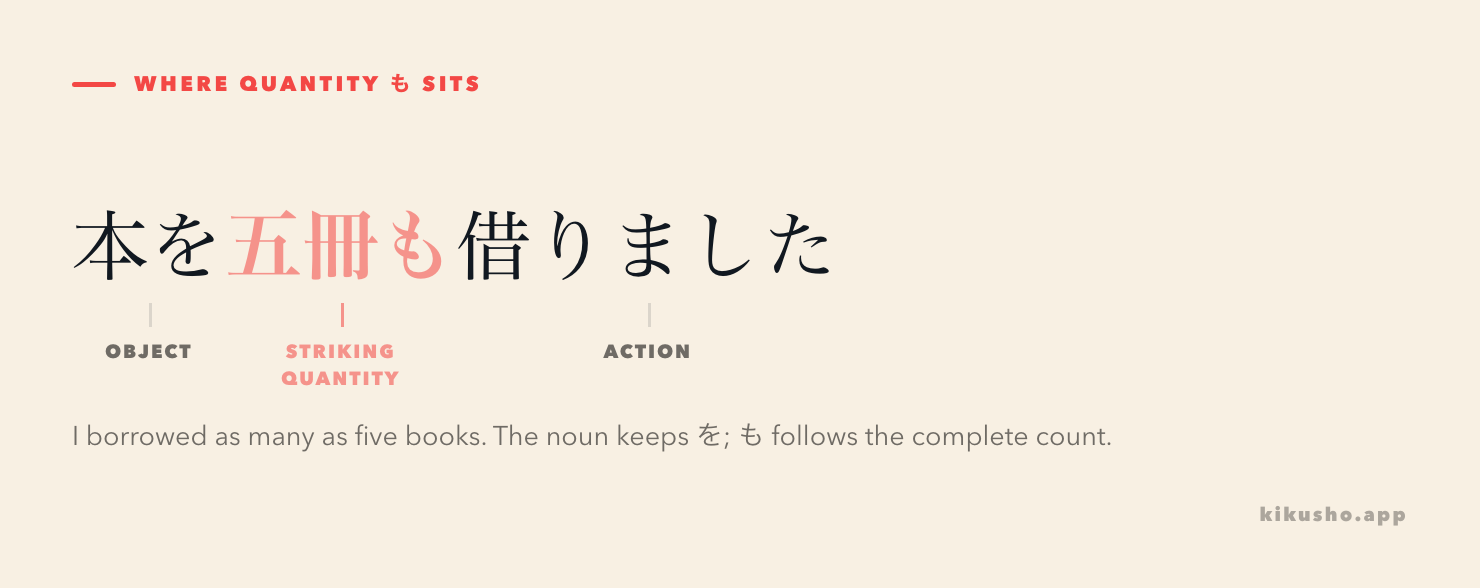
The quantified noun can also stand with が: 参加者が五十人も集まりました, “as many as fifty participants gathered.” The sentence structure decides where the noun belongs; the sequence quantity + counter + も remains intact.
Context decides what counts as a lot
The same number can feel large in one setting and ordinary in another. 学生が三十人来ました gives a count. 学生が三十人も来ました suggests that thirty exceeds the relevant expectation, perhaps because the room is small or only ten people registered.
That evaluation can sound pleased, annoyed, impressed or worried:
- 写真を百枚も撮りました may celebrate an event or complain about sorting the pictures.
- 修理に十万円もかかりました presents the repair cost as painfully high.
- 一日に四冊も読みます can express admiration or disbelief.
Nothing in も chooses the emotion for you. The surrounding sentence and situation do that. Tokyo University of Foreign Studies illustrates the underlying inclusion logic with 百人も来ました: reaching one hundred includes the lower expected possibilities and goes beyond them.
This is why a fixed English gloss is unreliable. “As many as,” “as much as,” “a whole” and emphasis in the voice can all work. Translate the number first, then preserve the judgment that it is notable.
Neutral, a lot, at least and only are four claims
Changing the particle after one quantity changes the claim.
| Sentence | What the speaker commits to |
|---|---|
| 三十分かかりました。 | It took thirty minutes; neutral count. |
| 三十分もかかりました。 | It took a whole thirty minutes; thirty felt long. |
| 三十分はかかります。 | It will take at least about thirty minutes; it may take longer. |
| 三十分しかかかりませんでした。 | It took only thirty minutes; thirty felt short or limited. |
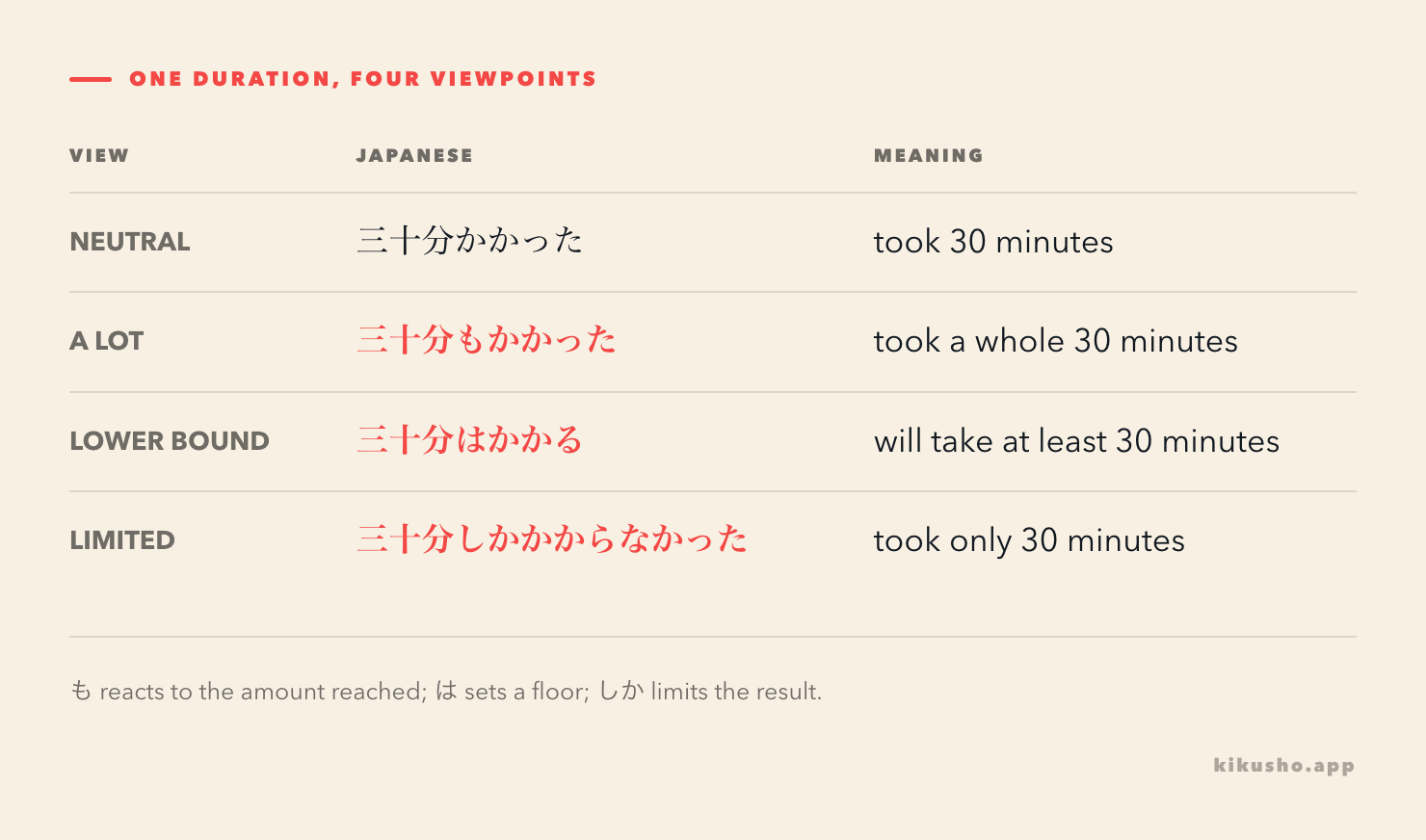
は after an amount commonly marks a minimum estimate in this use. It leaves room above the stated amount. も instead reacts to the amount reached. Bunpro's number + も reference makes this same contrast between 三十分もかかった and 三十分はかかる.
しか requires a negative predicate and limits the result to the marked amount. Compare:
三冊も読みました。
さんさつも よみました。
I read three whole books.
一冊しか読みませんでした。
いっさつしか よみませんでした。
I read only one book.
In the first sentence, three is presented as much. In the second, one is the sole amount reached and is presented as little. This contrast is about viewpoint as well as arithmetic.
A negative predicate can put the quantity below a threshold
With a minimum unit and a negative predicate, も says that even that unit was not reached.
その映画は一度も見たことがありません。
その えいがは いちども みたことが ありません。
I have never seen that film, not even once.
パーティーには一人も来ませんでした。
パーティーには ひとりも きませんでした。
Not one person came to the party.
These results are zero viewings and zero arrivals. Contrast 一人しか来ませんでした: one person did come, and the speaker presents one as few. The negative endings look similar, but 一人も~ない fails to reach one while 一人しか~ない limits the actual result to one.
A larger threshold is possible when the context supplies a scale:
駅まで十分もかかりません。
えきまで じゅっぷんも かかりません。
It does not take even ten minutes to the station.
The sentence places the duration below ten minutes. It does not say exactly how far below. The predicate's polarity matters: affirmative 十分もかかります treats ten minutes as long; negative 十分もかかりません says the duration does not even reach that boundary.
何 + counter + も removes the question
In 何回も, 何人も and 何冊も, the question word no longer asks for a number. The combination means many times, many people or many volumes.
この説明を何回も読みました。
この せつめいを なんかいも よみました。
I read this explanation many times.
The exact count is unspecified, unlike 五回も, but repetition or abundance remains prominent. Do not answer 何回も読みました with a number as though it were 何回読みましたか. One is a statement about many repetitions; the other asks how many.
The N5 も, と and や lesson teaches additive も in 私も学生です, “I am a student too.” Quantity も grows from the same inclusive particle, but the cue is different: a number and counter immediately before も put a point on the scale into focus.
Publishers split the level because they package these uses differently. JLPT Sensei, NIHONGO NET and Bunpro place number + counter + も at N4. Bunpro and the Tanos comparison list place basic additive も at N5. These are study classifications; the JLPT does not publish an exhaustive official grammar list.
If you hear an amount that matters to you, capture the entire phrase in Kikusho rather than saving も alone. A voice card for 二時間も待った preserves the counter, predicate and annoyed or surprised context that make the particle interpretable. Check the editable example before keeping it, then review the phrase against a neutral 二時間待った.
Test the speaker's scale
Answer all seven questions before opening the correction block below.
Question 1: grammar choice. Your friend complains that they waited for five whole hours. Complete: 五時間__待ちました。
- A. を
- B. も
- C. しか
- D. で
Question 2: meaning. What extra information does 学生が三十人も来ました add to the neutral count?
- A. Exactly thirty came, and the speaker regards thirty as notably many.
- B. Fewer than thirty came.
- C. At least thirty came, perhaps more.
- D. Only thirty came, and the speaker regards thirty as few.
Question 3: sentence composition. Arrange the pieces to say “This bag cost as much as 30,000 yen”: しました / このかばんは / 三万円も.
Question 4: zero experience. Choose the sentence meaning “I have never seen that film, not even once.”
- A. その映画は一度も見たことがありません。
- B. その映画は一度しか見たことがありません。
- C. その映画は一度も見たことがあります。
- D. その映画は一度は見たことがありません。
Question 5: lower bound. You estimate that the trip will take at least thirty minutes and may take longer. Complete: 三十分__かかると思います。
- A. も
- B. しか
- C. は
- D. を
Question 6: unspecified repetition. Which sentence means “I read this explanation many times” without giving an exact count?
- A. この説明を何回読みましたか。
- B. この説明を何回か読みました。
- C. この説明を何回も読みました。
- D. この説明を一回も読みませんでした。
Question 7: short passage. Read: 先週、図書館から本を五冊も借りました。二冊は一日で読みましたが、難しい本は十ページも読めませんでした。返すまでに三日しかありません。 Which account is faithful?
- A. The speaker borrowed only one book and has more than ten days to return it.
- B. Five books felt like a notable number; the speaker read two in a day, could not get through even ten pages of a difficult one, and has only three days left.
- C. The speaker read all five books and returned them after three days.
- D. Ten pages felt like a large completed amount, and three days is a guaranteed minimum.
Answers and explanations
Answer 1. B, も. 五時間も待ちました keeps five hours as the measured duration and marks it as strikingly long. しか would require a negative predicate for the “only” construction.
Answer 2. A. The sentence asserts thirty arrivals and adds the speaker's evaluation that thirty is a lot in context. も does not turn thirty into a lower bound or say that fewer arrived.
Answer 3. このかばんは三万円もしました。 The topic comes first, 三万円も supplies and evaluates the price, and しました completes the cost expression.
Answer 4. A. 一度も~ありません says the experience count never reached one. B says the speaker has seen it once and only once. C is affirmative, and D does not form the standard not-even-once statement.
Answer 5. C, は. 三十分はかかる treats thirty minutes as the lower estimate while allowing a longer duration. 三十分もかかる instead reacts to thirty as already long.
Answer 6. C, 何回も読みました. 何回も means many times without fixing the count. A asks a question, B means a few times, and D says not even once.
Answer 7. B. 五冊も evaluates five as notably many. 十ページも読めませんでした places the completed reading below ten pages, while 三日しかありません limits the available time to three days. The three particles point in different directions even though every phrase contains a quantity.
On the next quantity you meet, remove its particle for a moment. Decide whether the speaker is reporting a count, reacting to it, setting a floor or limiting it. The particle then becomes evidence for a viewpoint instead of an English word to memorize.
Common questions
What does も mean after a number in Japanese?
After a number and its counter, も marks that quantity as striking in the speaker's view. In an affirmative sentence, it often presents the amount as large: 三時間も待った means waited a whole three hours.
Does number + も mean more than the stated number?
No. 五人も来た says that five people came and evaluates five as a lot in context. The particle adds emphasis; it does not change five into more than five or an approximate upper limit.
What is the difference between quantity + も and quantity + しかない?
Quantity + も with an affirmative predicate presents the amount as large. Quantity + しか followed by a negative predicate presents the amount as limited or small: 三冊も読んだ versus 一冊しか読まなかった.
How does も work with a negative verb?
A minimum unit plus も and a negative predicate means that even that unit was not reached. 一人も来なかった means nobody came, while 一人しか来なかった means one person came and that felt like few.