On this page
Formal Japanese uses ないものでもない to leave a possibility cautiously open and と言えなくもない to accept a description with reservations. Their two negatives make room for a qualified “yes”; neither construction turns that yes into certainty or an obligation.
An English translation may say “might be able to” or “could be called,” even though the Japanese looks negative twice. Read what the speaker is declining to rule out, then look for the condition or objection that keeps the affirmation small.
Removing a denial leaves room without making a promise
This N1 grammar lesson teaches 〜ないものでもない(nai mono demo nai)and 〜と言えなくもない(といえなくもない, to ienaku mo nai). They share a reserved affirmation, but qualify different things: an action or possibility, and the defensibility of a statement.
The two specific JLPT Sensei pages for ないものでもない and と言えなくもない place them at N1. 絵でわかる日本語 does too. 日本語NET groups ないものでもない with ないでもない at N2, so the first form crosses a study-list boundary. These labels are editorial estimates; the JLPT supplies no exhaustive official grammar list.
You need plain negative verb formation and the ability to recognise a plain statement before と. The ない-form lesson provides the first prerequisite. Counting the negative endings is less useful than locating their targets.
| Construction taught here | Attachment | What remains possible |
|---|---|---|
| ないものでもない | Verb in ない-form + ものでもない | Doing the action, perhaps under a condition |
| と言えなくもない | Plain statement or noun description + と言えなくもない | Applying that statement or description, to some extent |
Suppose you are asked to help with a project. A reserved willingness to help does not tell the other person to begin planning on your definite participation. Equally, conceding that a trial “could be called successful” does not approve every result. A translation that drops the reservation gives the listener more than the Japanese offers.
ないものでもない keeps an action or possibility open
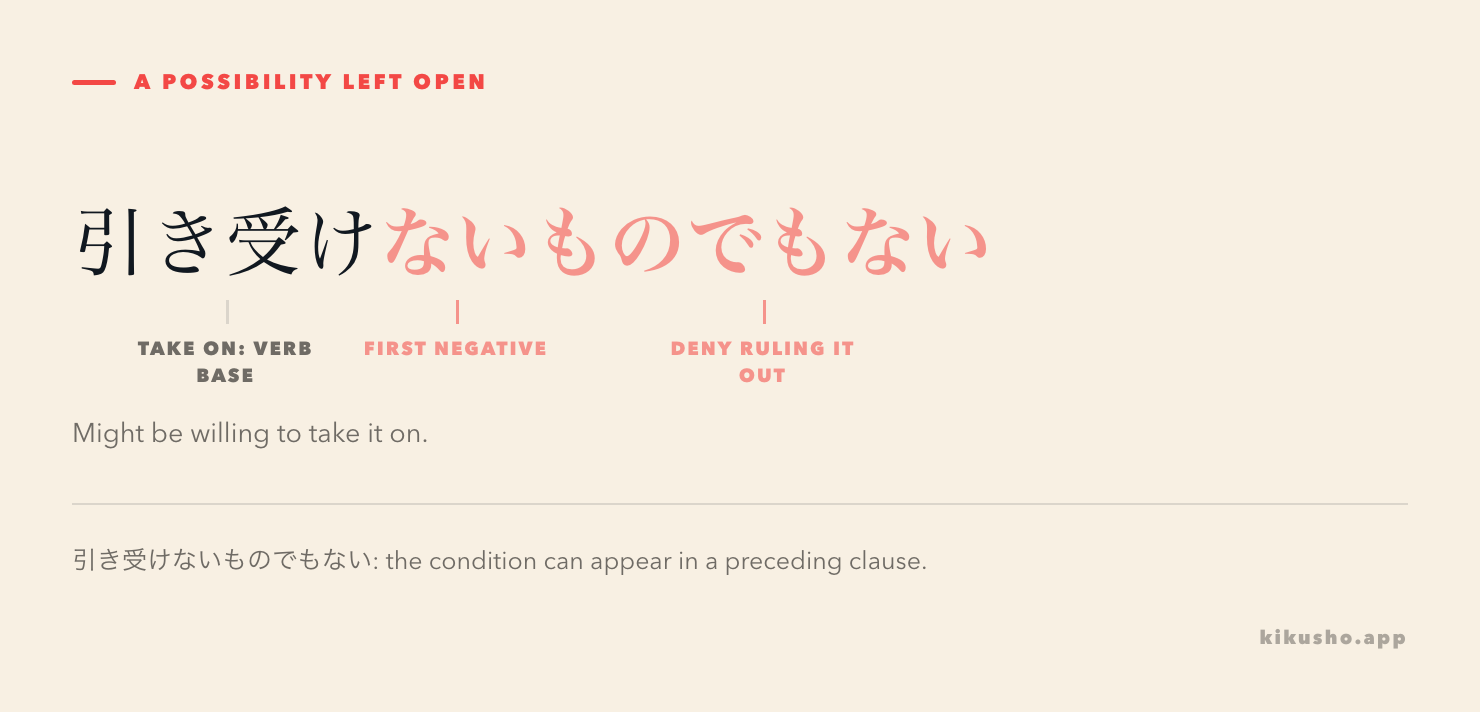
Keep the verb's complete ない-form, then add ものでもない. The final ない belongs to the fixed outer expression; do not remove the first one.
| Starting verb | Plain negative | Completed construction |
|---|---|---|
| 引き受ける(ひきうける), take on | 引き受けない | 引き受けないものでもない |
| 行く(いく), go | 行かない | 行かないものでもない |
| する, do | しない | しないものでもない |
| できる, be able to | できない | できないものでもない |
作業が一日で終わるなら、引き受けないものでもない。
さぎょうが いちにちで おわるなら、ひきうけないものでもない。
If the work can be finished in a day, I might be willing to take it on.
作業 is work or a task. The conditional なら supplies a limit on the offer. The speaker leaves acceptance open rather than saying either “I refuse” or “I definitely accept.” This can sound reluctant or guarded; the context determines how warmly the offer is made.
A potential verb makes ability the thing being qualified:
時間はかかるが、一人でも修理できないものでもない。
じかんは かかるが、ひとりでも しゅうりできないものでもない。
It would take time, but repairing it alone isn't entirely out of the question.
修理する means repair; できない is the negative of できる. The sentence cautiously admits feasibility. It gives no promise of a quick repair and no instruction to attempt one alone. 絵でわかる日本語's explanation verifies this possibility reading, conditional willingness and a somewhat stiff tone.
The condition need not be a separate なら clause. Cost, available time or the speaker's reluctance can supply the reservation in the surrounding passage. Nor does the expression assign a numerical probability. “Not entirely ruled out” cannot be converted into a measured chance of success.
JLPT Sensei also records a shorter ないでもない variant. Recognise the family resemblance, but keep ないものでもない as this lesson's production target. You are learning its verb attachment here, not a license to insert もの after every negative noun or adjective.
と言えなくもない qualifies the description itself
言える(いえる) is the potential of 言う(いう), say: “can say.” In the fixed 言えなくもない, 言えない becomes 言えなく before もない. The speaker does not completely reject the possibility of saying the preceding statement.
Put と after the description you are evaluating. The first part need not be negative:
| Description type | Example before the fixed ending | Completed expression |
|---|---|---|
| Plain verb clause | 改善した(かいぜんした), improved | 改善したと言えなくもない |
| い-adjective | 安い(やすい), inexpensive | 安いと言えなくもない |
| な-adjective predicate | 便利だ(べんりだ), convenient | 便利だと言えなくもない |
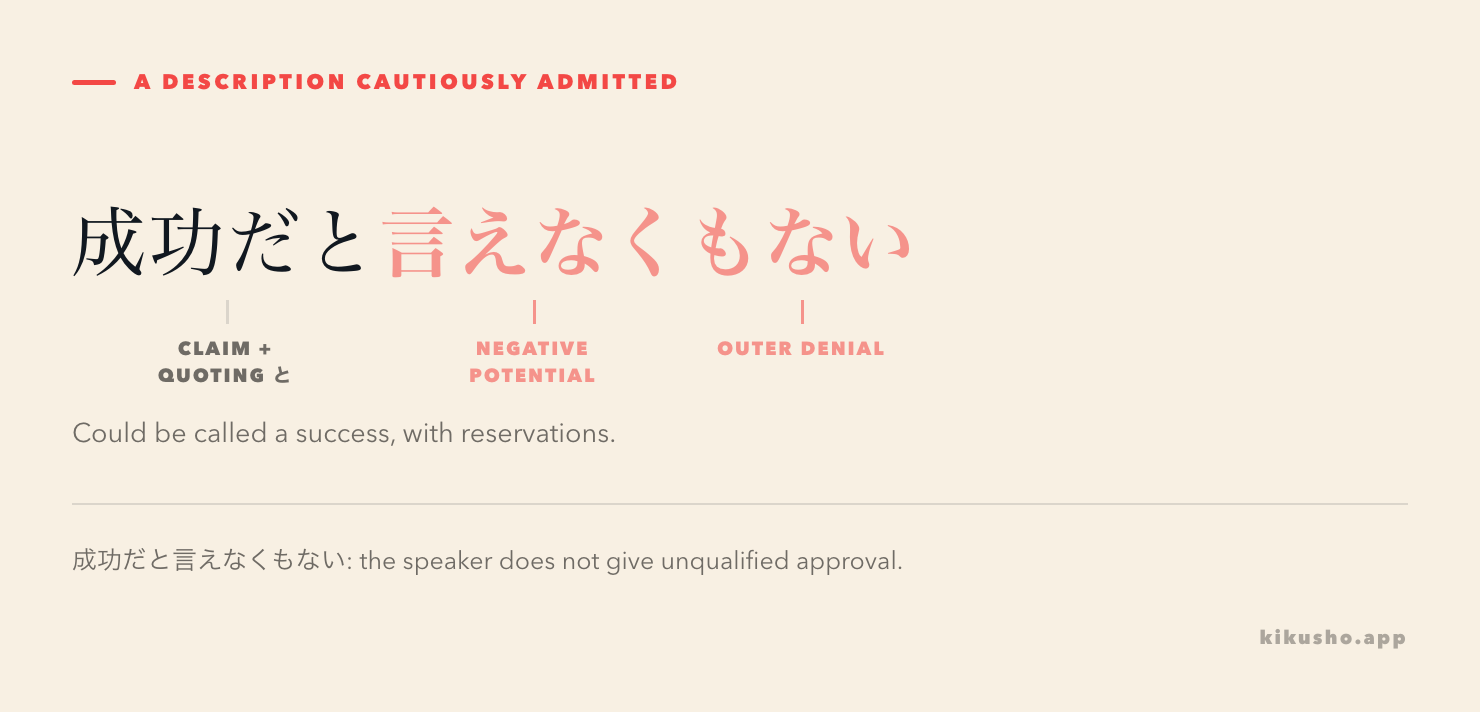
| Noun predicate | 成功だ(せいこうだ), a success | 成功だと言えなくもない |
With a noun or な-adjective description, だ or the written である may appear before と. You can also meet a bare noun label, 成功と言えなくもない. Do not attach the noun-modifying な as in 便利なと言えなくもない.
この試みは成功だと言えなくもないが、費用がかかりすぎた。
この こころみは せいこうだと いえなくもないが、ひようが かかりすぎた。
This attempt could be called a success, but it cost too much.
試み is an attempt; 費用 is expense. The achievement permits the label 成功, while cost prevents unqualified praise. The が clause spells out that objection. 絵でわかる日本語's と言えなくもない page checks the ordinary-predicate attachment and this noncommittal judgment.
A university analysis by 田中寛 also describes といえなくもない as conceding that there is some basis for a judgment, often from a particular perspective. That is a useful reading habit: ask under which description or standard does this claim survive? See section 4.4 of the paper.
The statement being qualified can still be negative
The outer double negative qualifies your willingness to make a claim. It does not decide whether that claim contains praise or criticism.
この説明は不十分だと言えなくもない。
この せつめいは ふじゅうぶんだと いえなくもない。
This explanation could be considered inadequate, to some extent.
不十分 means insufficient or inadequate. The adjective is adverse, even though the speaker tentatively accepts it. Do not translate the sentence as “the explanation is adequate” merely because two negative endings occur later.
An explicitly negated description works the same way:
彼の説明は正しくないと言えなくもない。
かれの せつめいは ただしくないと いえなくもない。
You could say that his explanation is not correct, with some reservation.
The statement before と is 正しくない, “not correct,” from 正しい(ただしい). Treat と言えなくもない as the frame around that statement. The full sentence cautiously allows a criticism; it does not confidently endorse the explanation. This separation is more reliable than trying to cancel every ない in a long line.
For another kind of concession, ないまでも and なりとも organise a higher degree and a smaller minimum. That is a different relation from saying that a description is defensible.
Formal wording can be less committed than a short affirmative
引き受けます, “I'll take it on,” provides a clear acceptance. 引き受けないものでもない leaves acceptance available while holding something back. A longer expression can commit you to less.
Likewise, 成功だ, “It is a success,” and 成功だと言えなくもない do different work in an evaluation. Use the latter when the reservation belongs in the meaning; formality alone is not a reason to weaken a clear decision. Neither ending automatically supplies honorific or humble grammar.
Other double negatives reverse a different denial. In ざるを得ない, avoiding the action is unavailable, so circumstances make it necessary. Here the two assigned constructions leave a possibility or judgment available. Learn each complete relation rather than a rule that two negatives always mean either “must” or “perhaps.”
When an assessment contains 成功だと言えなくもないが…, the objection after が is useful material for a Kikusho example. Paste the assessment and keep that objection in the editable card, so retrieving 成功 does not erase the writer's reservation. The phrase's register note can remind you why a guarded evaluation sounds different from a definite acceptance.
Practice questions
Work through these six original exercises before consulting the numbered explanations that follow.
Question 1
Complete the guarded willingness to revise. Use the construction containing もの, with the ordinary plain negative of する.
時間があれば、修正を( )。
修正(しゅうせい)means revision.
- A. するないものでもない
- B. しませんものでもない
- C. しないものでもない
- D. しなくものでもない
Question 2
Interpret the response while retaining its reservation rather than assuming a final decision.
日程が合えば、会議に参加しないものでもない。
日程(にってい)means schedule; 参加する(さんかする)means participate.
- A. Participation is possible if the schedule works, but is not firmly promised.
- B. The speaker has already attended every meeting.
- C. The speaker must participate whatever the schedule.
- D. The speaker absolutely refuses to participate.
Question 3
Arrange the four fragments once each to make the reserved evaluation. Identify the fragment occupying ★.
この案は__ __ ★ __。
案(あん)means proposal; 現実的(げんじつてき)means realistic.
- A. ない
- B. 現実的だ
- C. と言えなく
- D. も
Question 4
Choose the closing comment that fits both the improvement and the remaining difficulty.
新しい手順で待ち時間は短くなった。ただ、操作はまだ複雑だ。この変更は改善だ( )が、問題が全部解決したわけではない。
手順(てじゅん)means procedure; 操作(そうさ)means operation; 複雑(ふくざつ)means complicated.
- A. と言えなくもな
- B. と言えなくもない
- C. なと言えなくもない
- D. と言いなくもない
Question 5
Select the sentence that cautiously permits a criticism of the explanation, rather than affirming its correctness.
- A. この説明は正しい。
- B. この説明は正しくないとは言えない。
- C. この説明は正しくないと言えなくもない。
- D. この説明は正しいとしか言えない。
Question 6
Read the exchange and choose what can be concluded without inventing enthusiasm or a guarantee.
A:「この修理、一人でできますか。」 B:「時間はかかりますが、できないものでもないです。」
- A. B leaves open the possibility of doing it alone, while warning about time.
- B. B says the repair cannot possibly be done alone.
- C. B guarantees that the repair will be finished immediately.
- D. B has already completed the repair alone.
Answers and explanations
Keep the action's feasibility separate from a judgment about its description when assessing your choices.
Answer 1: C. しないものでもない keeps the irregular verb's plain negative しない and adds ものでもない. A appends ない to the dictionary form; B uses the polite negative inside a plain-negative attachment; D changes ない to なく before the wrong continuation. The resulting offer remains guarded even when time is available.
Answer 2: A. 参加しないものでもない leaves participation open, and 日程が合えば makes the schedule a condition. C replaces this possibility with an unconditional duty. D treats the outer denial as if it were absent. B introduces completed attendance and frequency, neither stated in the response.
Answer 3: D at ★. The order is B → C → D → A: この案は現実的だと言えなくもない。 “This proposal could be considered realistic, with reservations.” 現実的だ supplies the adjective predicate; と introduces that evaluation; 言えなく joins to もない. The fixed sequence prevents moving も before the description or putting ない before 言えなく.
Answer 4: B. 改善だと言えなくもない tentatively accepts the label improvement, which the shorter waiting time supports. The following clause preserves the unresolved problems. A drops the final い; C inserts noun-modifying な after an already complete predicate 改善だ; D fails to use the potential 言える. Here 改善(かいぜん)is improvement and 解決(かいけつ)is resolution.
Answer 5: C. The description before と is 正しくない, and the outer frame admits that criticism with a reservation. A asserts correctness. B denies being able to say “not correct,” pulling in the other direction. D restricts the available judgment to “correct.” None of those alternatives preserves this cautiously adverse assessment.
Answer 6: A. B concedes feasibility while warning that the repair takes time. The potential verb is inside できないものでもない, so B is not denying every possibility of doing it. C adds a quick finish; D adds a completed past event. B's polite final です changes how the reply addresses A, without turning the qualified answer into a guarantee.
Common questions
What does ないものでもない mean?
It cautiously leaves an action or possibility open, often under a condition. Use a verb in its plain negative form followed by ものでもない: 引き受けないものでもない can mean that the speaker might be willing to take something on. It does not make the action compulsory or promise that it will happen.
What does と言えなくもない mean?
It means that a description could be defended to some extent, while the speaker withholds a firm assertion. 成功だと言えなくもない means that something could be called a success, with reservations. Put the plain statement or noun description before と; 言えなくもない is the fixed qualifying ending.
Do Japanese double negatives always mean must?
No. Different constructions negate different things. ないものでもない leaves a possibility open and と言えなくもない tentatively accepts a description. Other patterns can express obligation. Identify the complete construction instead of assigning one meaning to every pair of negatives.