On this page
Five N3 words cluster around a single job: taking something that lives inside you, whether a feeling, a meaning or your own name, and giving it an outward form. 表す (あらわす), 示す (しめす) and 表現 (ひょうげん) turn thoughts into words or signs; 署名 (しょめい) and サイン put your identity onto a page. The trouble is that four of them collapse into "show," "express" or "signature" in an English gloss, so a learner reaches for whichever one surfaced first and picks wrong about half the time.
This page keeps them apart. It is the vocabulary the JLPT files under reading, writing and verbal expression: words you have to produce, not only recognise on a list.
Why these five belong together
Japanese draws a line English does not. When you make something inner visible, the language cares whether you are giving it a form of its own or pointing a reader at it. 表す and 表現 sit on the first side: they bring what was inside up to the surface, which is the whole point of the kanji 表, the "outward face" of a thing. 示す sits on the second: you direct someone's attention to something so they can see it for themselves.
署名 and サイン are the same instinct made physical. A signature is the smallest possible act of putting yourself into a written form, and Japanese keeps two words for it: one formal and homegrown, one borrowed and everyday.
Learn them as a group and the group teaches the split. Learn them one flashcard at a time and they blur, because every gloss you meet will use the same three English words.
The set, at a glance
The readings are the first thing to fix, because two of these kanji hide a verb you already half-know and one word is not kanji at all.
| Word | Reading | Type | The job it does | A phrase it lives in |
|---|---|---|---|---|
| 表す | あらわす | transitive verb | give an inner thing an outward form | 感謝を表す (express gratitude) |
| 示す | しめす | transitive verb | point out, indicate, demonstrate | 道を示す (show the way) |
| 表現 | ひょうげん | noun / する-verb | expression; a phrasing | 表現の自由 (freedom of expression) |
| 署名 | しょめい | noun / する-verb | your own name written formally | 署名を集める (collect signatures) |
| サイン | — | noun / する-verb | signature, signal, or sine | サインをもらう (get an autograph) |
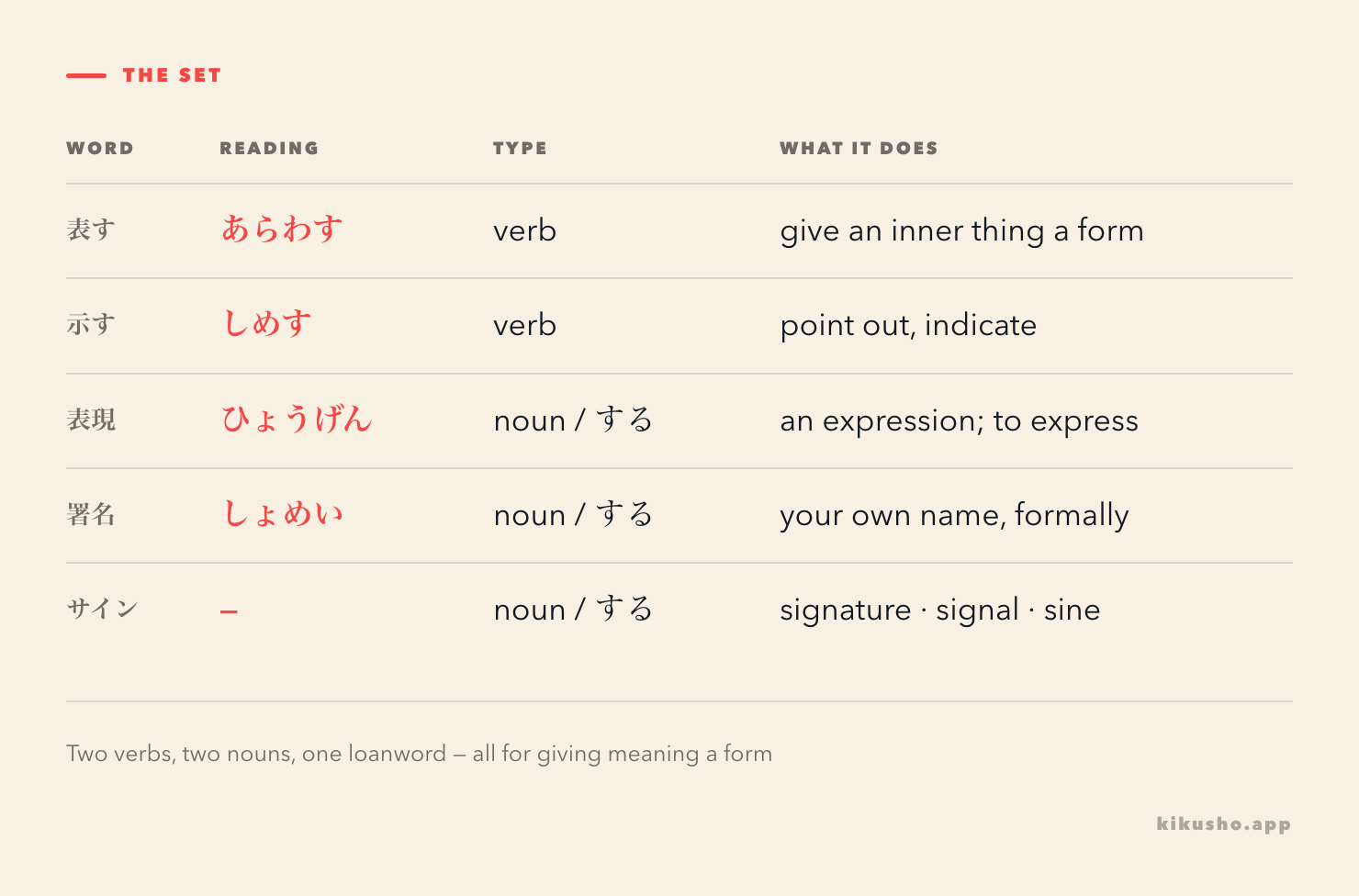
Notice that 表す and 表現 share the 表 kanji, and that サイン, alone in the set, carries no kanji and no Japanese root.
表す and 示す both come out as "show"
Here is the pair that costs marks. A dictionary gives 表す as "to express, to show" and 示す as "to show, to indicate," and from those two lines you cannot tell them apart. The distinction is not in the translation; it is in what you are doing to the thing.
表す gives an inner or abstract thing an outward form. A feeling becomes words, a meaning becomes a symbol, a quantity becomes a mark on a page. The thing was already there, formless, and you supply the form.
- 感謝の気持ちを言葉で表す。 Express one's gratitude in words.
- この記号は「危険」を表す。 This symbol stands for "danger."
示す points a reader at something so they can see it. A direction, a piece of evidence, an attitude, a worked example. You are not giving it form; you are directing attention to it.
- 彼は地図で駅の場所を示した。 He pointed out the station on the map.
- データは景気の回復を示している。 The data indicates an economic recovery.
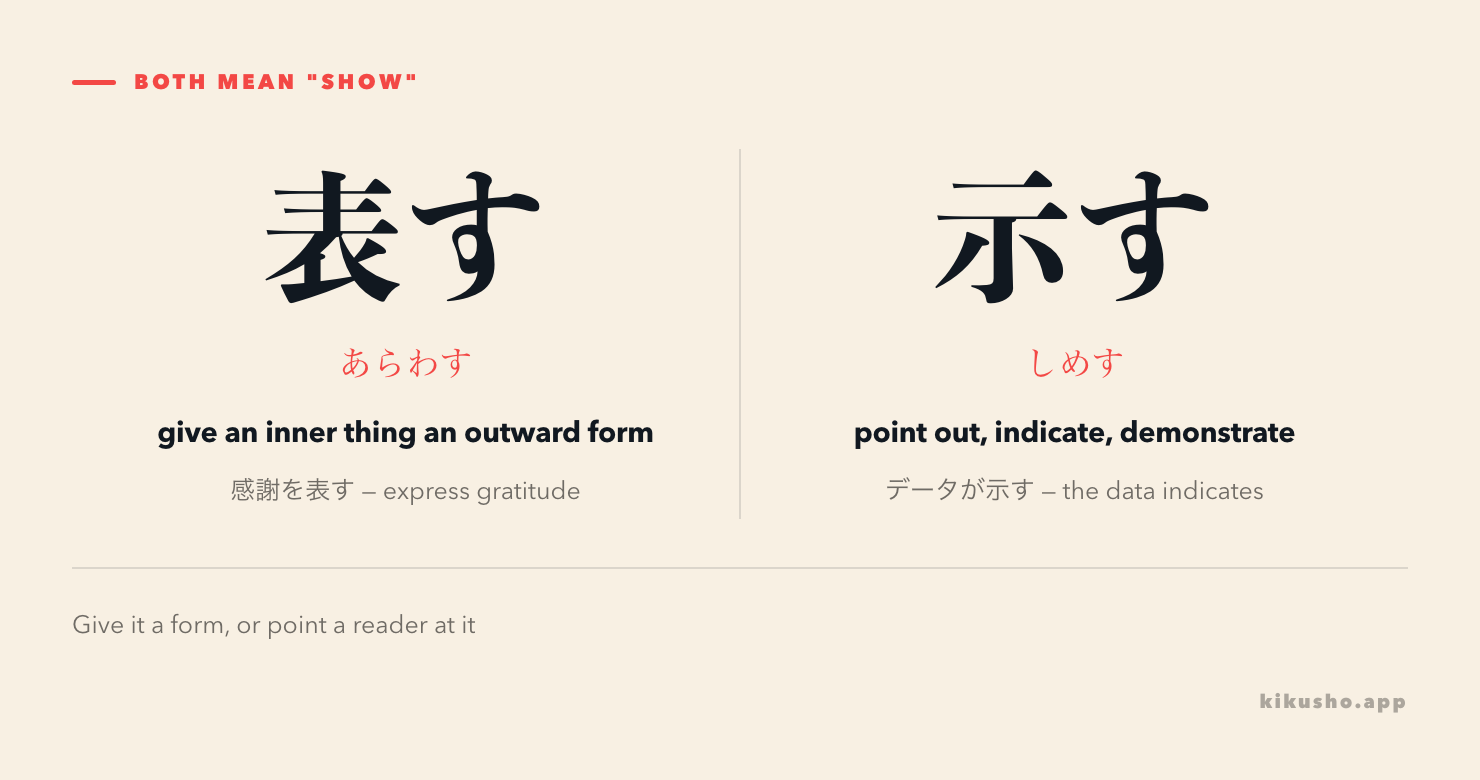
The test that decides most cases: could you replace "show" with "express" or "embody"? Then it is 表す. Could you replace it with "point out," "indicate" or "demonstrate"? Then it is 示す. A graph shows a trend two ways. グラフで結果を表す gives the result a graphical form, while グラフが傾向を示す points you at the trend inside it.
The two overlap around feelings and intentions, where both are grammatical and the nuance shifts. 誠意を示す leans on demonstrating your sincerity to the other person; 感謝を表す leans on the outward form your thanks takes. Pick by which half of the meaning you want in front.
表現 is what 表す leaves behind
Turn 表す into a noun and you get 表現. It keeps the 表 and the idea: the outward form that inner content takes. That is how N3 abstract nouns tend to work, where the kanji carry the meaning and knowing one character opens several words. Two ways to use it, and N3 wants both.
As a する-verb it means "to express," close to 表す but reaching further into art, language and gesture: 感情をうまく表現できない, "I can't express my feelings well." As a plain noun it is countable, meaning an expression or a turn of phrase. In 「腹が立つ」は怒りを表す表現だ, the phrase hara ga tatsu is called an expression that conveys anger, and that one sentence puts the verb and the noun side by side, which is exactly how they divide the work.
This is where Kikusho fits the second kind. A phrasing like 丁寧な表現 or 表現の自由 is rarely something you sit down to look up; it slides past in a subtitle or on a sign and is gone. Capturing it by voice, photo or pasted text hands back an editable card that carries the reading and the nuance the phrase held in that sentence, so what you keep is the expression you met, not a dictionary's closest headword. Reviewing it afterwards runs offline, on the same FSRS schedule as the rest of your deck.
署名 and サイン are two different signatures
Both get translated "signature," and they are not interchangeable. The split is register, the same axis that separates a formal synonym from the everyday word you already know, and getting it wrong reads as either stiff or careless.
署名 is the formal act of writing your own name to authenticate a document and take responsibility for it: contracts, petitions, official declarations. It has to be your own hand. The related 記名 only means a name written by any means, a printed or stamped label, which is why a form will ask for 署名 when it wants your commitment and not just your details.
サイン is the everyday word, and it does three unrelated jobs because it is borrowed straight from English "sign":
- Signing something casually: 契約書にサインする, sign the receipt or the form.
- A celebrity's autograph: 選手にサインをもらった, I got the player's autograph.
- A signal, or the mathematical sine: ピッチャーにサインを送る, send the pitcher a sign.
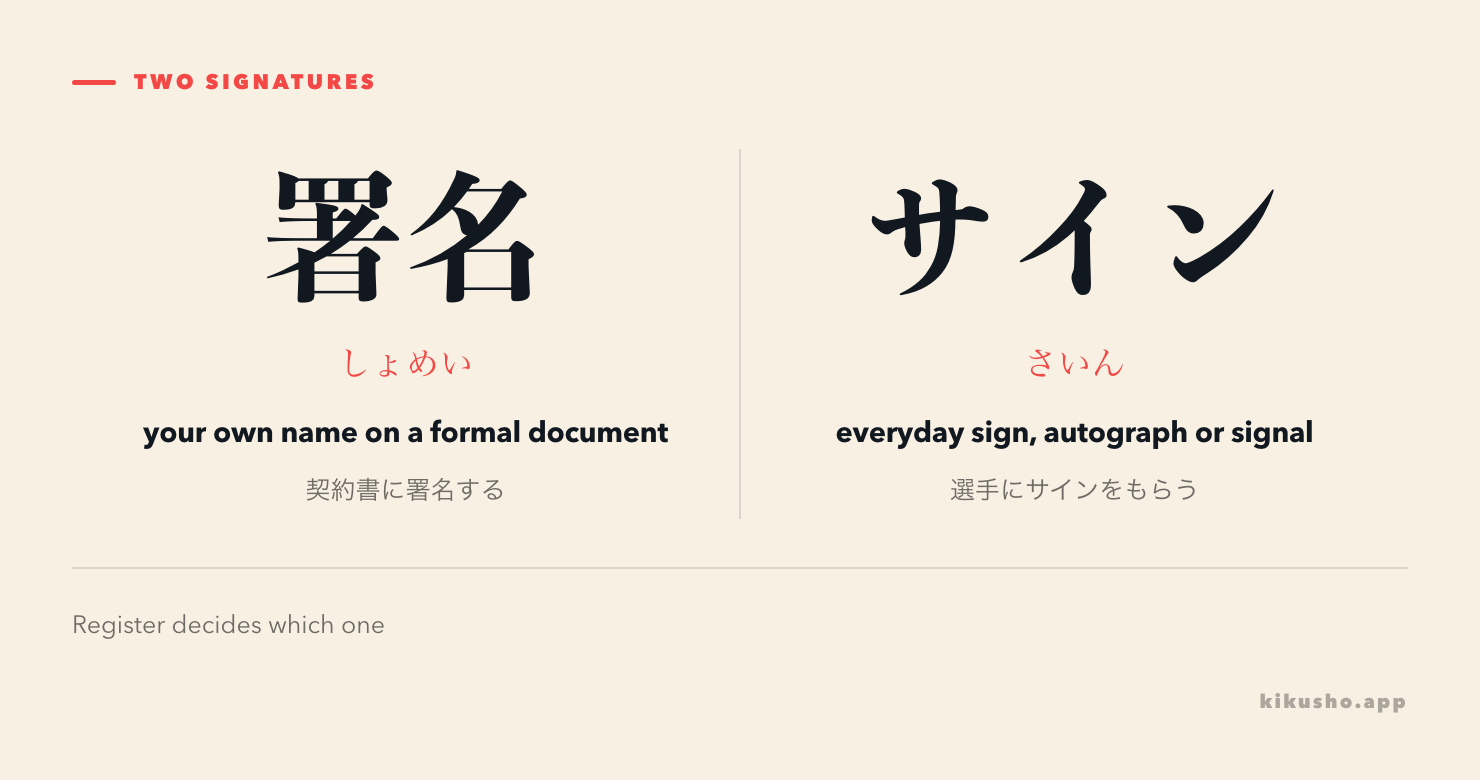
On a lease or a petition, use 署名. Handing back a card reader at a till, you will hear サイン. Asking a musician to sign your ticket, only サイン works, and 署名 would be absurd there.
What breaks the set
A set is worth owning when the members that don't fit teach you as much as the ones that do.
サイン is the outlier twice over. It is the only member with no kanji, so it will never test you on a reading, but it is also the only one whose meanings scatter, because English "sign" arrived carrying a signal and a trig function that have nothing to do with the others. That scattering is a habit worth expecting: plenty of N3 verbs run several meanings at once, and the collocation around them decides which is live. Meet サイン and you have to read the context, not the word.
示す is the quieter outlier. The rest of the set works from the inside out, surfacing a feeling, a name or an expression. 示す works from the outside: the thing already exists, and you turn a reader toward it. That is why data, maps and examples take 示す and not 表す, and it is the single fact that resolves most of the pair above.
Which of these you will meet first
Not in the order a list prints them.
表現 and サイン are the daily two. 表現 turns up the moment you ask "how do you say…," alongside the N3 verbs for saying things, and サイン waits at every till and signing. 示す is a reading and writing word: reports, instructions, data, the sentence that says what a result means. 表す lives in set phrases and explanations, often beside 表現. 署名 you will meet the first time you fill in a Japanese form, and rarely in speech.
So if you are drilling for the exam's reading and verbal-expression sections, 示す and 表現 earn the most attention: they carry the abstract, argue-a-point sentences N3 is built on. サイン and 署名 are the pair you keep straight once, then never confuse again.
Test yourself
Attempt all five before opening the key.
1 · Kanji reading. Read the underlined word aloud: このグラフは人口の変化を示している。 (a)あらわして (b)しめして (c)しょめいして (d)ひょうげんして
2 · Context. Fill the blank: 「もったいない」は日本語らしい___だ。 (a)表現 (b)署名 (c)サイン
3 · Context. Pick 表す or 示す: 彼は言葉ではなく、態度で本気を___た。 (a)表し (b)示し
4 · Usage. Which sentence uses サイン correctly? (a)大事な契約なので、正式にサインを集めた。 (b)好きな選手にサインをもらって、うれしかった。
5 · Paraphrase. 会員が全員で書類に署名した most nearly means: (a)every member wrote their own name on the document (b)every member stamped the document with a seal (c)every member read the document aloud
Show, point out or sign: the key
- (b) しめして. 示す is read しめす, so the underlined 示している is しめしている. A graph indicating a trend points the reader at it, the core of 示す's job, while (a) あらわして belongs to 表す, not 示す.
- (a) 表現. A turn of phrase that feels characteristic of a language is a 表現. 署名 (b) is a signature and サイン (c) an autograph or signal, and neither is a phrasing.
- (b) 示し. He shows his seriousness through his attitude, directing it at the other person, which is what 示す does. 表す would suggest giving the seriousness a form of its own, a weaker fit for the "demonstrate to someone" reading that 態度で sets up.
- (b). サイン covers a celebrity's autograph, so もらって (receiving one) is natural. In (a) the setting is a formal contract and 集めた ("collected") points to gathering many signatures on a petition, which is 署名 territory, not one person's サイン.
- (a) they wrote their own name. 署名 is specifically writing your own name by hand. Option (b) describes 記名 or a seal, a name put down by any means, and (c) has nothing to do with signing at all.
Behind all five is one habit English never makes you form: before you say "show," Japanese asks whether the thing was already out there for you to point at, or still inside you waiting for a shape. Answer that, and the word chooses itself.
Common questions
What is the difference between 表す and 示す?
Both are often glossed "to show," but 表す (あらわす) means to give an inner thing an outward form: a feeling put into words, a meaning carried by a symbol. 示す (しめす) means to point something out or demonstrate it to someone, such as a direction, a trend in data, or your intentions. Give form, or point out.
Is サイン the same as 署名?
They overlap but differ in register. 署名 (しょめい) is the formal act of writing your own name on a document: contracts, petitions, official forms. サイン is the everyday loanword: signing a receipt, a celebrity's autograph, and, separately, a signal or the mathematical sine. On a legal document the word is 署名.
Is 表現 a verb or a noun?
Both. 表現する means "to express" (感情を表現する, to express one's feelings), and 表現 on its own is a countable noun meaning "an expression" or "a phrase" (丁寧な表現, a polite expression).