On this page
に越したことはない presents an action or state as the preferable, safest or ideal choice. 早めに予約するに越したことはない means “It is best to book early,” but it does not say that early booking is a rule or an absolute necessity.
The expression literally says that nothing surpasses what comes before に. In practice, English often needs a modest “it is best to,” “you are better off,” or “the more X, the better.”
混雑する時期だから、ホテルは早めに予約するに越したことはない。
こんざつする じきだから、ホテルは はやめに よやくするに こしたことはない。
It is a busy season, so it is best to book the hotel early.
Booking late remains possible. The speaker names the prudent course before problems arise.
The form marks an ideal, not an obligation
に越したことはない(にこしたことはない, ni koshita koto wa nai) often appears in advice about safety, preparation, cost or convenience. It can sound like common sense shared with the listener.
| Sentence | Force |
|---|---|
| 早めに予約しなければならない | You must book early; necessity |
| 早めに予約したほうがいい | You should book early; direct advice |
| 早めに予約するに越したことはない | Booking early is the preferable course; ideal or precaution |
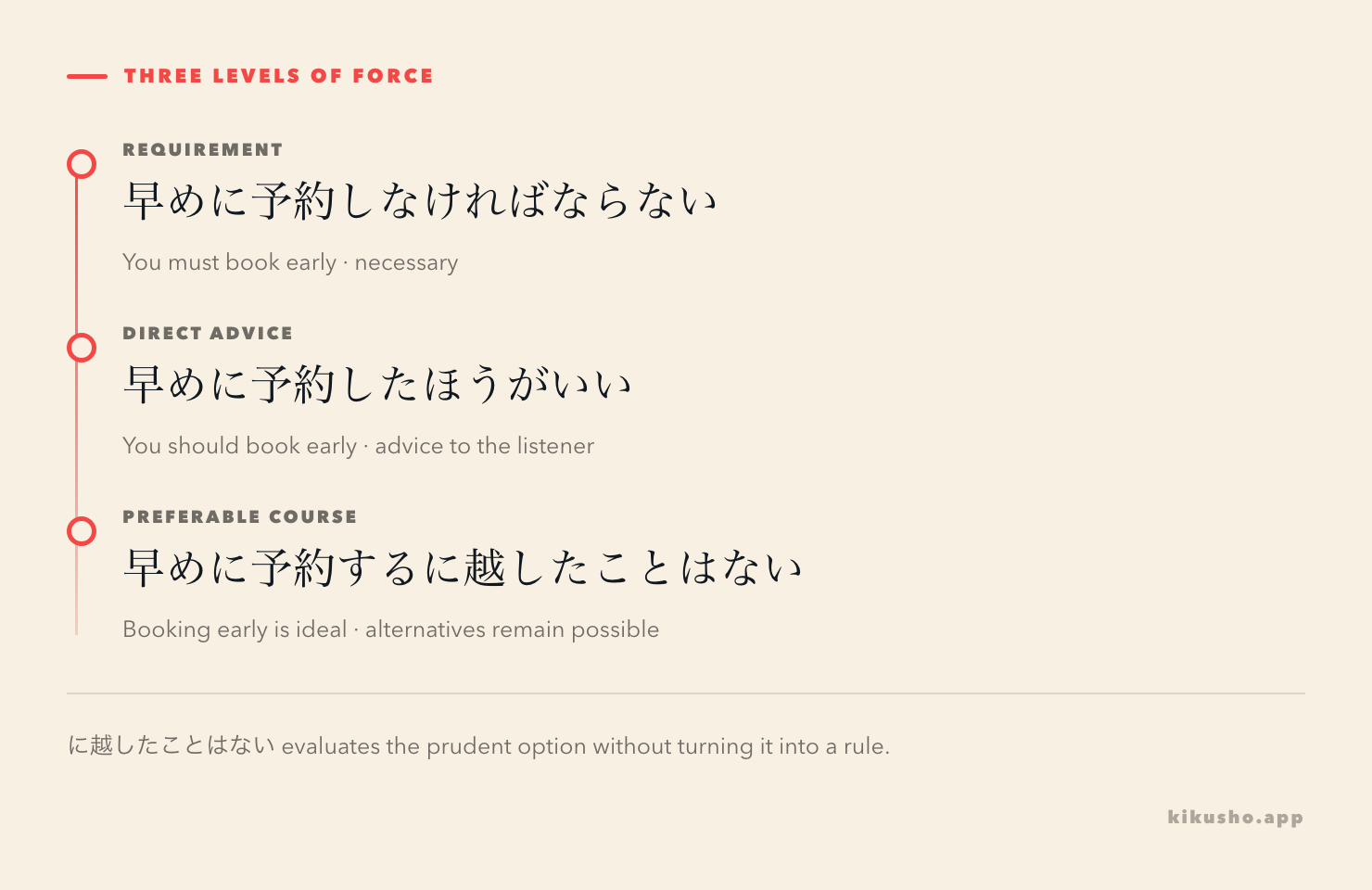
The first sentence imposes a requirement. The second directly advises the listener. The third evaluates the option itself: among the available choices, earlier is better.
Tanosuke's N2 explanation describes the form as a sensible or safer choice that need not be absolutely required. Japanese NET independently gives the same “better or safer” account and places it at N2.
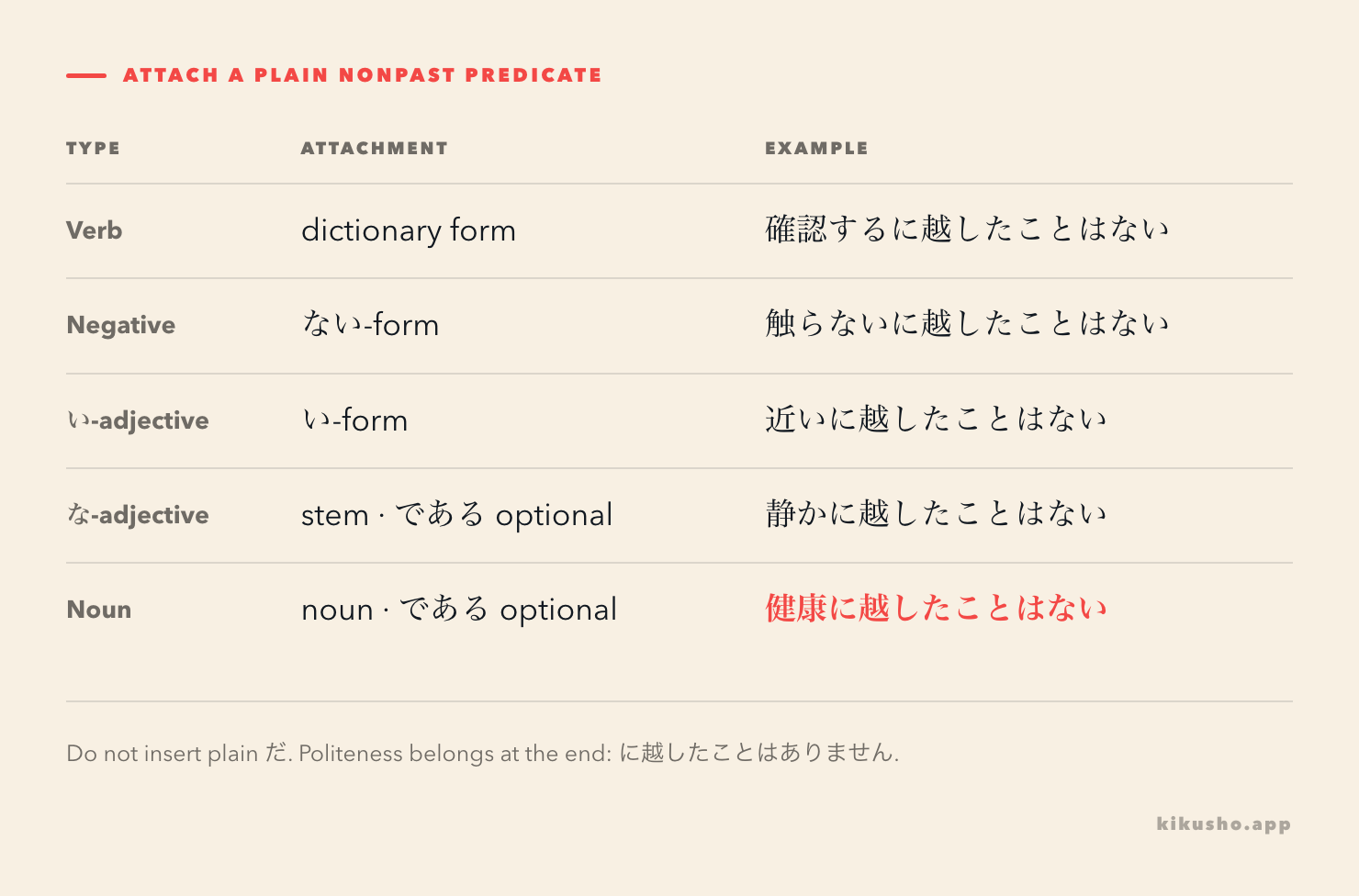
Attach a plain nonpast predicate before に
Verbs use the plain nonpast form, including ない when the preferred course is not doing something. い-adjectives keep い. Nouns and な-adjectives attach directly, with optional である in more formal wording.
| Predicate | Attachment | Example |
|---|---|---|
| Verb | dictionary form + に越したことはない | 確認するに越したことはない |
| Negative verb | ない-form + に越したことはない | 触らないに越したことはない |
| い-adjective | い-form + に越したことはない | 近いに越したことはない |
| な-adjective | stem + (である)+ に越したことはない | 静か(である)に越したことはない |
| Noun | noun + (である)+ に越したことはない | 健康(である)に越したことはない |
大切なデータは、別の場所にも保存するに越したことはない。
たいせつな データは、べつの ばしょにも ほぞんするに こしたことはない。
Important data is best saved in another location too.
危険な場所には近づかないに越したことはない。
きけんな ばしょには ちかづかないに こしたことはない。
It is best not to approach a dangerous place.
The negative belongs to the recommended proposition: 近づかない is what the speaker considers safest. The final ない in ことはない is part of the fixed expression and does not cancel that negative.
For a な-adjective, both of these are possible:
- 住む場所は静かに越したことはない。 Ideally, the place where you live is quiet.
- 住む場所は静かであるに越したことはない。 The same judgement in a more explicit, formal shape.
Do not insert plain だ: 静かだに越したことはない is not the target attachment.
越した does not put the recommendation in the past
The 越した inside the phrase comes from 越す, “to surpass,” but the whole construction is fixed. It normally follows a nonpast proposition and evaluates what is preferable now or in general.
出発前にもう一度確認するに越したことはない。
しゅっぱつまえに もういちど かくにんするに こしたことはない。
It is best to check once more before departure.
The recommendation concerns a future check even though the written form contains 越した. Do not change the preceding verb to past 確認した merely because the trip is being discussed in the past.
The polite ending is に越したことはありません:
念のため、身分証明書も持参するに越したことはありません。
ねんのため、みぶんしょうめいしょも じさんするに こしたことはありません。
To be safe, it is best to bring identification as well.
Politeness changes only the final ない/ありません. The predicate before に stays plain.
Negative forms recommend the absence of a problem
Sometimes the ideal is a state in which nothing bad happens:
旅行中のトラブルはないに越したことはない。
りょこうちゅうの トラブルは ないに こしたことはない。
Ideally, there will be no trouble during the trip.
This can look like two negatives, but their jobs differ. The first ない describes the desired absence of trouble. The fixed ことはない says that no alternative surpasses that state.
The pattern often continues with が, けれど or とはいえ because real choices involve a tradeoff:
駅から近いに越したことはないが、家賃も考えなければならない。
えきから ちかいに こしたことはないが、やちんも かんがえなければならない。
Being close to the station would be ideal, but we also have to consider the rent.
The first clause states the ideal; the second admits a constraint. This is one reason the form is less absolute than it first appears.
〜ば〜に越したことはない strengthens a scale
A common frame repeats a gradable adjective around ば:
荷物は軽ければ軽いに越したことはない。
にもつは かるければ かるいに こしたことはない。
The lighter the luggage, the better.
連絡は早ければ早いに越したことはない。
れんらくは はやければ はやいに こしたことはない。
The sooner the contact, the better.
The conditional establishes the scale, and the repeated adjective identifies its preferred end. The structure is 安ければ安い, not 安いなら安い. The broader ば〜ほど lesson teaches proportional change such as “the more you read, the faster you become”; 〜ば〜に越したことはない instead judges one end of a scale as ideal.
This frame still allows a limit:
値段は安ければ安いに越したことはないが、品質は確かめたい。
ねだんは やすければ やすいに こしたことはないが、ひんしつは たしかめたい。
The cheaper the better, but I want to check the quality.
The speaker prefers lower cost while refusing to make price the only criterion.
に限る makes a more categorical preference
Both に越したことはない and recommendation に限る can translate as “nothing beats.” Their stance differs.
旅行の前には、早めに準備するに越したことはない。
Before a trip, preparing early is the safer or preferable course.
疲れた夜は、早く寝るに限る。
On a tiring night, nothing beats going to bed early.
The first sentence presents a prudent ideal that most people could accept. The second sounds like the speaker's firmer choice, often grounded in personal experience. Bunpro's comparison likewise describes に限る as more categorical and に越したことはない as a desirable option that is not essential.
The difference does not mean that one is always objective and the other always subjective. Context can blur the boundary. Use the contrast as a production guide: choose に越したことはない when less ideal alternatives remain acceptable, and recommendation に限る when you want to endorse one option as the best.
The full lesson on に限る, に限り, に限らず and に限って also separates this preference use from restriction and exception meanings.
Level placement and a useful way to save the form
JLPT Sensei, Bunpro, Tanosuke and Japanese NET all place に越したことはない at N2. Some newer teaching pages label it N1, which reflects the usual disagreement among unofficial study lists. Since the exam organizer supplies no exhaustive post-2010 grammar list, Kikusho follows the converging N2 references while recording the boundary as editorial guidance.
Save the reason with the recommendation in Kikusho. A card containing only 準備するに越したことはない tells you the form, but 天気が変わりやすいから、雨具も準備するに越したことはない preserves why the advice is prudent. That clue helps you recover the “preferable, not mandatory” stance during review.
Practice questions
Finish the six questions before opening the shared solution block.
Question 1
Which sentence says that checking once more is the prudent choice, without making it an obligation?
- A. もう一度確認しなければならない。
- B. もう一度確認するに越したことはない。
- C. もう一度確認するわけがない。
- D. もう一度確認したことはない。
Question 2
Complete the blank after the な-adjective 安全.
子供が遊ぶ場所は、安全( )。
- A. だに越したことはない
- B. なに越したことはない
- C. に越したことはない
- D. でに越したことはない
Question 3
Put the fragments in order. Which fragment fills ★?
連絡は __ __ ★ __。
- A. 早い
- B. 早ければ
- C. ことはない
- D. に越した
Question 4
What does the negative sentence mean?
大きな事故はないに越したことはない。
- A. A major accident is impossible.
- B. It is best if there is no major accident.
- C. There has never been a major accident.
- D. A major accident is required.
Question 5
Choose the more natural ending for a speaker who presents one personal remedy as categorically best.
頭が疲れたときは、少し散歩する( )。
- A. に限る
- B. に越したことはないが
- C. とは限らない
- D. しかないことはない
Question 6
Complete the short passage with the option that keeps preparation desirable but not compulsory.
山の天気は変わりやすい。晴れの予報でも、雨具を持って行く( )。ただし、荷物が重すぎる場合は装備全体を見直そう。
- A. べきではない
- B. に相違ない
- C. に越したことはない
- D. ざるを得ない
Commit to every response now; all answers and explanations are concealed below.
Answers and explanations
Read the predicate before に as the option being evaluated, then decide whether the sentence presents an ideal, an obligation or a categorical preference.
Answer 1: B. 確認するに越したことはない evaluates another check as the preferable precaution. A makes it necessary. C says the check cannot reasonably happen, and D says the speaker has no experience of having checked.
Answer 2: C. The な-adjective stem attaches directly: 安全に越したことはない. 安全であるに越したことはない is also possible in more formal wording, but plain だ, attributive な and isolated で do not fit the displayed slot.
Answer 3: D at ★. The order is B → A → D → C: 連絡は早ければ早いに越したことはない. The conditional and repeated adjective create “the earlier,” while に越したことはない evaluates that end of the scale as best.
Answer 4: B. The first ない describes the desired absence of an accident. The fixed ending then says no alternative surpasses that state. The sentence expresses an ideal, not impossibility, past experience or obligation.
Answer 5: A. Recommendation に限る fits a firm personal endorsement: “When my head is tired, nothing beats a short walk.” B leaves the sentence hanging with a contrast marker and is less categorical. C denies certainty, while D is not a valid form for this meaning.
Answer 6: C. 持って行くに越したことはない presents rain gear as the prudent option while the next sentence allows a tradeoff with weight. A advises against it. B expresses confident inference, and D says circumstances make taking it unavoidable.
Common questions
What does に越したことはない mean?
It says that one action or state is the ideal, preferable or safest choice: “it is best to” or “nothing is better than.” It commonly recommends a good precaution without saying that the choice is absolutely required.
How do nouns and な-adjectives attach to に越したことはない?
Attach the expression directly to a noun or な-adjective stem, as in 健康に越したことはない and 静かに越したことはない. Formal wording may insert である: 健康であるに越したことはない.
What is the difference between に越したことはない and に限る?
に越したことはない presents an ideal while often allowing less ideal alternatives. The recommendation use of に限る is more categorical and foregrounds the speaker's preferred choice: “nothing beats X.”