On this page
この映画には考えさせられました is causative-passive, though it means “This film made me think,” not “I was forced to think as punishment.” 私は先生に作文を書かせられました uses the same pattern to say “I was made to write a composition by my teacher.” Japanese 使役受身形(しえきうけみけい) puts the person who acts or reacts at the center of an event someone else brought about.
This N4 lesson teaches the standard ~(さ)せられる form, common shorter godan forms, the change of sentence viewpoint, and the permission reading it does not carry. Learn the causative and passive separately first. JLPT Sensei places させられる at N4; the Japan Foundation teaches an unwanted-action use in Irodori Pre-Intermediate and treats reflective 考えさせられる later in Marugoto Intermediate 1. These are teaching sequences, not an official exhaustive JLPT grammar list.
The actor becomes the subject
Consider a plain causative: 母は私に皿を洗わせました (ははは わたしに さらを あらわせました), “My mother made me wash the dishes.” 母 is the causer; 私 is the person who washes; 皿を is the object. Turn the same event around: 私は母に皿を洗わせられました (わたしは ははに さらを あらわせられました), “I was made to wash the dishes by my mother.” The washer now heads the sentence. The object 皿を stays an object; the mother, if named, takes に.
| Viewpoint | Sentence | Who heads it? | Who washes? |
|---|---|---|---|
| Causative | 母は私に皿を洗わせました。 | 母, the causer | 私 |
| Causative-passive | 私は母に皿を洗わせられました。 | 私, the actor | 私 |
The ending does not say that the mother washed anything. It says her influence led to my washing, then lets the sentence follow my experience of that action. Mango Languages' instructor-authored explanation confirms this actor-to-subject shift; the Japan Foundation's Irodori notes show an unwilling actor with a named causer marked に.
Make the causative first, then make it passive
Do not add two endings directly to the dictionary form. First make the causative. That causative verb ends in る and behaves like an ichidan verb, so remove its final る and add passive られる. For 食べる, the path is 食べる → 食べさせる → 食べさせられる(たべさせられる). For 書く, it is 書く → 書かせる → 書かせられる(かかせられる). Mango Languages and the Japan Foundation independently give that order.
| Dictionary form | Causative | Full causative-passive | Shorter godan form |
|---|---|---|---|
| 書く(かく) | 書かせる | 書かせられる(かかせられる) | 書かされる(かかされる) |
| 飲む(のむ) | 飲ませる | 飲ませられる(のませられる) | 飲まされる(のまされる) |
| 歌う(うたう) | 歌わせる | 歌わせられる(うたわせられる) | 歌わされる(うたわされる) |
| 話す(はなす) | 話させる | 話させられる(はなさせられる) | No regular short form |
| 食べる(たべる) | 食べさせる | 食べさせられる(たべさせられる) | No godan short form |
| する | させる | させられる | Learn separately |
| 来る(くる) | 来させる(こさせる) | 来させられる(こさせられる) | Learn separately |
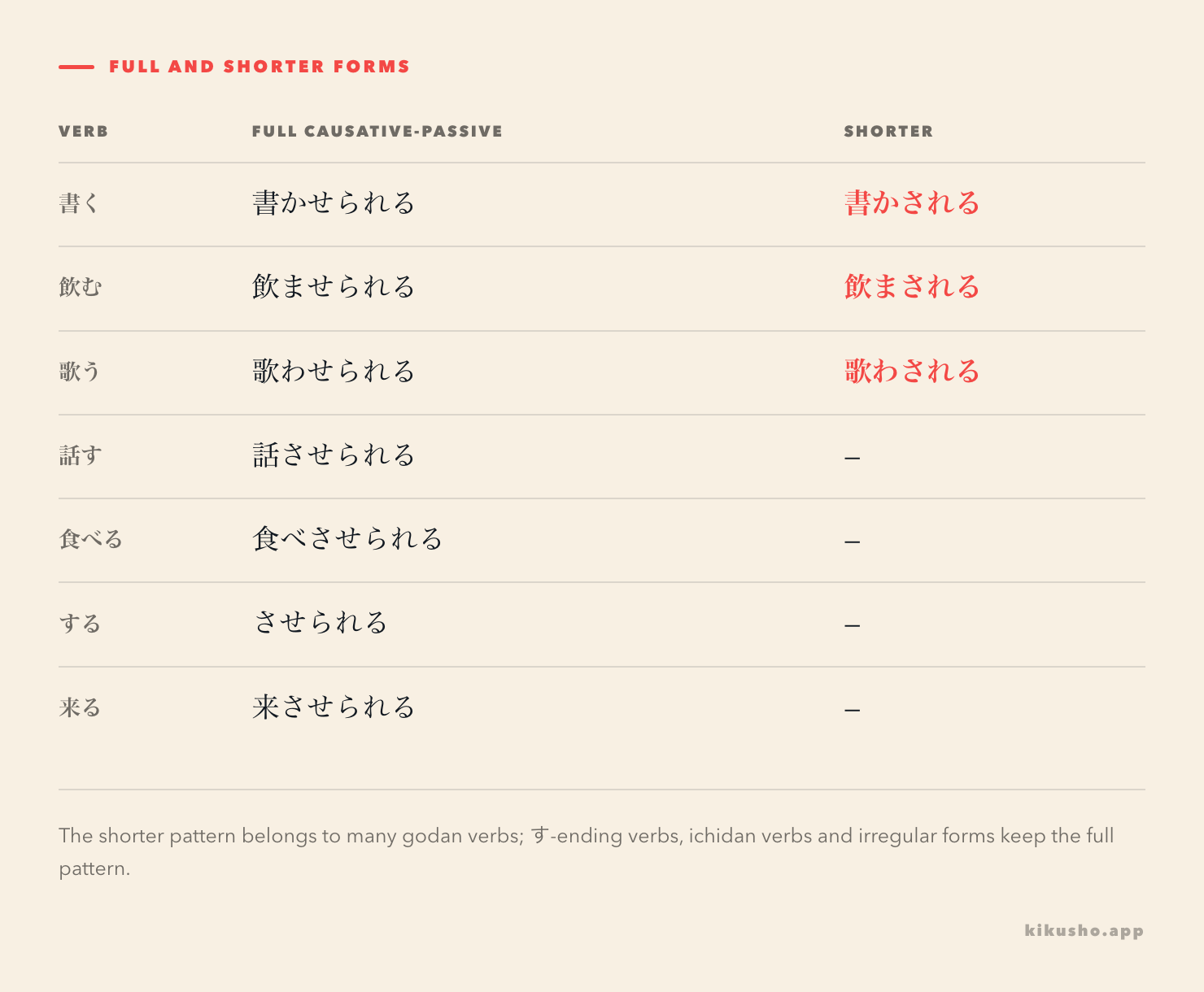
The shorter ~あされる pattern is common with many godan verbs: 飲まされる means the same core “was made to drink” as 飲ませられる. It is not a shortened version of every causative-passive. A godan verb ending in す keeps the full form 話させられる, not 話さされる; an ichidan verb keeps 食べさせられる, not 食べさされる. The う → わ change still appears in 歌わされる. Irodori prints 飲まされる, 歌わされる and the す-ending exception; Mango Languages compares the full and short spellings. Full forms remain useful for seeing the two grammatical steps, while the shorter forms matter for recognizing ordinary speech. Neither spelling alone fixes whether a person feels angry.
The result conjugates as an ichidan verb too: 書かせられる → 書かせられました, 書かせられない, 書かせられて. In shorter speech, 書かされました is a past polite alternative. Keep the passive ending when changing tense; 書かせました is only causative, with the causer's viewpoint.
A forced action often feels burdensome
昨日、上司に休日も働かされました (きのう、じょうしに きゅうじつも はたらかされました) means “Yesterday my boss made me work even on my day off.” 働く → 働かせる → 働かせられる/働かされる. The worker is the person the sentence follows; 上司に names the causer. 休日も explains why the action may feel unwelcome. The Japan Foundation's lesson uses this form for actions the speaker had to do regardless of their wishes, including pressure from circumstances rather than a deliberately cruel person.
友だちに駅で一時間待たされました means “A friend kept me waiting at the station for an hour.” Read 待たされました as またされました. The sentence presents waiting as something imposed on the speaker; it does not prove the friend intended to hurt them. 待つ → 待たせる → 待たせられる/待たされる is another full/short pair. Mango Languages distinguishes the actor's experience from the causer's act, and JLPT Sensei documents 待たされる as a spoken shorter form.
A film can make you think without making you complain
Now return to この映画には考えさせられました (この えいがには かんがえさせられました), “This film made me think.” The film prompted reflection; it did not assign a task. 考える → 考えさせる → 考えさせられる follows the same formation as another ichidan verb, but this use describes a thought that arose naturally. The Japan Foundation's Marugoto teaching notes explicitly distinguishes 考えさせられる from forced action and groups it with reactions such as surprise or being moved; Mango Languages independently explains the experience-focused reflective reading.
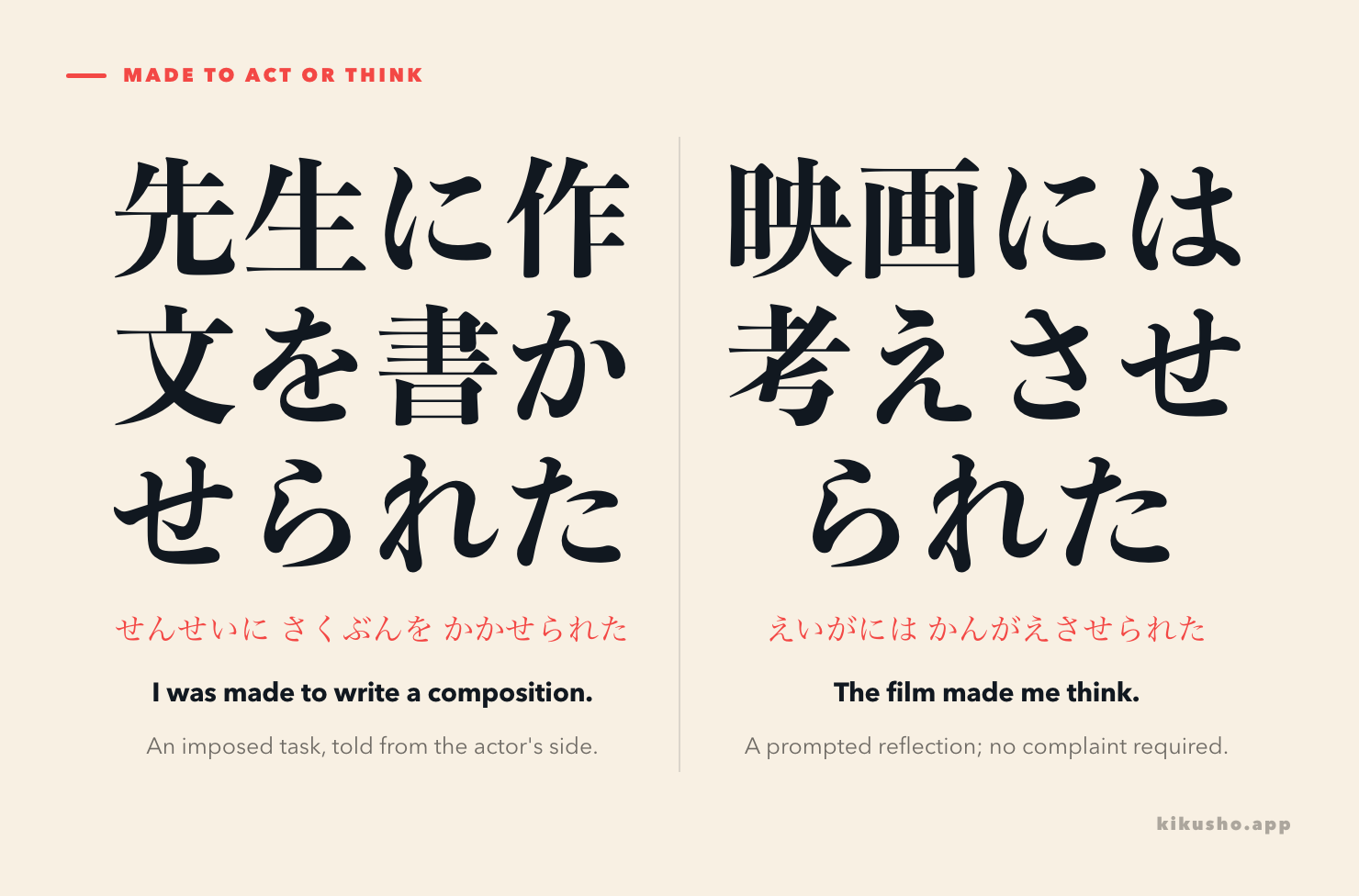
This reflective use is a limit on the easy rule “causative-passive equals complaint,” not a reason to translate every ~させられる as “made me think.” The verb and event still matter. The Japan Foundation teaches the unwanted-action form in Irodori Pre-Intermediate and discusses the broader reaction use in Marugoto Intermediate 1. Learn the N4 formation and forced-action reading here; recognize 考えさせられる without treating every reaction as an N4 exam requirement.
Permission needs a different ending
The ordinary causative can mean “let someone do something”; the causative-passive is a poor way to report receiving that permission. Compare 父に本を読ませられました, “My father made me read a book,” with 父に本を読ませてもらいました, “My father let me read a book.” The latter keeps causative 読ませて and adds receiving もらいました. It presents permission as a favour to the reader. Mango Languages and Tofugu's causative guide both distinguish that permission expression from “was made to read.”
Not every causative sentence can become a natural causative-passive either. A person can be made to run or read; a flower cannot usually be portrayed as unwillingly made to bloom by rain. For that non-volitional event, Mango Languages advises against mechanically turning the causative into a passive. Keep the actor's possible experience in mind before flipping the viewpoint.
A bare card for 待たされる remembers the form; a card with 友だちに駅で一時間待たされた remembers why the speaker felt put upon. Kikusho can save the sentence you heard by voice or text with a reading and context, so the form stays attached to the event that gave it meaning.
Practice: keep the actor's viewpoint
Attempt all six questions before the single answer section below.
Question 1 — grammar choice. Which is the full standard causative-passive of 食べる?
- A. 食べさせられる
- B. 食べられる
- C. 食べさせる
Question 2 — grammar choice. Which is the common shorter godan causative-passive of 飲む?
- A. 飲ませられる
- B. 飲まされる
- C. 飲まさされる
Question 3 — sentence composition. Turn 先生は私にレポートを書かせました into a past polite causative-passive with 私 at the center. Keep 先生 named and keep レポート as the object.
Question 4 — sentence composition. Your father let you read a book you wanted. Use 父に, 本を, and 読ませて to say that you received permission in past polite Japanese. Do not use a causative-passive.
Question 5 — text grammar. Yesterday was your day off, but your boss had you work. Complete the second sentence with the shorter past polite causative-passive of 働く: 昨日は私の休日でした。でも上司は私を働かせました。私は上司に休日も__。
Question 6 — text grammar. The final scene of a film prompted you to reflect. Complete the second sentence with the past polite causative-passive of 考える: 映画の最後の場面を見て、いろいろ考えました。この映画には__。
Answers and explanations
Answer 1. The full form is A, 食べさせられる(たべさせられる). First 食べる → 食べさせる makes the causative; removing its final る and adding られる makes the actor's experience central. B is the ordinary passive or potential 食べられる. C stops at the causative, with no passive ending.
Answer 2. B, 飲まされる(のまされる) is the shorter godan form. A, 飲ませられる, is valid but full, so it does not answer the question asked. C duplicates さ and is not the regular short form.
Answer 3. One model is 私は先生にレポートを書かせられました。 私 did the writing and now heads the sentence; 先生に names the causer. レポートを is still the object of 書く. 書かせました alone would leave the sentence at the causative stage.
Answer 4. 父に本を読ませてもらいました。 The omitted actor is the speaker; 読ませて is the causative て-form, and もらいました says the speaker received the favour of being allowed to read. Adding 私は is also possible. 読ませられました would say the father made the speaker read.
Answer 5. 働かされました. The full sentence is 私は上司に休日も働かされました。 働く → 働かせる → 働かせられる/働かされる gives the required short past polite form. 働かせました would put the causer back in charge of the sentence and would not describe my imposed work.
Answer 6. 考えさせられました. この映画には考えさせられました describes reflection prompted by a film. 考える is ichidan, so 考えさせる → 考えさせられる has no godan short form. Nothing in the connected text says the speaker was complaining; the film gave them something to think about.
Common questions
How is the Japanese causative-passive formed?
First form the causative, then replace its final る with られる. 食べる becomes 食べさせる, then 食べさせられる. 書く becomes 書かせる, then 書かせられる. The actor becomes the sentence's subject, and a named person causing the action normally takes に.
Why do I hear 飲まされる instead of 飲ませられる?
飲まされる is the shorter, common godan causative-passive of 飲む; 飲ませられる is its full form. Many godan verbs have both, but す-ending verbs such as 話す keep 話させられる, not 話さされる.
Does the causative-passive always mean a complaint?
No. Being made to perform an unwanted task often sounds burdensome, but 考えさせられる can describe a film or remark that naturally makes someone reflect. Context and the verb decide the experience.
Can させられる mean I was allowed to do something?
Not in the ordinary permission sense. 私は父に本を読ませられた says my father made me read. 私は父に本を読ませてもらった says he allowed me to read and I received that permission.