On this page
明日、雨が降るかな lets a thought escape: “I wonder whether it will rain tomorrow.” 明日、雨が降るかい turns to someone and asks, “Will it rain tomorrow?” かしら can do the first job with a softer, traditionally feminine voice.
All three sit at the end of a sentence, but they do not make the same conversational move. The useful test is not the English question mark. Ask whether the speaker is wondering aloud or requesting a yes-or-no answer, then check whether the social voice fits.
The first split is inward or outward
Put the same event before each ending:
| Ending | Model | Main direction | Practical register |
|---|---|---|---|
| かな | 明日、雨が降るかな。 | the speaker considers a doubt aloud | casual; common across genders |
| かしら | 明日、雨が降るかしら。 | the speaker considers a doubt aloud | soft; traditionally feminine |
| かい | 明日、雨が降るかい。 | the speaker asks the listener | very casual; strongly masculine and often older-sounding |
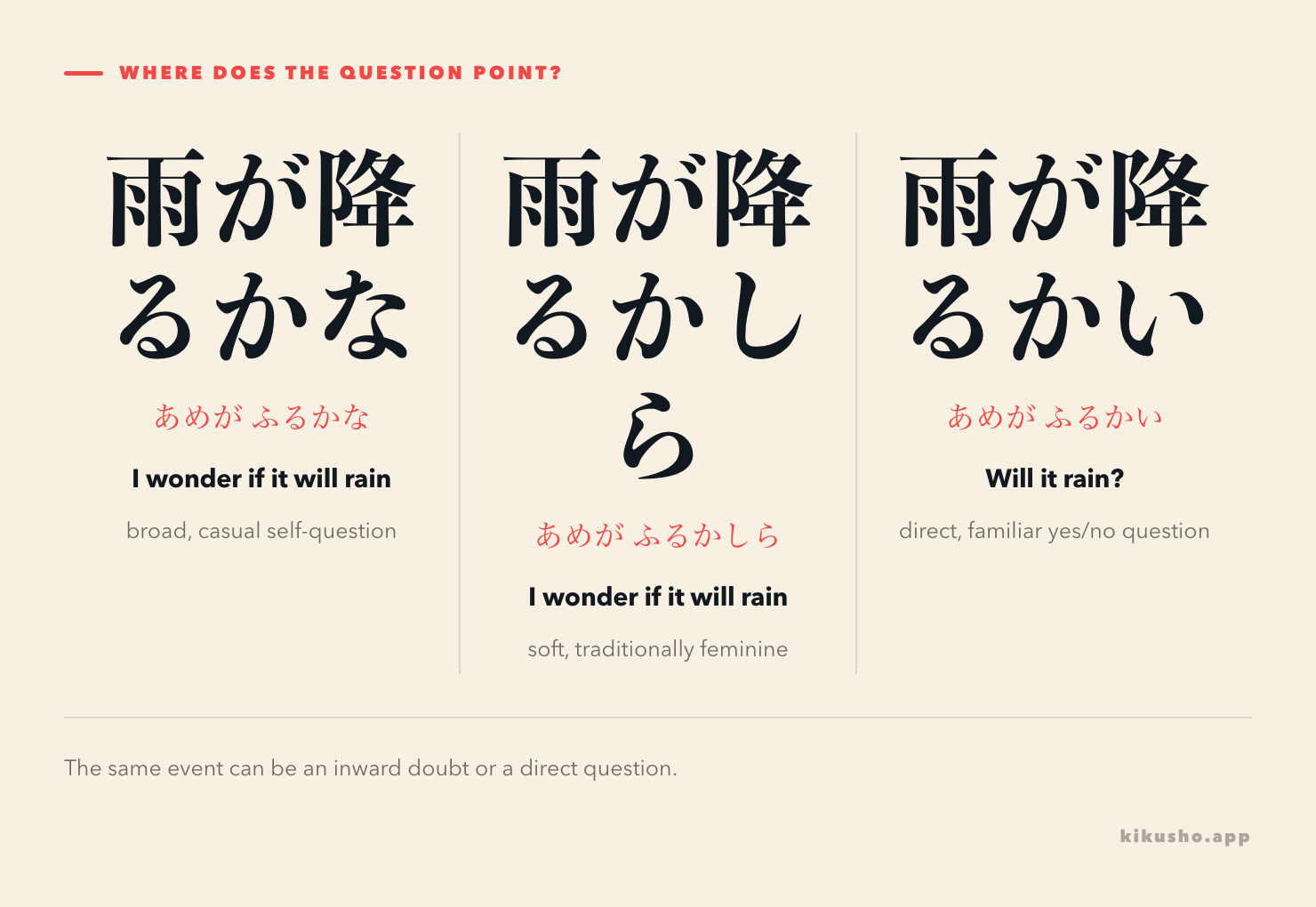
The Tokyo University of Foreign Studies grammar guide groups かな and かしら with self-directed questions. It notes that かしら is used mainly by adult women, while men can also use it when speaking as if to themselves. Bunpro's かな entry describes かな as common for modern speakers of any gender.
That does not make かな private speech only. At a café, どれがいいかな can let a friend hear your indecision and give them room to answer. The sentence still presents your uncertainty rather than assigning them a clean yes-or-no question.
By contrast, 元気かい seeks an answer from the other person. Bunpro's かい guide treats it as a casual ending used mainly for simple yes-or-no questions. Its voice matters as much as its grammar: it is associated especially with masculine speech, familiar relationships and older speakers. A learner should recognize it before adopting it as a default.
かな is the general way to wonder aloud
Use かな when you are considering whether something is true, possible or a good choice:
この道で合っているかな。
このみちで あっているかな。
I wonder whether this is the right road.
もう一度、確認したほうがいいかな。
もういちど、かくにんしたほうがいいかな。
I wonder whether I should check once more.
The second sentence may be said where another person can hear it. They may offer advice, but the ending does not directly order them to answer. かなあ, with a longer final sound, can give the hesitation more space.
A question word can remain inside the uncertainty:
鍵はどこに置いたかな。
かぎは どこに おいたかな。
Where did I put the key, I wonder?
This differs from かどうか inside a sentence. 鍵があるかどうか確認する makes a yes-or-no question part of the verb 確認する. 鍵はどこかな is a complete conversational thought ending in the speaker's uncertainty.
かしら shares the doubt but marks a social voice
The central meaning of かしら is close to かな:
この席、空いているかしら。
このせき、あいているかしら。
I wonder whether this seat is free.
Bunpro's かしら entry calls it a soft way to express uncertainty and records its strong association with feminine speech. The university guide is slightly less absolute: women use it mainly, while a man may use it in self-talk or a self-talk-like question. Those descriptions are compatible. Gendered sentence endings are tendencies in voices and relationships, not biological conjugations.
For production, かな is the safer general choice when you want “I wonder.” Learn かしら well enough to hear the speaker being portrayed. In fiction, subtitles and older dialogue, it may help build a character's voice. In real conversation, age, region and individual style can weaken or reinforce that coloring.
Do not confuse sentence-final かしら with 頭(かしら), an uncommon reading meaning “head” or “chief.” The grammar ending is written in kana and follows a complete phrase.
かい asks someone a casual yes-or-no question
かい points outward:
本当に一人で行くのかい。
ほんとうに ひとりで いくのかい。
Are you really going alone?
これは君の傘かい。
これは きみの かさかい。
Is this your umbrella?
The first example includes explanatory の, which can become ん in speech. 行くんかい exists in some voices and varieties, but it is not the neutral N4 model to imitate. 行くのかい makes the contextual question visible; 行くかい is also possible as the simpler yes-or-no form.
Tae Kim's grammar guide separates かい for yes-or-no questions from だい for questions containing words such as どこ or 何. This pairing belongs to strongly masculine casual speech. Modern friends commonly ask 行く? or どこに行くの? instead. Use ですか/ますか when the relationship calls for ordinary politeness.
Because かい is direct, tone can make it sound warm, theatrical, patronizing or accusatory. No English gloss can choose among those effects for you. The listener, age difference and preceding line do that work.
When you meet one of these endings in dialogue, save the whole turn rather than an isolated particle. Kikusho can draft a card from text, voice or a photo; keep the speaker relationship in the editable note. “Older uncle to nephew” explains 元気かい better than a definition that says only “question.”
Attach the endings after a plain predicate
Verbs and い-adjectives keep their plain form. With かな and かしら, affirmative non-past nouns and な-adjectives normally omit だ. TUFS explicitly lists かしら among the sentence-final particles that require this omission, and Bunpro records the same attachment behavior for かな.
| Predicate | かな | かしら | かい model |
|---|---|---|---|
| 行く, go | 行くかな | 行くかしら | 行くかい / 行くのかい |
| 高い, expensive | 高いかな | 高いかしら | 高いかい / 高いのかい |
| 静かだ, quiet | 静かかな | 静かかしら | 静かなのかい |
| 学生だ, a student | 学生かな | 学生かしら | 学生なのかい |
| 行った, went | 行ったかな | 行ったかしら | 行ったのかい |
| 学生じゃない, not a student | 学生じゃないかな | 学生じゃないかしら | 学生じゃないのかい |
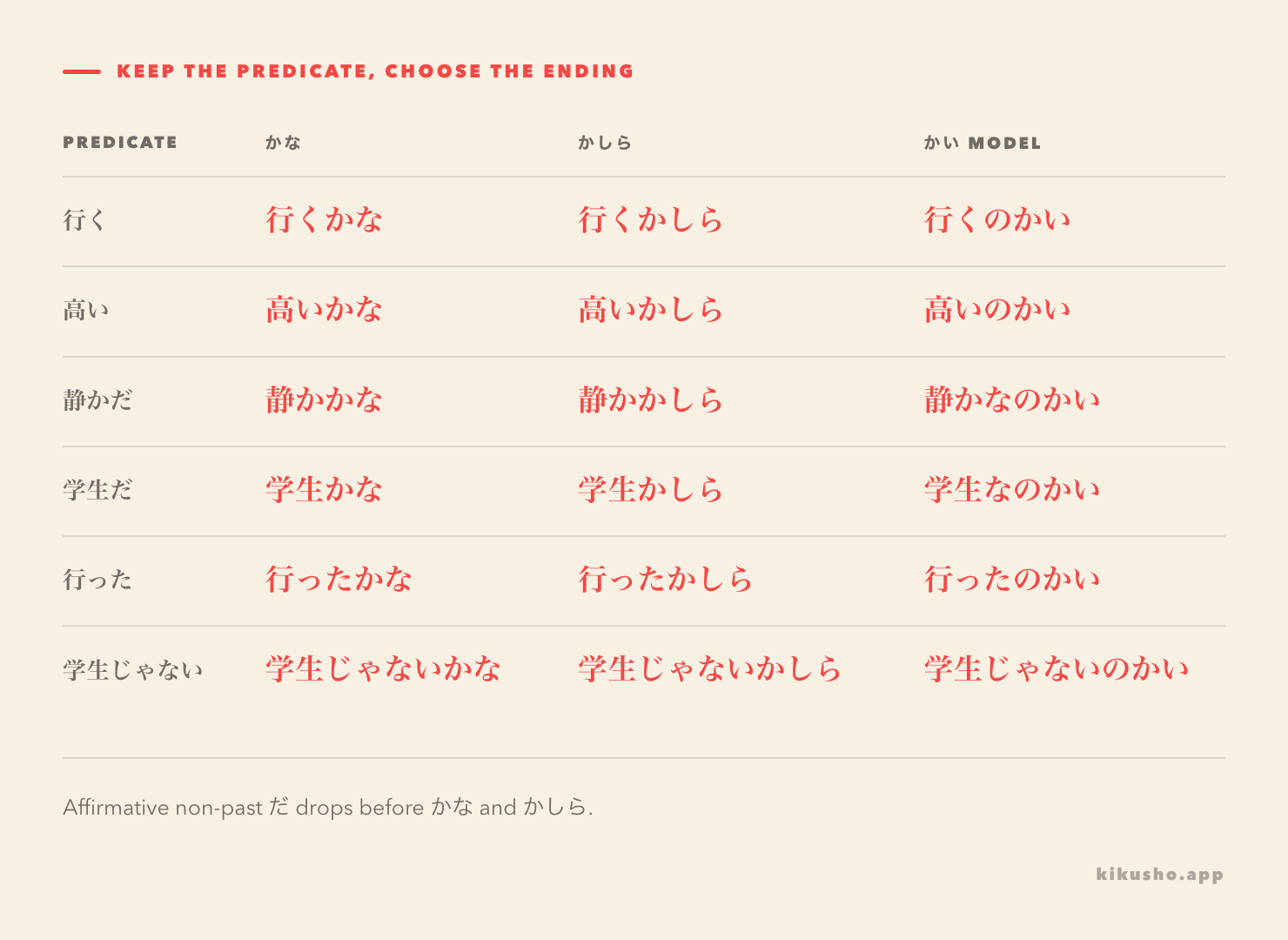
Past and negative endings stay because they carry meaning. 学生だったかな wonders about a past fact; 学生じゃないかな considers a negative proposition and, in context, can also offer a softened guess. This page keeps practice on straightforward uncertainty rather than every discourse use of かな.
Avoid 静かだかな, 学生だかしら and 行きますかい as your basic models. A polite question ending in ますか belongs to a different register. Mixing formal distance with a strongly familiar particle does not create a neutral middle.
One decision path handles the three
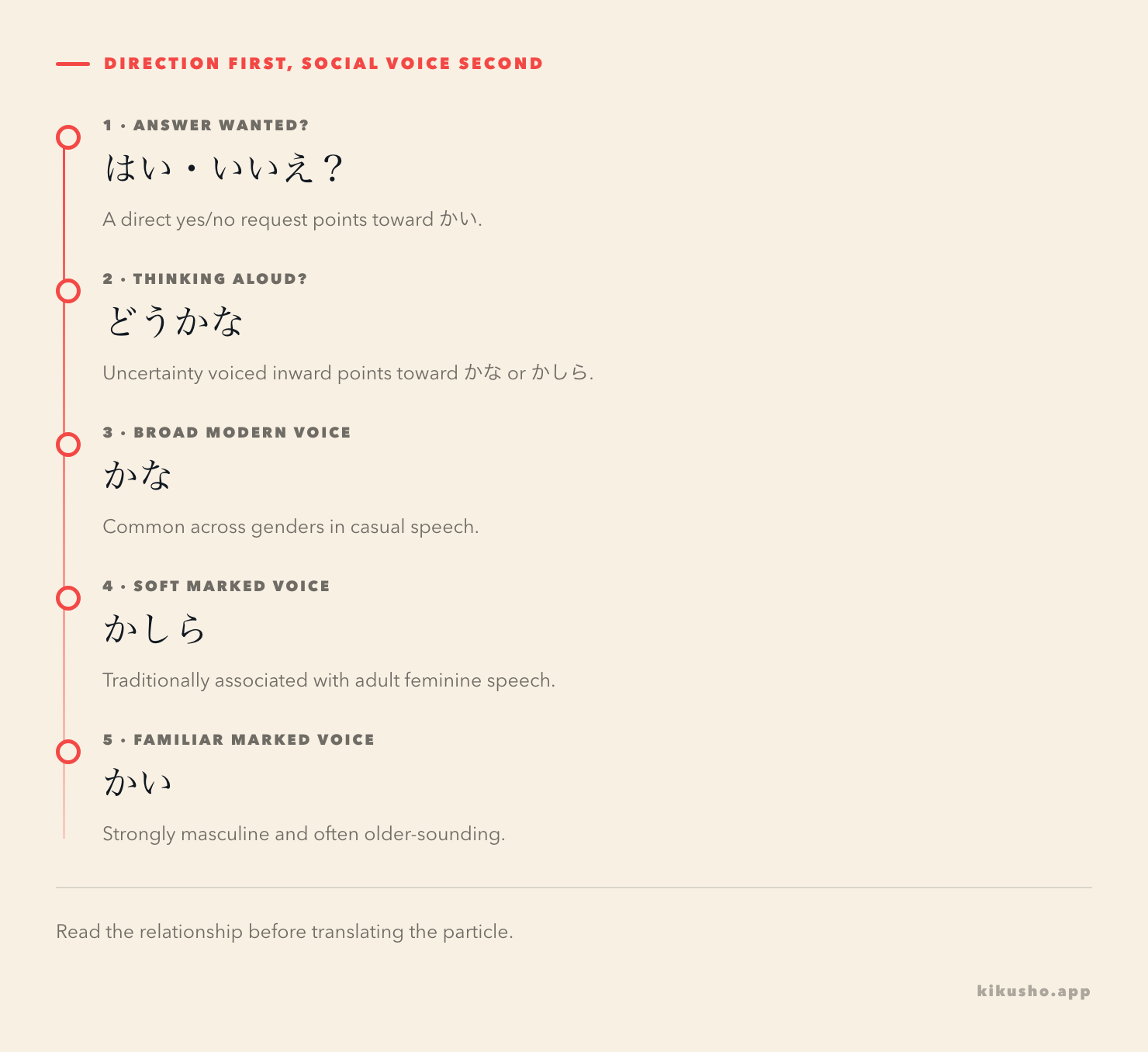
Use this order when reading a line:
- Is the speaker directly asking the listener for yes or no? Consider かい.
- Is the speaker voicing uncertainty or thinking aloud? Consider かな or かしら.
- Does the character's social voice matter? かな is broad; かしら is soft and traditionally feminine; かい is strongly masculine and familiar.
- Does the attachment preserve the predicate? Keep past and negative forms, and remove only affirmative non-past だ where required.
JLPT Sensei and Bunpro place all three endings at N4. The JLPT publishes no exhaustive grammar list, so N4 is a study estimate. The useful examination skill is recognizing who is being asked and what response the ending makes relevant.
Practice: decide where the question points
Complete all seven questions before opening the shared explanation section.
Question 1
You are alone at the station, looking at the departure board. Choose the natural ending for “I wonder whether the train is late.”
電車、遅れている__。
- かな
- かい
- ですか
- だかな
Question 2
An older man asks a close friend a yes-or-no question. Choose the ending that matches the specified voice.
もう帰る__。
- かしら
- かな
- かい
- どうか
Question 3
Complete the sentence with かしら, using the correct form of 静かだ.
隣の部屋は__。
Question 4
Write a casual sentence meaning “Where did I put the key, I wonder?” Use どこ, 置いた and かな.
Question 5
Choose the sentence that asks a listener “Are you really going alone?” in the かい pattern practised here.
- 本当に一人で行くかな。
- 本当に一人で行くのかい。
- 本当に一人で行きますかい。
- 本当に一人で行くだい。
Question 6
Explain why 学生だったかな keeps だった while 学生かな does not keep だ.
Question 7
Read the exchange and choose the best interpretation of the ending.
A:この席、空いているかしら。
B:たぶん空いていますよ。
- A issues a command to B.
- A wonders aloud, and B responds to the uncertainty.
- A asks a formal yes-or-no question.
- A states that the seat is certainly free.
Answers and explanations
1
1. かな. The speaker is reading the board and voicing uncertainty: 電車、遅れているかな. かい would point a familiar, strongly gendered question at a listener. ですか would be a polite direct question, while だかな is not the attachment for a verb.
2
3. かい. もう帰るかい directly asks for a yes-or-no answer and matches the specified older masculine voice between close people. かな and かしら would recast the line as wondering; どうか belongs inside an embedded yes-or-no question.
3
隣の部屋は静かかしら。 The affirmative non-past な-adjective loses だ before かしら. 静かだかしら is not the target form. Read the sentence as となりのへやはしずかかしら.
4
鍵はどこに置いたかな。 Read かぎはどこにおいたかな. The question word どこ identifies the missing place; かな leaves the speaker considering it aloud. This is not a かい yes-or-no question.
5
2. 本当に一人で行くのかい。 Explanatory の links the question to the situation, and かい directs it to the listener. Option 1 expresses the speaker's own uncertainty. Option 3 mixes polite ます with the strongly casual ending; option 4 misuses だい after a verb.
6
だった carries past time, so it remains; だ is only the affirmative non-past copula omitted before かな. 学生だったかな means “I wonder whether the person was a student.” 学生かな wonders whether the person is a student now. Removing だった would remove the time contrast.
7
2. A wonders aloud, and B responds to the uncertainty. かしら presents a soft, traditionally feminine wondering voice. B is free to answer because the thought was audible, but A did not use a formal direct question or express certainty.
Let the response reveal the grammar
When a subtitle gives you only “I wonder?” for both かな and かしら, look at the character voice. When かい appears, look at who answers and how close the speakers are. The next line often contains the distinction that an English gloss erased.
The N5 question guide supplies the neutral ですか/ますか baseline, while the lesson on ね, よ and なあ shows how one final sound redirects an otherwise complete sentence. Together, they make these three endings easier to hear as conversational choices rather than interchangeable question particles.
Common questions
What is the difference between かな and かい?
かな lets the speaker wonder aloud and may invite a response without directly demanding one. かい asks a listener a casual yes-or-no question and has a strongly masculine, often older-sounding register.
Are かな and かしら interchangeable?
They can express similar uncertainty, but かな is the broadly useful modern choice across genders. かしら sounds softer and is traditionally associated with adult feminine speech, though real usage is not an absolute gender rule.
Does だ come before かな or かしら?
In the affirmative non-past, omit だ after nouns and な-adjectives: 静かかな, 学生かしら. Past だった and negative forms remain when they belong to the predicate.
Can かい ask a question with a question word?
At this level, treat かい as a casual yes-or-no ending. Traditional masculine speech often uses だい for question-word questions, while ordinary modern conversation frequently uses a plain question with rising intonation.