On this page
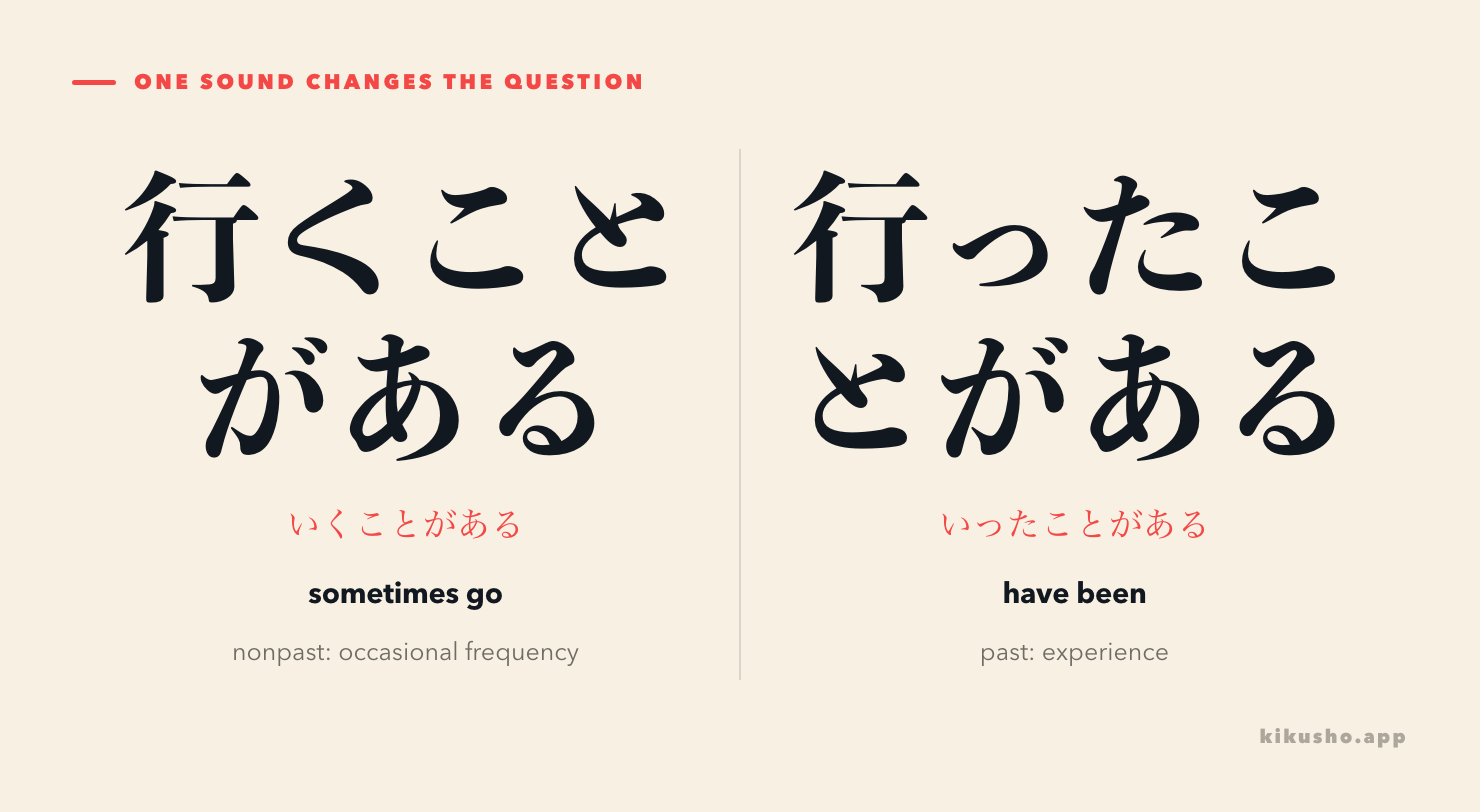
Plain nonpast verb + ことがある says that an action happens on some occasions: 仕事で遅くなることがあります, “Sometimes I am late because of work.” One small change creates a different pattern: 遅くなったことがあります looks back on the experience of having been late.
The verb form decides the time relationship
| Form before ことがある | Meaning | Example |
|---|---|---|
| plain nonpast | happens sometimes | 日本へ行くことがある |
| plain negative nonpast | sometimes does not happen | 朝ごはんを食べないことがある |
| plain past | has had the experience | 日本へ行ったことがある |
The complete sentence can be polite even though the inner verb is plain:
この電車は遅れることがあります。+> このでんしゃは おくれることが あります。+> This train is sometimes late.
Use 遅れる, not 遅れます, before こと. Politeness appears on the final あります. JLPT Sensei identifies plain nonpast attachment and the “there are times when” meaning. Tofugu's independently authored guide likewise describes an event that occurs on occasion.
It describes irregular frequency, not a fixed schedule
ことがある fits events that are possible and recurring, but not guaranteed every time.
忙しい日は、昼ごはんを食べる時間がないことがあります。+> いそがしいひは、ひるごはんを たべるじかんが ないことが あります。+> On busy days, there are times when I have no time to eat lunch.
冬でも暖かい日があります。コートを着ないこともあります。+> ふゆでも あたたかいひが あります。コートを きないことも あります。+> Even in winter there are warm days. Sometimes I do not wear a coat.
Do not use the pattern to state a dependable timetable. 毎週月曜日に会議があります says there is a meeting every Monday. 月曜日に会議があることがあります says meetings occur on some Mondays. The first is a schedule; the second leaves open which Mondays.
Frequency adverbs can sharpen the claim. たまに and 時々(ときどき) both work when the context needs an explicit “occasionally” or “sometimes.” The grammar itself already carries occasionality, so they are not required.
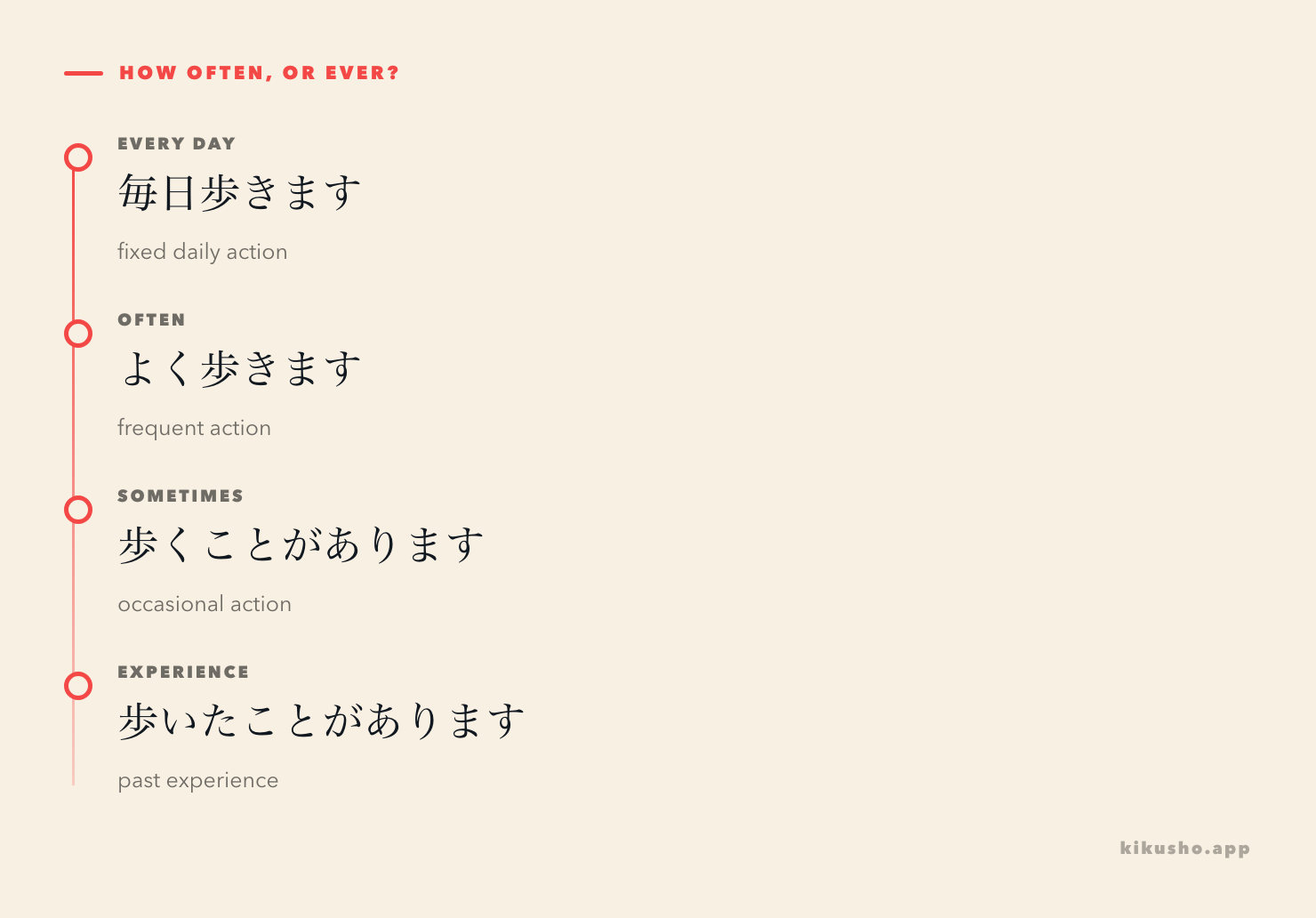
| Sentence | Frequency claim |
|---|---|
| 毎日歩きます | I walk every day |
| よく歩きます | I often walk |
| 歩くことがあります | I walk on some occasions |
| 歩いたことがあります | I have walked before |
A negative clause means “sometimes not”
Negate the verb inside the pattern when the missing action is occasional:
疲れていると、メールにすぐ返事をしないことがあります。+> つかれていると、メールに すぐ へんじを しないことが あります。+> When I am tired, there are times when I do not reply to email immediately.
The negative belongs to 返事をしない. The final あります still says such occasions exist. This differs from 返事をすることがありません, which denies that the action ever occurs: “I never reply.” In ordinary conversation, 全然返事をしません may state that simpler meaning more directly.
| Pattern | What is negated? | Meaning |
|---|---|---|
| Vない + ことがある | the inner action | sometimes does not V |
| Vる + ことがない | the existence of occasions | never V; occasions do not occur |
| Vた + ことがない | past experience | has never V-ed |
The experience lesson covers the third row in depth. Keep the verb form attached to the meaning rather than translating every ことがある as “have done.”
こともある presents one possibility among alternatives
Replacing が with も often suggests that the stated event is one possibility beside another:
普段は家で働きますが、会社へ行くこともあります。+> ふだんは いえで はたらきますが、かいしゃへ いくことも あります。+> I usually work at home, but sometimes I also go to the office.
The surrounding contrast makes も useful: home is normal, and going in is another case. With ことがある, the sentence would still report occasional office visits, but it would not highlight the alternative as clearly. Tofugu documents this contrastive force of も alongside the basic pattern.
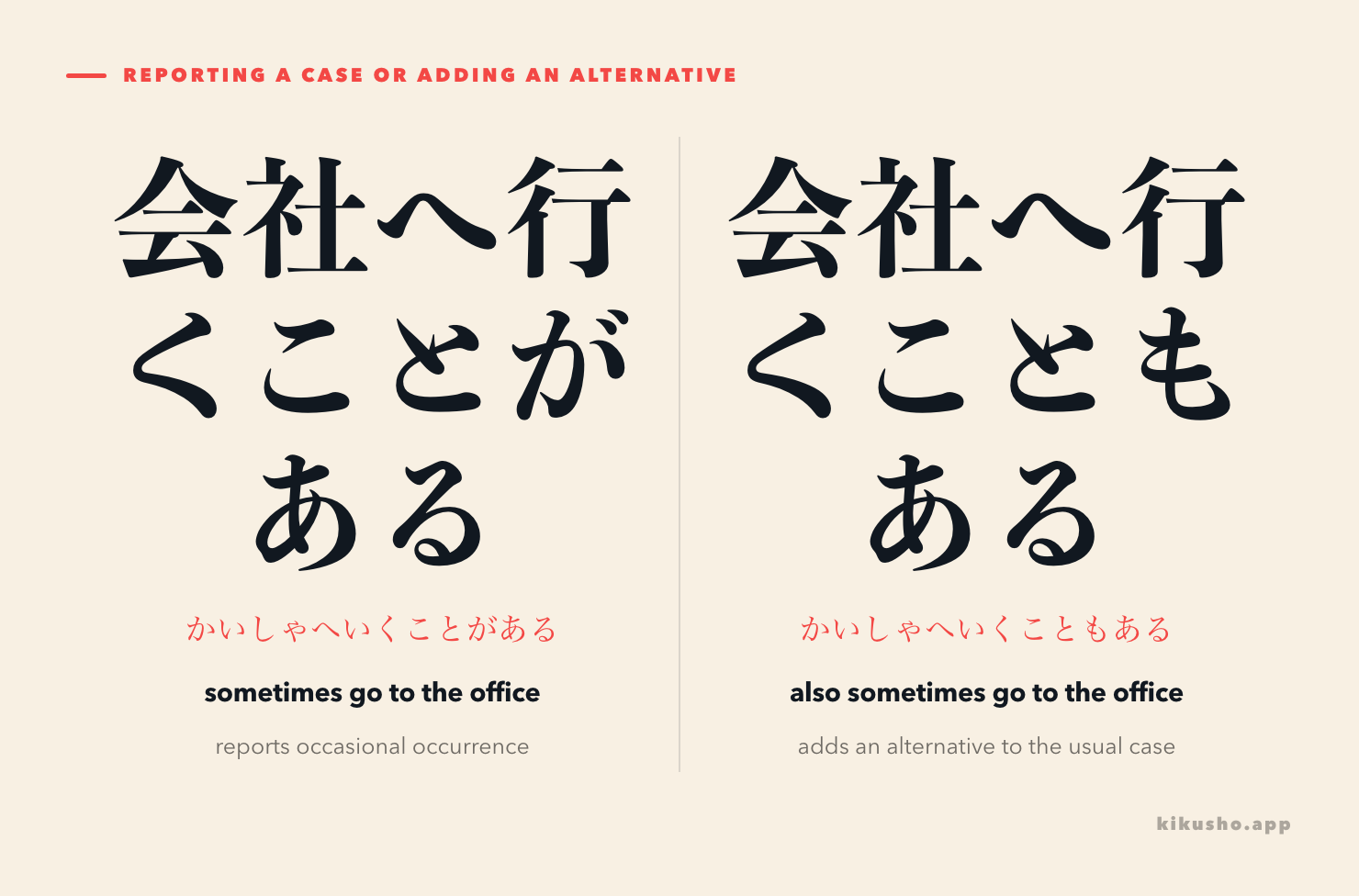
Do not force も into a sentence with no relevant alternative. It is not a stronger or more polite version of が.
When you save this pattern in Kikusho, keep the verb immediately before こと. A card for 行くことがある preserves occasional frequency; a card containing only ことがある hides the exact form that separates it from 行ったことがある. Check the reading and retain the surrounding condition when it explains when the exception happens.
The pattern can describe people, objects and changing conditions
The subject need not be the speaker:
このアプリは、電波が弱い場所で開くのに時間がかかることがあります。+> このアプリは、でんぱが よわいばしょで ひらくのに じかんが かかることが あります。+> This app can sometimes take time to open where the signal is weak.
田中さんは、忙しいと昼休みを取らないことがあります。+> たなかさんは、いそがしいと ひるやすみを とらないことが あります。+> When Tanaka is busy, there are times when he does not take a lunch break.
The pattern does not promise that the event is rare, surprising or accidental. It only denies an all-the-time reading. Context and words such as たまに or よく give a more precise impression of frequency.
JLPT Sensei places this occasional-use row at N4, while Bunpro places its ことがある page at N3. These are publisher study levels; the exam maker does not publish an exhaustive item-by-item grammar syllabus.
Check yourself
Question 1: grammar choice. “This bus is sometimes late.” Which verb form fits このバスは__ことがあります?
- A. 遅れる
- B. 遅れた
- C. 遅れます
- D. 遅れて
Question 2: meaning. What does 日曜日も仕事をすることがあります say?
- A. I worked last Sunday once.
- B. I always work on Sundays.
- C. There are occasions when I work even on Sundays.
- D. I have never worked on Sunday.
Question 3: negative scope. Which sentence means “Sometimes I do not eat breakfast”?
- A. 朝ごはんを食べないことがあります。
- B. 朝ごはんを食べたことがありません。
- C. 朝ごはんを食べることがありません。
- D. 朝ごはんを食べませんでした。
Question 4: sentence composition. Write “When I am busy, I sometimes get home late” using 忙しいと, 帰りが遅くなる and ことがあります.
Question 5: contrast. Explain the difference between 京都へ行くことがあります and 京都へ行ったことがあります.
Question 6: が or も. A speaker usually drives but sometimes takes the train. Complete: 普段は車で行きますが、電車で行くこと__あります。
Question 7: text grammar. Read: この店は九時に開きます。ただし、店員が少ない日は、開店が少し遅れることがあります。今まで一時間以上遅れたことはありません。 Which interpretation is correct?
- A. The shop always opens late and has once been over an hour late.
- B. Opening can occasionally be a little late, but it has never been over an hour late.
- C. The shop sometimes never opens.
- D. The staff have experience opening every shop at nine.
Answers and explanations
Answer 1. A, 遅れる. Plain nonpast creates occasional frequency. 遅れた would report experience, 遅れます is polite inside the pattern, and 遅れて is incomplete here.
Answer 2. C. Nonpast することがあります marks occasional action, and も presents Sunday as an additional possibility.
Answer 3. A. The inner negative 食べない says the skipped breakfast happens on some occasions. B denies past experience of eating it; C says eating does not occur; D reports one past non-eating event.
Answer 4. 忙しいと、帰りが遅くなることがあります。 The condition comes first, and plain nonpast 遅くなる attaches to ことがあります.
Answer 5. 行くことがあります means the speaker goes on some occasions. 行ったことがあります uses the past form 行った and says the speaker has been to Kyoto before.
Answer 6. も. The usual car trip supplies the first possibility; train travel is the occasional alternative.
Answer 7. B. 遅れることがあります allows occasional slight delay. 一時間以上遅れたことはありません uses past 遅れた and denies any experience of a delay longer than one hour.
Read the verb immediately before こと first. Nonpast reports what occurs from time to time; past reports what has occurred at least once; an inner negative reports what is sometimes omitted.
Common questions
What does dictionary-form verb plus ことがある mean?
It means that the action happens sometimes or on certain occasions, rather than regularly.
What is the difference between 行くことがある and 行ったことがある?
行くことがある means someone sometimes goes; 行ったことがある reports the past experience of having gone.
Can a negative verb come before ことがある?
Yes. 朝ごはんを食べないことがある means there are occasions when the speaker does not eat breakfast.