On this page
こと and の can both turn a plain-form verb clause into something noun-like, but のは~です has a second job: it can identify the person, time, place or reason behind an event. Compare 日本語を勉強することは大切です, “studying Japanese is important,” with 私が勉強しているのは日本語です, “what I am studying is Japanese.” The first evaluates an action; the second puts the answer in focus.
A verb clause needs a noun-like ending before は
A bare verb phrase cannot simply occupy every place a noun can. Add こと or の, then a particle can mark the resulting unit as a topic, subject or object.
| Verb clause | Nominalized unit | Role in a sentence |
|---|---|---|
| 日本語を勉強する | 日本語を勉強すること | 日本語を勉強することは大切です。 |
| 旅行の計画を立てる | 旅行の計画を立てるの | 旅行の計画を立てるのは楽しいです。 |
| 田中さんが来る | 田中さんが来ること | 田中さんが来ることを知っています。 |
The verb before the nominalizer uses a plain form, even when the complete sentence is polite:
| Time or polarity | こと topic | の topic |
|---|---|---|
| nonpast | 毎日歩くことは大切です | 毎日歩くのは楽しいです |
| past | 昨日歩いたことは事実です | 昨日歩いたのは私です |
| negative | 夜歩かないことは安全策です | 夜歩かないのはなぜですか |
Do not put a polite verb immediately before the nominalizer: 歩きますこと and 歩きますのは do not form these patterns. Politeness belongs at the end in 大切です, 私です or the final question.
Tokyo University of Foreign Studies confirms that both nominalizers can make a verb clause function as a noun, and that emotion or evaluation predicates often allow either. The choice becomes stricter in the patterns below.
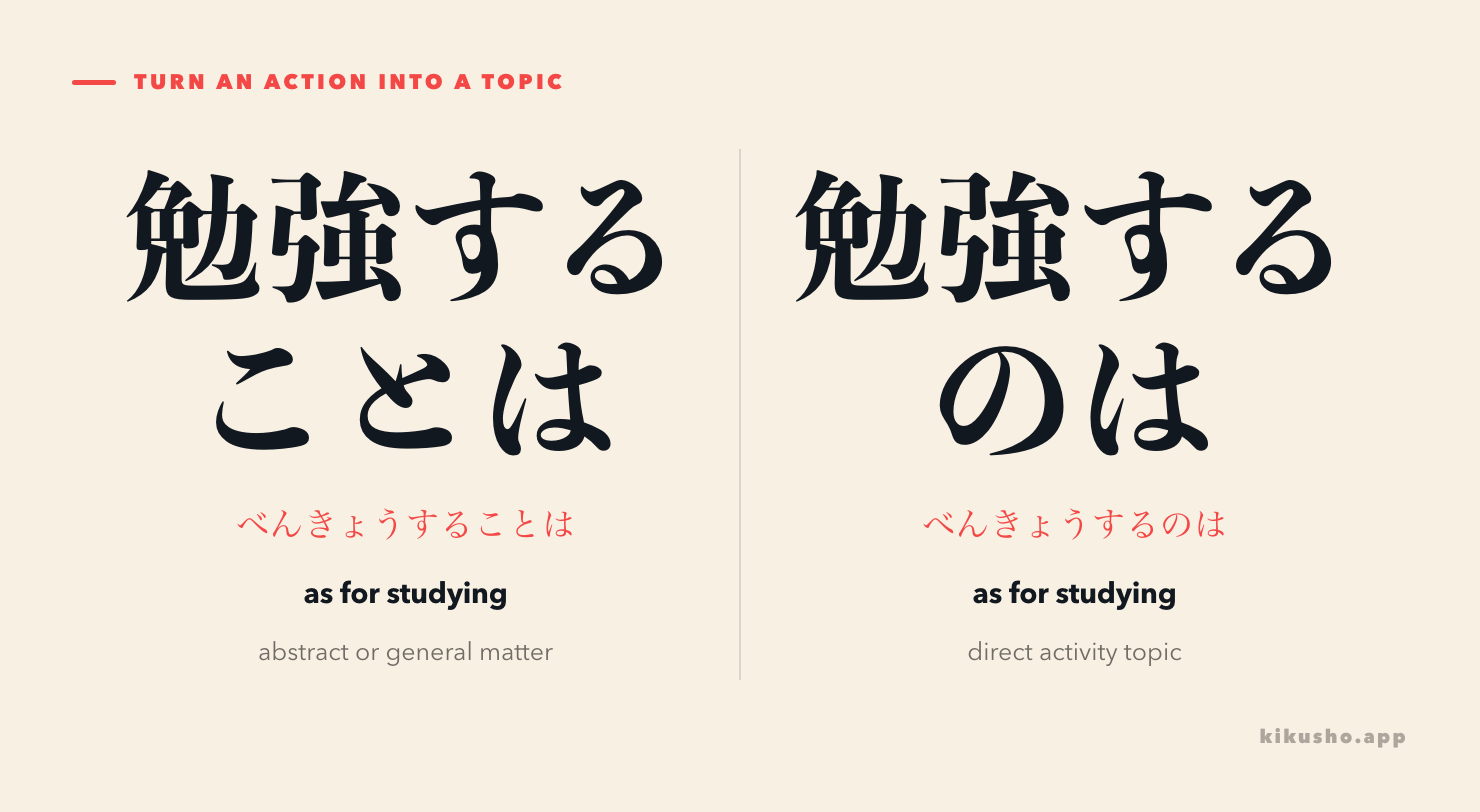
こと treats the action as content or a general matter
Use plain clause + こと when the sentence handles an action as information, a rule, a decision or an abstract activity.
毎日少しずつ復習することは大切です。
まいにち すこしずつ ふくしゅうすることは たいせつです。
Reviewing a little every day is important.
来月引っ越すことを家族に伝えました。
らいげつ ひっこすことを かぞくに つたえました。
I told my family that I will move next month.
The first action is the topic of an evaluation. In the second, こと packages a whole proposition as what was communicated. The Japan Foundation's detailed こと guide places こと before verbs of communication, thought, decision and promise, where の is generally not substituted.
こと is also required when the action itself fills the noun side of an X は Y です equation:
私の趣味は古い映画を見ることです。
わたしの しゅみは ふるい えいがを みることです。
My hobby is watching old films.
Here 古い映画を見ること is the predicate noun after 趣味は. Replacing it with 見るのです would be heard as explanatory のです, a separate structure. It would not simply mean “my hobby is watching.”
Some fixed grammar also requires こと. 話すことができます expresses ability, and 話したことがあります expresses experience. The nominalizer is not a free slot in those established forms; the potential-form lesson and experience lesson teach their different attachments.
のは can evaluate an activity in a direct, conversational way
For a general reaction or evaluation, both nominalizers may work:
外国語を勉強することは楽しいです。
外国語を勉強するのは楽しいです。
Studying a foreign language is fun.
The こと version can sound more abstract or written; the の version often feels closer to the activity and is frequent in conversation. This is a tendency, not a complete rule. Predicate type and construction matter more than the shortcut “こと is formal, の is casual.”
のは is especially natural when the speaker reacts to a concrete activity:
一人でこの箱を運ぶのは無理です。
ひとりで このはこを はこぶのは むりです。
Carrying this box alone is impossible.
旅行の計画を立てるのは楽しいです。
りょこうの けいかくを たてるのは たのしいです。
Planning a trip is fun.
The existing lesson on のが好き, 上手 and 下手 uses の to make an activity the thing liked or assessed. Here は makes the whole activity the topic instead.
のは~です can identify the missing detail
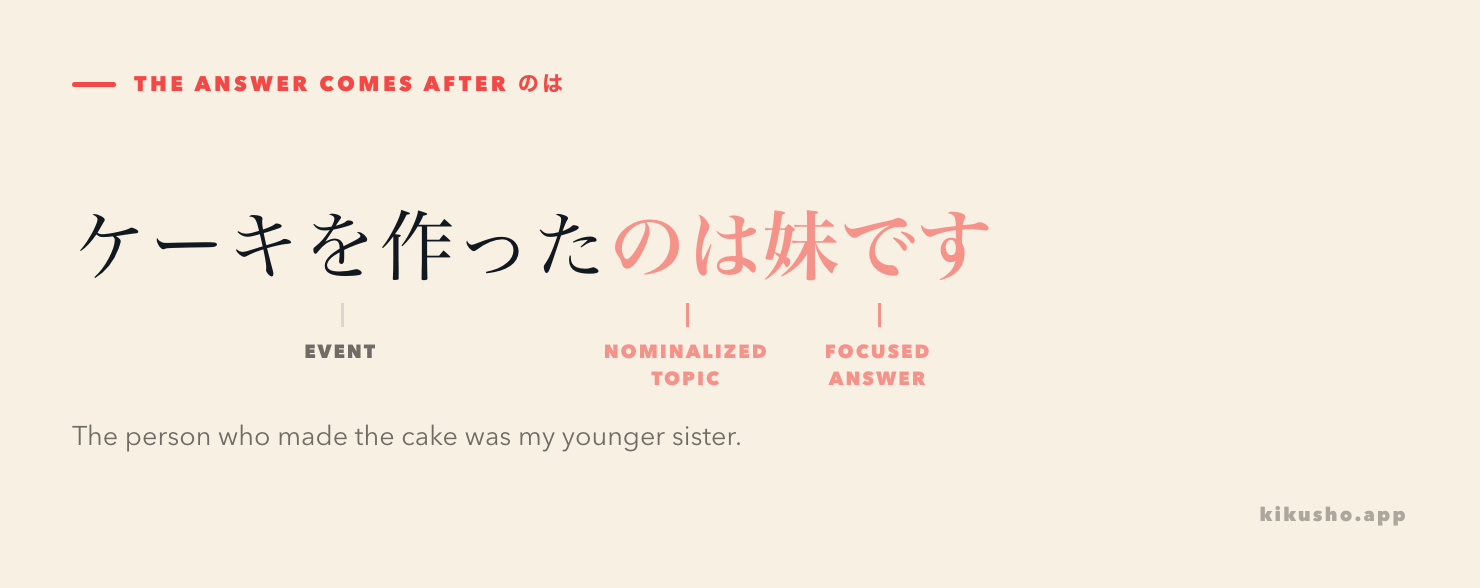
In a focus sentence, the clause before のは describes an event while the expression after it supplies the detail the speaker wants to identify.
ケーキを作ったのは妹です。
ケーキを つくったのは いもうとです。
The person who made the cake was my younger sister.
The ordinary sentence is 妹がケーキを作りました. The focused version removes 妹 from its original subject position, turns ケーキを作った into the topic with のは, and places the answer 妹です at the end.
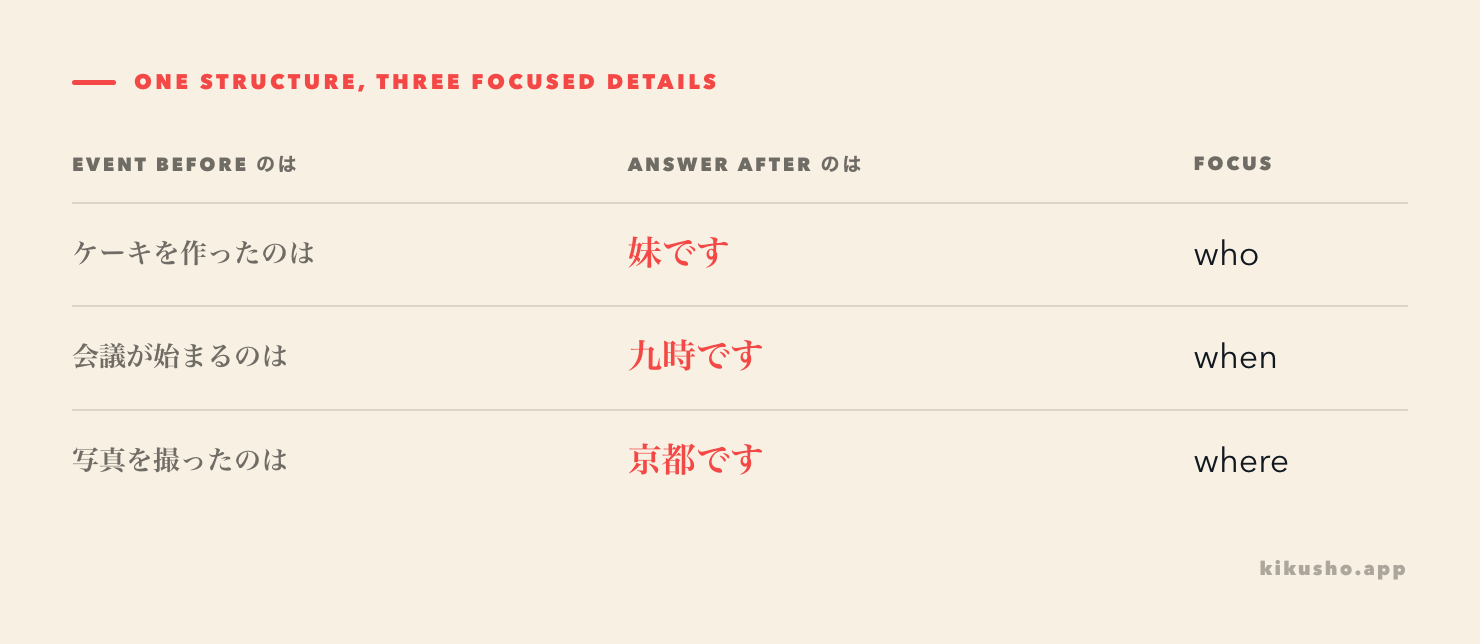
The same structure can focus different details:
| Ordinary statement | Focus sentence | Detail identified |
|---|---|---|
| 妹がケーキを作りました | ケーキを作ったのは妹です | who: 妹 |
| 会議は九時に始まります | 会議が始まるのは九時です | when: 九時 |
| 京都でその写真を撮りました | その写真を撮ったのは京都です | where: 京都 |
This is why こと cannot replace の in these examples. ケーキを作ったことは妹です does not recover the removed subject. The Japan Foundation nominalization reference and the TUFS guide both reserve の for this focus construction.
When you save a focused sentence in Kikusho, keep both sides of のは. A card containing only 作ったのは hides the answer slot; ケーキを作ったのは妹です preserves the event, the focused person and the particle that originally belonged to ケーキ.
A から clause can put the reason in focus
The answer after のは can also be a reason ending in からです:
日本語を勉強しているのは、日本で働きたいからです。
にほんごを べんきょうしているのは、にほんで はたらきたいからです。
The reason I am studying Japanese is that I want to work in Japan.
The first half identifies the event under discussion. The second supplies the reason. A plain causal sentence, 日本で働きたいから、日本語を勉強しています, presents the reason first and the resulting action second. The focused version answers “Why are you studying Japanese?” by holding the action as the topic and landing on the reason.
Do not treat every のは + adjective sentence as a focus cleft. Compare:
| Sentence | Job of the ending |
|---|---|
| 毎日勉強するのは大変です | 大変 evaluates the activity |
| 毎日勉強するのは試験があるからです | からです identifies the reason |
| 勉強を始めるのは月曜日です | 月曜日 identifies the time |
The shape is similar, but the predicate tells you whether the speaker evaluates the activity or fills a missing detail.
Keep の nominalization separate from explanatory のです
The sequence のです does not always mean “nominalizer の + copula.” In 電車が遅れたのです, the ending presents an explanation or background. That is the explanatory pattern covered in んです and のです.
Use the surrounding structure:
- 電車が遅れるのは困ります: の makes “the train being late” the topic; 困ります evaluates it.
- 遅れたのは電車です: のは opens a focus slot; 電車 identifies what was late.
- 電車が遅れたのです: のです presents the delay as explanation or context.
- 問題は電車が遅れることです: こと creates the predicate noun after 問題は.
The kana may look alike, but their jobs are different.
Check yourself
Question 1: grammar choice. Complete the hobby equation: 私の趣味は、町の写真を撮る__です。
- A. こと
- B. のは
- C. のを
- D. から
Question 2: focus. Which sentence means “The person who reserved the room was Tanaka”?
- A. 田中さんは部屋を予約することです。
- B. 部屋を予約したのは田中さんです。
- C. 部屋を予約したことは田中さんです。
- D. 田中さんが部屋を予約したのですか。
Question 3: identify the focus. In 会議が始まるのは十時です, which detail does 十時 supply?
- A. the person who starts the meeting
- B. the reason for the meeting
- C. the time when the meeting starts
- D. an opinion about meetings
Question 4: sentence composition. Write “Studying kanji every day is important” using 毎日, 漢字を勉強する, ことは and 大切です.
Question 5: register and structure. Why can 外国語を勉強するのは楽しいです use の, while 私の趣味は外国語を勉強することです requires こと?
Question 6: focus transformation. Start with 妹が昨日ケーキを作りました. Rewrite it to focus the time: “It was yesterday that my younger sister made the cake.”
Question 7: text grammar. Read: 私は毎朝六時に起きます。早く起きるのは、静かな時間に本を読みたいからです。読書を続けることは大切だと思います。 Which analysis is correct?
- A. The first のは evaluates waking early as quiet; こと names the time.
- B. The のは sentence focuses the reason for waking early; こと makes continuing to read the topic of an evaluation.
- C. Both nominalizers identify the person who reads.
- D. Both forms are fixed ability expressions.
Answers and explanations
Answer 1. A, こと. The complete predicate noun is 町の写真を撮ることです, equated with 私の趣味. 撮るのです would be an explanatory ending, and のは or のを would require more structure after the particle.
Answer 2. B, 部屋を予約したのは田中さんです. The event becomes the のは topic and 田中さん fills the missing subject. C cannot use こと to create this focus relation; A gives an unnatural equation and uses nonpast; D asks an explanatory yes-no question.
Answer 3. C, the starting time. The event “the meeting starts” is held before のは, and 十時 supplies the time after it.
Answer 4. 毎日漢字を勉強することは大切です。 The plain nonpast clause ends in こと, then は marks the whole action as the topic evaluated by 大切です.
Answer 5. 楽しい evaluates an activity, an environment where both の and こと can often nominalize the clause; の is natural and conversational here. In the hobby sentence, the action itself is the predicate noun directly before です, so こと is required. Using の would create the separate explanatory のです shape.
Answer 6. 妹がケーキを作ったのは昨日です。 妹 remains the subject inside the event clause, ケーキ remains its object, and 昨日 moves to the focused position after のは.
Answer 7. B. 早く起きるのは~からです holds waking early as the topic and identifies the reason after it. 読書を続けることは大切だ turns continuing to read into the matter evaluated as important. Neither sentence expresses ability or focuses a person.
When you meet こと or の, look one step to the right. A particle shows that the clause has become a noun-like unit; です after こと can complete an equation; and a noun, time, place or からです after のは often reveals the detail placed in focus.
Common questions
What do こと and の do after a verb?
They can turn a plain-form verb clause into a noun-like unit. That unit can then take particles such as は, が or を. The two are interchangeable in some evaluations, but each also has environments where the other does not fit.
What does のは~です emphasize?
It presents the clause before のは as known information and identifies a missing detail after it. ケーキを作ったのは妹です focuses 妹: the person who made the cake was my younger sister.
Can の replace こと in 趣味は写真を撮ることです?
No. When the nominalized action itself stands directly before です as the predicate noun, use こと. 写真を撮るのです is a separate explanatory のです construction, not the same hobby equation.