On this page
Big numbers in Japanese trip you up because the language groups digits by four, not by three. English gives every three digits a fresh name — thousand, million, billion — and drops a comma to match; Japanese gives every four digits a fresh name — 万, 億, 兆 — so the commas you have read your whole life fall in the wrong place. The words themselves are easy. The grouping is the obstacle, and once you learn to re-comma every four digits it turns mechanical.
That is the whole problem in one line, but it is worth seeing why it bites so hard, because the mismatch hides inside numbers you thought you already knew.
English counts in thousands; Japanese counts in ten-thousands
Up to a thousand, the two systems agree. 十 is ten, 百 is a hundred, 千 is a thousand — one word each, exactly like English. The paths split at the next milestone. English multiplies its thousand by another thousand to reach a million (1,000 × 1,000). Japanese multiplies its thousand by ten to reach 万 (man), ten thousand, and makes that the pivot the whole system turns on.
From there every large unit is ten thousand times the last, not a thousand times:
- 万 (man) — ten thousand, 10⁴
- 億 (oku) — a hundred million, 10⁸, which is 万 × 万
- 兆 (chō) — a trillion, 10¹², which is 万 × 億
So a new name appears every four digits in Japanese, where in English a new name appears every three. That single difference is the source of nearly every stall, and you can watch it happen by lining the two systems up.
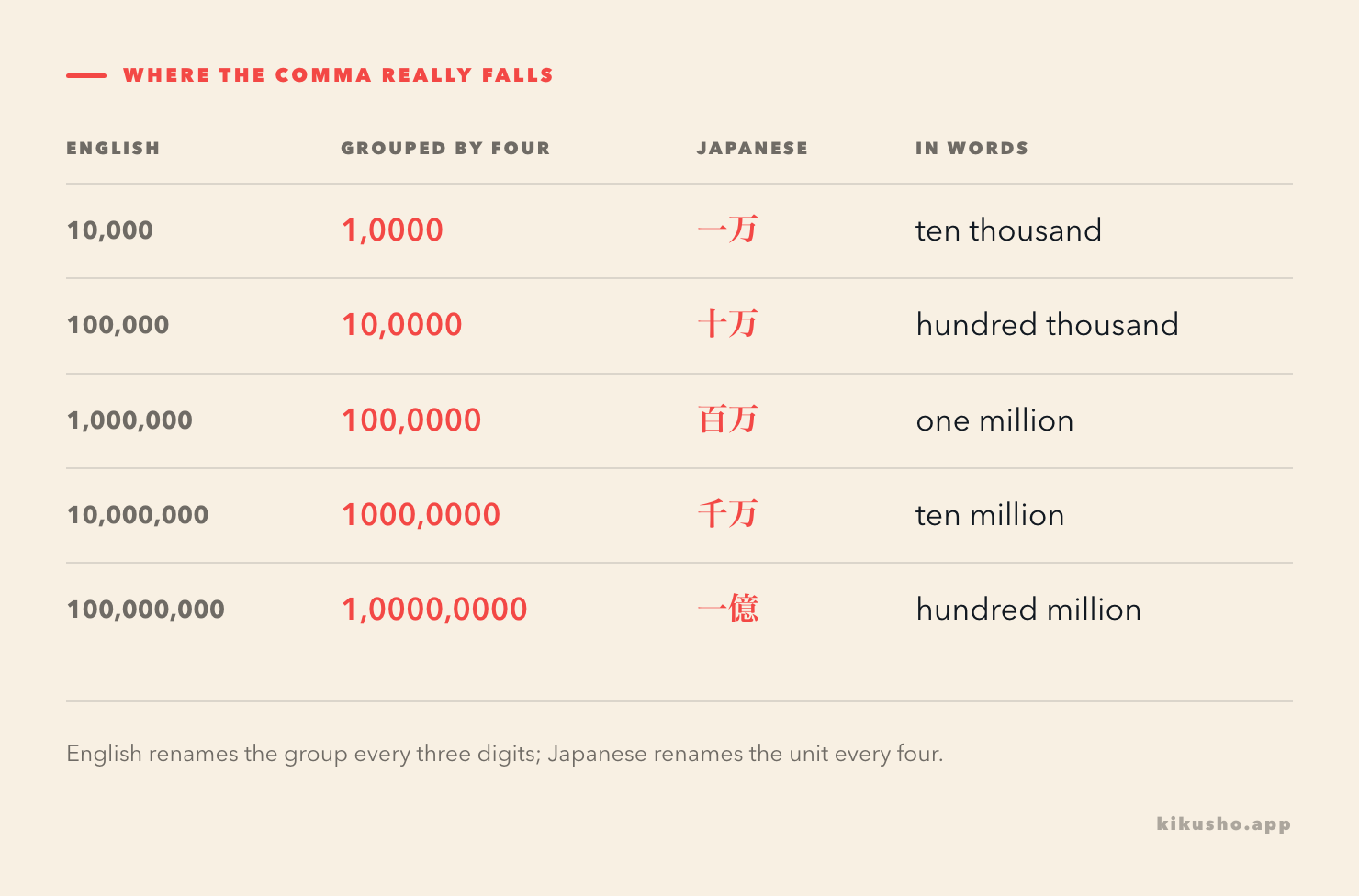
Read down the highlighted columns and the pattern is plain: as the number grows, English keeps the leading digit a 1 and renames the group, while Japanese renames the unit — 万 becomes 十万 becomes 百万 — and only returns to 一 when a brand-new word, 億, takes over.
A million has no word — it's a hundred ten-thousands
Here is the exact spot most people freeze. Write out one million: 1,000,000. In English the comma after the leading 1 tells you "millions," and you say the word without thinking. Japanese has no word for a million. It has to build the number out of 万, and 1,000,000 is a hundred of them: 百万 (hyaku-man), literally "hundred ten-thousand."
So the leading 1 you see in 1,000,000 is misleading about how the number is actually said. In Japanese the leading unit is 百 — a hundred — sitting in the 万 place. Ten million is not a new word either; it is 千万 (sen-man), a thousand ten-thousands. Only when you reach a hundred million does a fresh single word finally appear: 億.
One small rule rides along with this. Ten thousand is 一万 (ichi-man) — you always keep the 一, and you never say a bare "man" for the number the way you might say "thousand" alone in English. But 十万, 百万 and 千万 drop the 一: nobody says 一百万. The 一 comes back only at the top of a block, with 一億 and 一兆.
The fix: move the comma four digits at a time
Because the trip is caused by grouping and not by vocabulary, the fix is a procedure, not more memorising. Ignore the commas already printed on the number. Starting from the right, recount the digits in blocks of four and drop a mental comma at each break. The rightmost block is the plain ones, zero to 9,999. The next block up is multiplied by 万. The one above that is multiplied by 億. Then read each block as an ordinary small number and attach its unit.
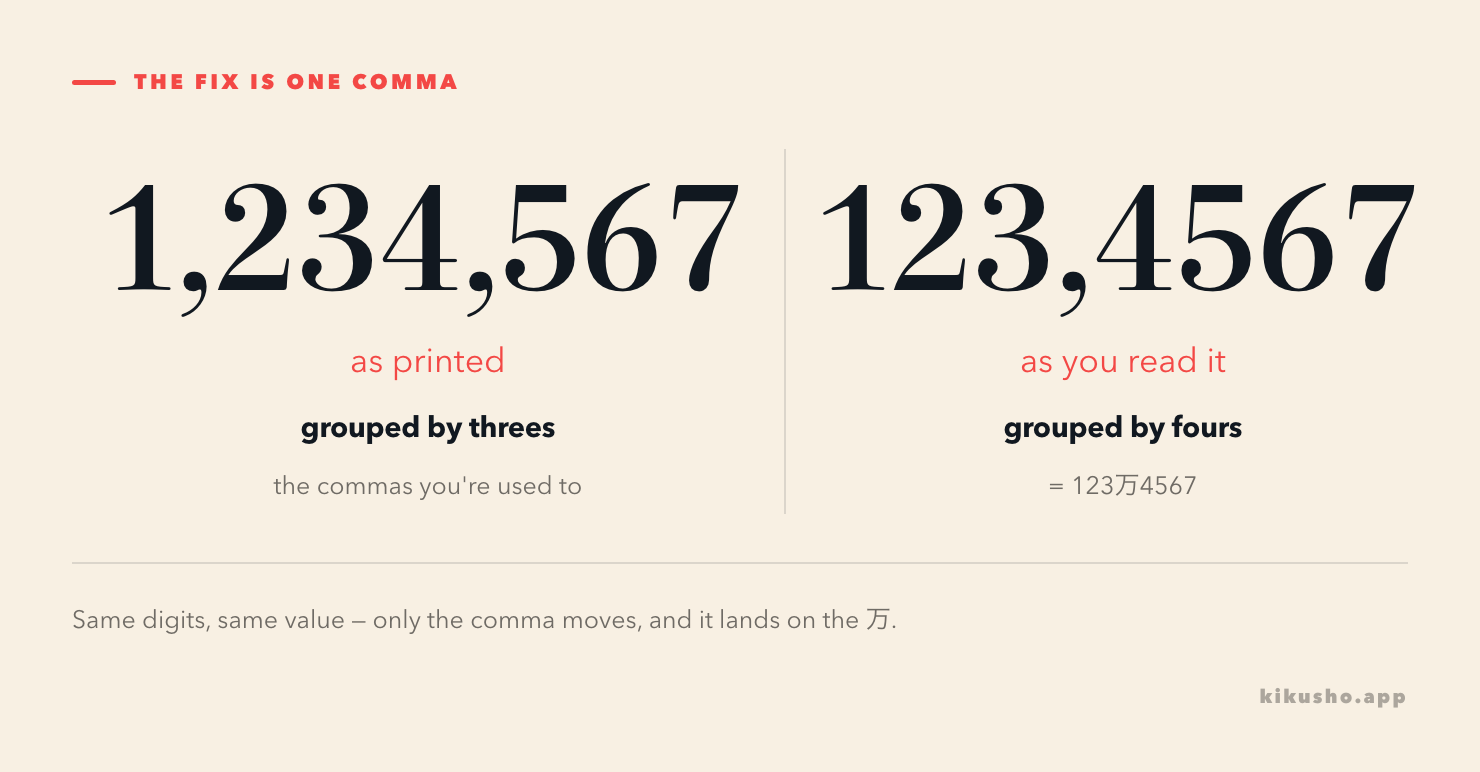
Take 1,234,567. Its printed commas — after the 1, after the 234 — are for a language that counts in thousands, so ignore them. Recount from the right in fours: 123,4567. Now it reads straight off. The right-hand block, 4567, is the ones. The left-hand block, 123, is multiplied by 万. So the number is 123万4567 — a hundred twenty-three ten-thousands, then four thousand five hundred sixty-seven — 百二十三万四千五百六十七. The comma moved one place, and the number that stalled you a moment ago is now just two small numbers joined by 万.
Empty blocks simply vanish. A round million, 1,000,000, has nothing in its ones block, so you say only 百万 — never a "zero" filler between the units.
Where you actually meet 万: prices
You will not spend much time converting arbitrary seven-digit numbers. What you will do, constantly, is read money — and Japanese prices lean on 万 harder than almost anything else, because the yen has no cents and everyday sums run large. Rent, salaries and big-ticket purchases are all quoted in ten-thousands, with the trailing zeros swallowed into the unit.
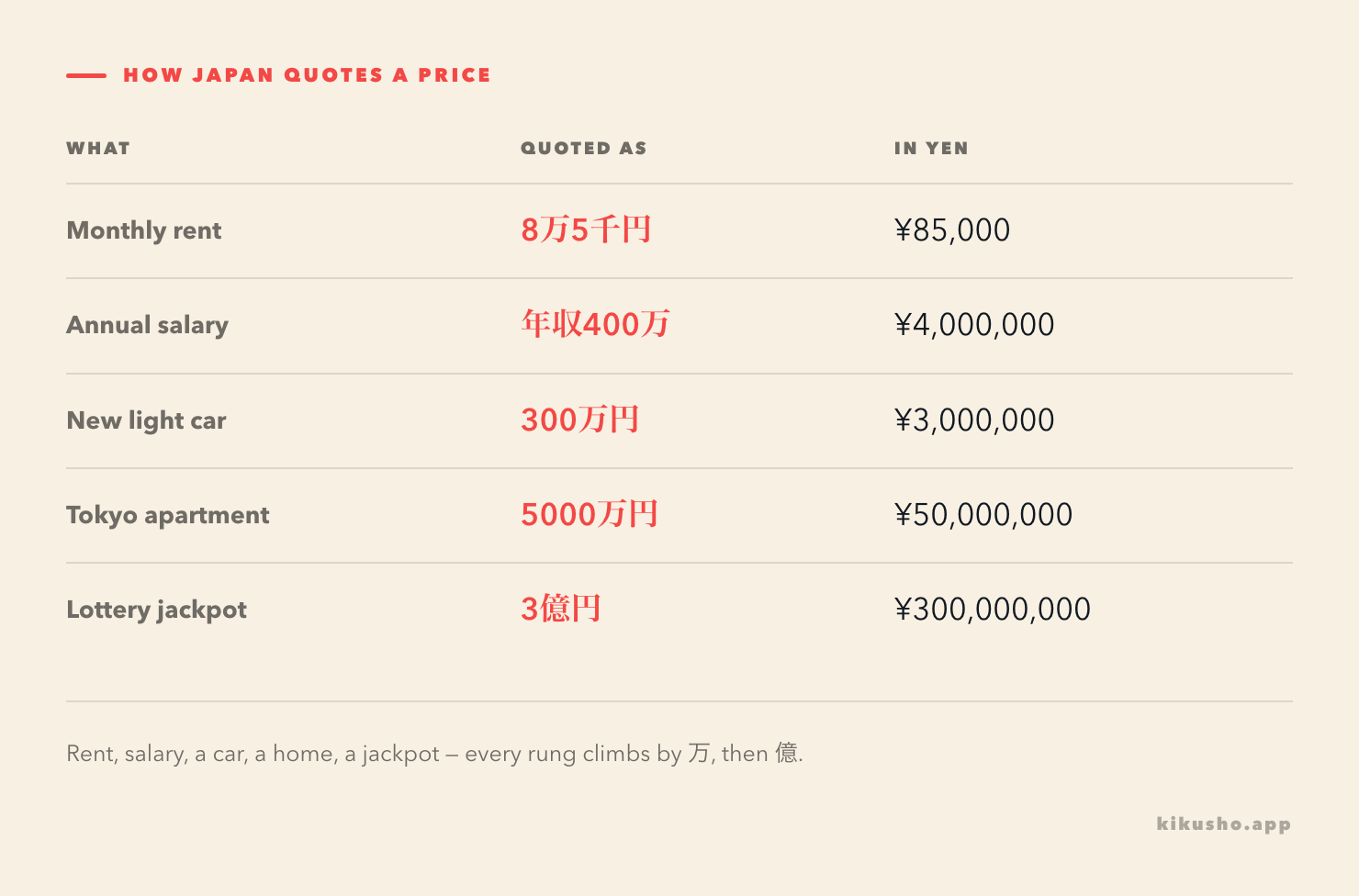
A salary advertised as 年収400万 is ¥4,000,000 a year — yonhyaku-man, four hundred ten-thousands, with the four zeros folded into the unit and never spoken aloud. The same swallowing happens at every rung in the figure above, right up to the top: once you are pricing property in central Tokyo or reading a lottery ticket's jackpot, you cross into 億, and 一億円 is ¥100,000,000. The practical upshot is that you hear the unit far more often than you see the zeros, so training your ear for "sanbyaku-man" matters more than being able to write the figure — and understanding a price as it goes past in speech is a different skill from decoding it on a tag. On a menu the numbers stay small, three or four digits, so reading a Japanese menu rarely pushes you past 千 — 万 shows up on the bill total, not the individual dishes.
The readings shift too, but that's the smaller trap
There is a second obstacle, and it is worth naming so you do not mistake it for the first. The number words change shape when they collide, for the sound of it. Three hundred is 三百 (sanbyaku), not "san-hyaku"; six hundred is 六百 (roppyaku); eight hundred is 八百 (happyaku). Thousands do it too: 三千 is sanzen, 八千 is hassen. These euphonic changes are real, and they catch you the first few times.
But they are a small, fixed set — a handful of combinations, always the same — and you meet them so often that they wear in on their own. 万 itself is well-behaved: 一万 ichi-man, 二万 ni-man, 十万 jū-man, 百万 hyaku-man, no surprises. The grouping, by contrast, stays counterintuitive long after the readings have stopped tripping you, because it works against a habit you built before you ever started Japanese. Fix the comma first; the sound changes will follow.
After 億 comes 兆 — and then it stops mattering
The same regrouping runs all the way up. Above 億 sits 兆 (chō), a trillion, another four digits along — it is where national budgets and government debt live, so you will see it in a newspaper and almost never say it. There is a unit above that, 京 (kei), 10¹⁶, but you can go a lifetime in Japan without needing it. The point is that you do not learn a new system for each altitude. Once the comma-every-four-digits habit is in place, 兆 is no harder than 万; it is the same split, one block further left.
This is also why the numbers are worth getting solid early rather than avoiding: they are the scaffolding under counting real things with counters, under prices, dates, ages and phone numbers. The four-digit grouping is the one genuinely foreign idea in the whole apparatus. Learn to move the comma, and everything built on top of the numbers gets easier at once.
Common questions
What is 万 in Japanese?
万 (man) is the unit for ten thousand. Japanese counts in ten-thousands the way English counts in thousands, so 万 is the building block for every large number: 100,000 is 十万 (ten 万) and 1,000,000 is 百万 (a hundred 万).
How do you say one million in Japanese?
One million is 百万 (hyaku-man), literally "a hundred ten-thousands." Japanese has no single word for a million — you build it from 万, since the number is a hundred lots of ten thousand.
Why does Japanese group numbers by four digits?
Its large-number units — 万, 億, 兆 — are each ten thousand times the last (10⁴ apart), where English's thousand, million and billion are each a thousand times the last (10³). So a new unit name appears every four digits in Japanese, not every three, which is why the commas fall in a different place.
What is 億 in Japanese?
億 (oku) is a hundred million (10⁸), the next unit above 万 and equal to 万 × 万. It is where house prices in central Tokyo and lottery jackpots live: 一億円 is ¥100,000,000.