On this page
A report can quote 「もう出発するぞ」 without making ぞ its own formal voice. さ, わ, ぞ and ぜ belong to conversation or a deliberately voiced character; for neutral formal prose, choose a suitable plain or polite ending instead.
This N1 grammar set teaches three assigned reference units: g-b940185e4426, final さ; g-e7e54b6a5dc5, final わ; and g-3faeb93b4012, grouped ぞ・ぜ. Four visible endings do not turn that grouped inventory row into two new units. The set belongs together because the small word after a predicate changes how a speaker presents it, while the predicate still tells you what happened.
JLPT Sensei places final さ, final わ and ぞ・ぜ at N1. That is a study-list placement, not a rule that familiar conversational endings must wait until advanced study. The JLPT organisers do not publish an exhaustive current grammar syllabus, and this reference does not supply separate reading or listening preparation.
Read the ending after you have read the statement
もう出発するぞ。
もうしゅっぱつするぞ。
“We're setting off now!”
Imagine a group leader addressing close companions. 出発する gives the action, and もう makes it immediate in this scene. ぞ lends a firm announcement. It is not a new past tense, and the verb has not become an imperative conjugation.
The Tokyo University of Foreign Studies explanation presents sentence-final particles as expressions of the speaker's communicative attitude. Recognising that layer helps when reading manga dialogue, but recognising a character's voice does not require adopting it.
| Ending | Reading | Main use in this set | What the label does not guarantee |
|---|---|---|---|
| さ | sa | a casual assertion or reassurance | that the statement is correct, or polite |
| わ | wa | a reaction, judgment or personal commitment | a single delivery or the speaker's gender |
| ぞ | zo | forceful assertion, resolve or warning | an imperative verb form |
| ぜ | ze | rough emphasis or a familiar invitation | friendliness toward every listener |
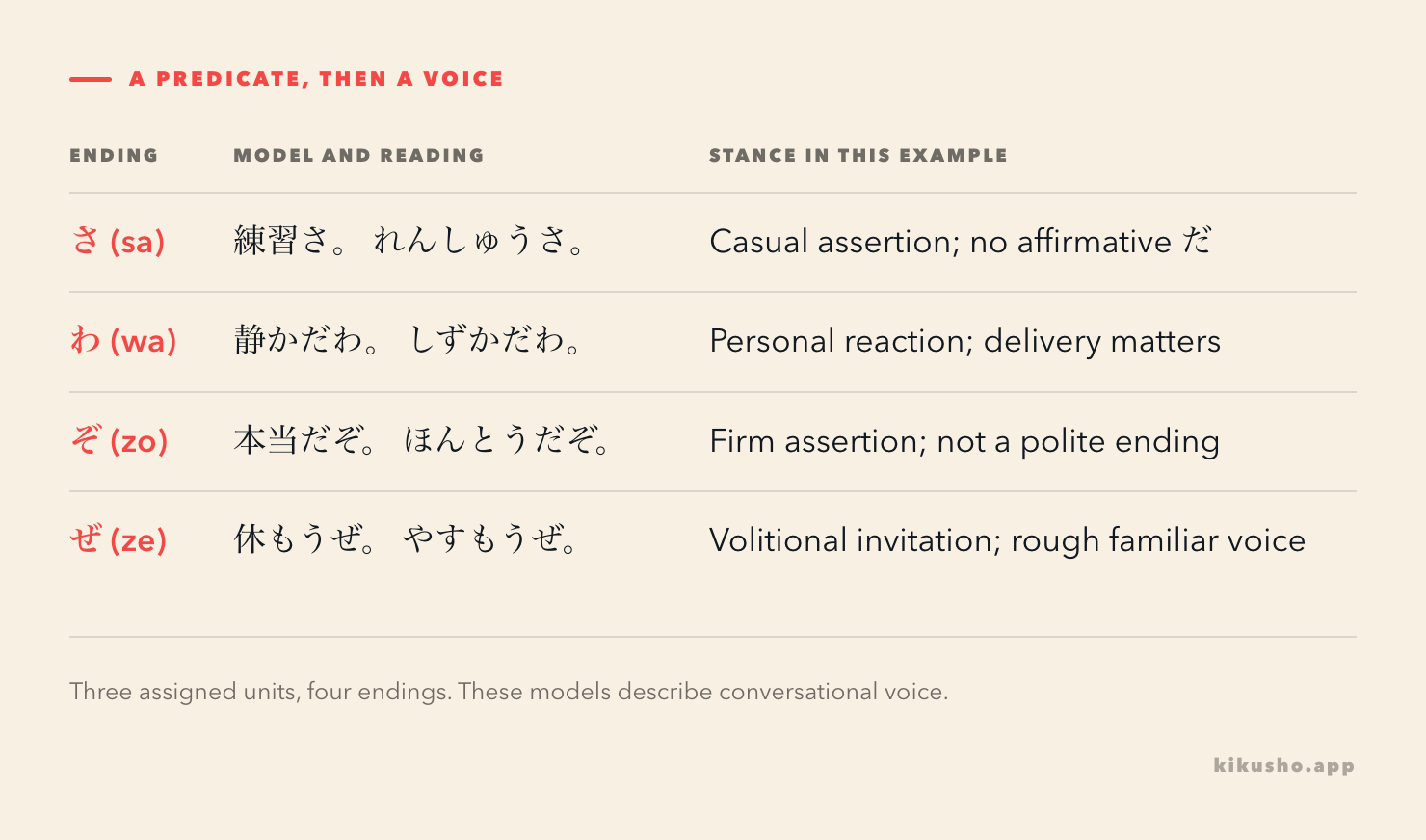
These are useful recognition guides, not four fixed English translations. An assured line can sound reassuring in one scene and dismissive in another.
さ leaves out the affirmative だ in this pattern
心配しなくても大丈夫さ。
しんぱいしなくてもだいじょうぶさ。
“You don't need to worry; it'll be fine.”
The speaker offers a casual reassurance. Final さ can also underline a judgment without reassuring anyone. Shogakukan's Daijisen entry distinguishes assertion, lightly dismissive statements and questions such as challenges; a positive gloss alone would miss that range.
The standard affirmative noun and な-adjective patterns in TUFS omit だ before this final さ:
- これは練習さ。 — これはれんしゅうさ。 — “This is just practice.”
- 大丈夫さ。 — だいじょうぶさ。 — “It's all right.”
For the other endings, the same chart retains だ: 練習だわ, 練習だぞ, 練習だぜ. If you are unsure which word supplies that ending, the だ/です foundation separates noun predicates from verbs and い-adjectives. Do not carry the noun rule over to 出発するだぞ.
There is a second distinction hidden by the same spelling. 高さ (たかさ, “height”) uses a suffix that turns an adjective into a noun. Bunpro's N4 さ page teaches that nominalisation, not this final assertion. The inventory's N1/N4 surface-match flag therefore does not establish a level disagreement about the same grammatical use.
You may also hear さ between conversational chunks, keeping someone's attention before the sentence is finished. Daijisen records that separately. This page's practice concerns the final particle; a pause after さ is not proof that the whole statement has ended.
わ needs a delivery as well as a spelling
あ、鍵がないわ。
あ、かぎがないわ。
“Oh, my key isn't here.”
The speaker discovers the missing key. The line reports an absence; わ contributes the personal reaction. Tofugu's わ guide describes this role and distinguishes a falling delivery from a rising, strongly feminine one. TUFS likewise supplies separate rising and falling examples. Print alone leaves that contrast partly open.
Do not infer “a woman said this” from every written わ. Regional speech and deliberately performed voices matter, and a falling わ is not confined to women. Equally, do not erase the conventional feminine association of a rising わ when you are interpreting a stylised character.
The attachment is more visible than the intonation:
| Predicate before わ | Example | Reading |
|---|---|---|
| verb, plain past | 見つかったわ。 | みつかったわ。 |
| い-adjective | 難しいわ。 | むずかしいわ。 |
| な-adjective, affirmative | 静かだわ。 | しずかだわ。 |
| noun, affirmative | 休みだわ。 | やすみだわ。 |
The verb stem alone is not a completed statement: 見つかりわ is not the model here. Nor does a な-adjective keep its noun-modifying な in 静かなわ. These examples are statements, not a rule that わ attaches to every command or question.
Forms with ですわ or ますわ exist, as Tofugu explains, but polite morphology does not remove their personal, regional or performed voice. They are not a general recipe for making an unfamiliar client's message more formal.
ぞ and ぜ add force without becoming polite
そこは危ないぞ。
そこはあぶないぞ。
“It's dangerous there!”
In this warning, 危ない states the danger and ぞ presses it on the listener. Daijisen's final ぞ entry also covers resolve and emphatic judgments. A speaker can direct that force at themself, rather than issuing an order to someone else.
ここで少し休憩しようぜ。
ここですこしきゅうけいしようぜ。
“Let's take a short break here.”
Picture familiar companions after a long walk. 休憩しよう is already a volitional invitation; ぜ supplies rough camaraderie. Daijisen's ぜ entry covers both familiar emphasis and threatening or condescending uses. Calling it friendly without naming the relationship would lose half the distinction.
| Statement type | Pattern used here | Example and reading |
|---|---|---|
| noun, affirmative | noun + だ + ぞ/ぜ | 本当だぞ。 — ほんとうだぞ。 |
| な-adjective, affirmative | stem + だ + ぞ/ぜ | 大丈夫だぜ。 — だいじょうぶだぜ。 |
| verb | completed plain form + ぞ/ぜ | 出発するぞ。 — しゅっぱつするぞ。 |
| invitation demonstrated above | volitional + ぜ | 休憩しようぜ。 — きゅうけいしようぜ。 |
The chart demonstrates these connections; it does not teach the whole volitional system. Conventional descriptions associate ぞ and ぜ with masculine or tough speech. Use that as a clue to a social voice, not an absolute rule about who is allowed to speak. Neither ending is a safe substitute for a request to a stranger.
A quotation keeps its voice inside the quotation
Compare a neutral announcement with a character's line:
- そろそろ出発します。 — そろそろしゅっぱつします。 — “We'll be setting off shortly.”
- 「もう出発するぞ」と健が言った。 — 「もうしゅっぱつするぞ」とけんがいった。 — “Ken said, ‘We're setting off now!’”
The second sentence preserves Ken's forceful delivery in direct speech. It does not mean that the narrator has addressed the reader with ぞ. A novel, transcript or a report that quotes someone can contain conversational language inside a larger written document.
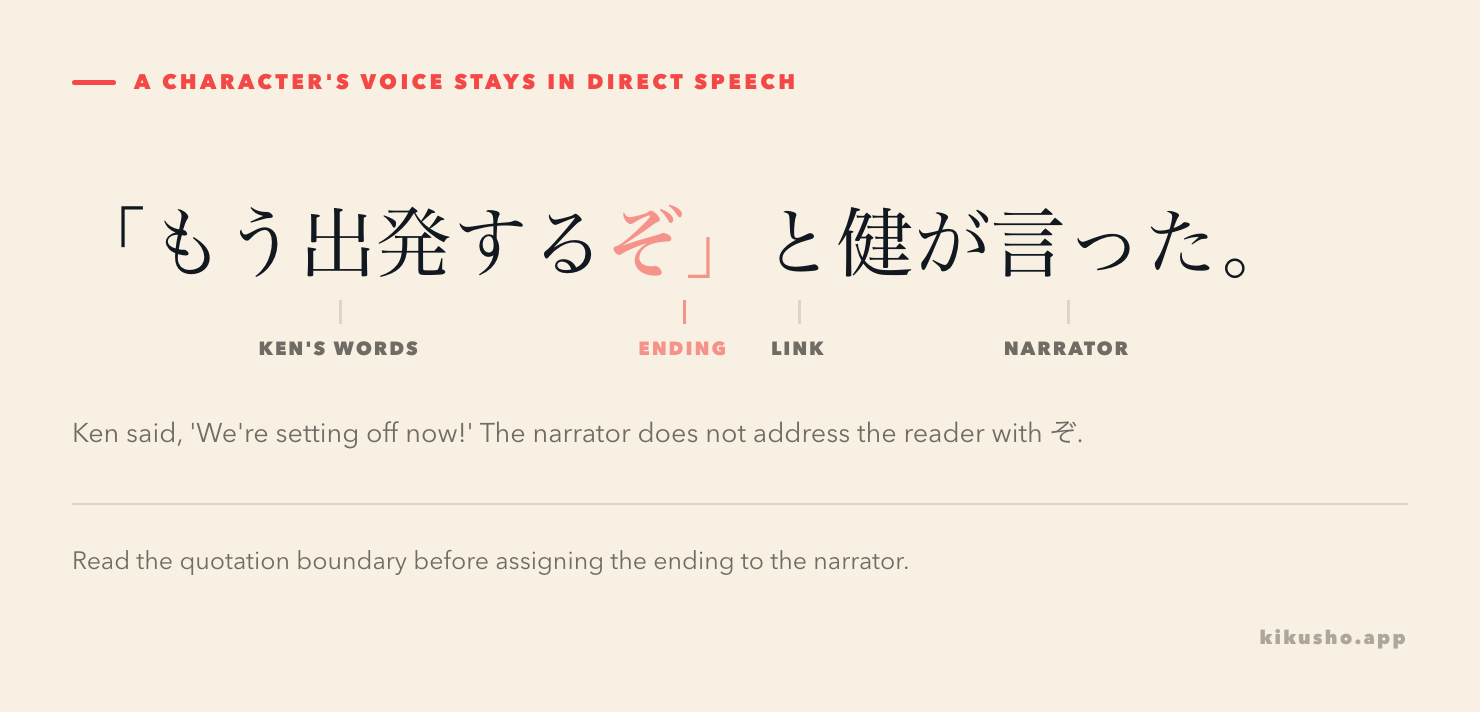
For an ordinary formal announcement, the first line is a more suitable model. When you need a considerate opening before asking for help, the ところを courtesy lesson teaches a different job. Adding ぞ or ぜ would not acknowledge the other person's inconvenient timing.
The Japan Foundation discussion by Harumi Noda stresses style, relationship and intonation when analysing final particles. “Written” and “formal” are not interchangeable labels. A message to a close friend is written too.
Try eight tasks before reading the shared explanations
Choose by attachment or by the stated scene. A character's gender is not the answer key.
Question 1
Complete the standard plain affirmative reassurance 大丈夫__さ。
- A. だ
- B. な
- C. の
- D. nothing
Question 2
Which line uses the taught affirmative な-adjective attachment before わ?
- A. ここは静かだわ。
- B. ここは静かいわ。
- C. ここは静かなわ。
- D. ここは静かますわ。
Question 3
A leader tells close companions もう出発するぞ。 Which description fits this scene?
- A. A polite request for a client to approve a departure.
- B. A firm announcement that the group is setting off.
- C. A question asking whether someone left yesterday.
- D. A report that the group has already returned.
Question 4
Arrange all four chunks in ここは __ __ ★ __。 Write the sentence and state what belongs in ★.
- A. 本当に
- B. だ
- C. 静か
- D. わ
Question 5
Invite close companions to take a short break here with a deliberately rough voice. Use ここで, 少し, 休憩する in its volitional form, and ぜ. Write the sentence, then distinguish the part making it an invitation from the part supplying the voice.
Question 6
The proposition is “This is true.” Write a standard plain affirmative sentence with これは, 本当, and final さ. Do not turn it into a question or an explanation with の.
Question 7
Read the connected passage:
「心配しなくても大丈夫さ」と兄が言った。弟はうなずいた。
Who gives the reassurance, and where does its casual stance occur? Does the narrator's use of 言った make the quoted さ a formal ending? Explain from the clause boundaries.
Question 8
Read this passage:
作業が終わった。健は「少し休もうぜ」と仲間に声をかけた。
Which account preserves the completed event and the voiced invitation?
- A. The work will start tomorrow, and Ken politely addresses a new client.
- B. Everyone has already rested; Ken only describes the past break.
- C. The work has finished, and Ken invites his companions to rest in a rough familiar voice.
- D. Final ぜ changes 終わった into a command to finish.
Answers and explanations
Answer 1: D. 大丈夫さ。 (だいじょうぶさ。) omits affirmative だ before this final さ. な would modify a following noun, and の alone does not supply this な-adjective's explanatory connection. The corresponding taught models with the other endings are 大丈夫だわ/だぞ/だぜ.
Answer 2: A. ここは静かだわ。 (ここはしずかだわ。) retains だ after the な-adjective stem. 静かい invents an い-adjective ending; 静かな is the noun-modifying form, and ます follows a verb's appropriate stem, not this adjective stem.
Answer 3: B. 出発する (しゅっぱつする) supplies the departure and ぞ makes the announcement firm in the given informal group scene. There is no request for approval, yesterday's question or completed return. A forceful statement is not automatically an imperative conjugation.
Answer 4: B goes in ★. The order is A → C → B → D: ここは本当に静かだわ。 (ここはほんとうにしずかだわ。) “It's really quiet here.” 本当に modifies 静か, and だ completes that affirmative predicate before わ. The written line does not itself specify the intonation.
Answer 5: One model is ここで少し休憩しようぜ。
ここですこしきゅうけいしようぜ。
“Let's take a short break here.” 休憩する → 休憩しよう supplies the invitation. ぜ adds the deliberately rough, familiar voice. Punctuation can vary; replacing the volitional with a completed past statement would not perform the same invitation.
Answer 6: これは本当さ。
これはほんとうさ。
“This is true.” 本当 is a noun predicate here, and the standard final-さ pattern leaves out affirmative だ. これは本当ださ is not the taught standard pattern. Neither the particle nor this model proves that a speaker's claim is factually true.
Answer 7: The older brother reassures; the narrator reports. 兄 (あに) gives the words inside 「 」, including the casual 大丈夫さ. と兄が言った (とあにがいった) reports his speech, and 弟はうなずいた (おとうとはうなずいた) says the younger brother nodded. A neutral reporting clause does not transfer its register into the direct quotation or turn さ into a formal-writing marker.
Answer 8: C. 作業が終わった (さぎょうがおわった) gives the finished work. 少し休もうぜ (すこしやすもうぜ) is the subsequent voiced invitation; 仲間に声をかけた (なかまにこえをかけた) tells us whom Ken addressed. A invents future work and a client, B changes the invitation into a past break, and D attaches the particle to the wrong clause.
Keep the speaker beside the line you save
If you save a dialogue sentence in Kikusho from pasted text, the editable register note can carry close companions, warning or quoted character, rather than a bare “formal” label. For わ, add the delivery you heard when one is available; do not invent it from print. A sentence from a familiar friend's message and the same sentence from a performed character can earn different notes even when every kana matches.
Common questions
Can I use さ, わ, ぞ and ぜ as formal writing particles?
These endings carry conversational stance or a deliberately voiced persona. They can appear in quoted dialogue without belonging to the narrator's neutral formal register. A report or a first message to a client normally needs an appropriate plain or polite ending instead.
Does sentence-final さ need だ after a noun?
In the standard plain affirmative pattern taught here, leave out だ before final さ: これは練習さ. The corresponding noun patterns with the other endings retain it: 練習だわ, 練習だぞ and 練習だぜ. This さ is not the adjective-to-noun suffix in 高さ.
Is わ always a women's particle?
No. In standard Japanese, a rising わ is associated with a feminine voice, while a falling わ has broader conversational use. Region, surrounding wording and the speaker's persona also matter. A written わ alone cannot identify the speaker's gender or reproduce the delivery.
Are ぞ and ぜ interchangeable with a polite request?
No. They can add force, resolve or rough familiarity, but they do not make a sentence considerate toward an unfamiliar listener. An invitation such as 休憩しようぜ contains a volitional form; the particle adds the voice rather than supplying polite request grammar.