On this page
You can read a paragraph, follow a show with half an eye on the subtitles, maybe pass a reading test, and then someone asks you a simple question and nothing comes out. It is one of the most common and most demoralising plateaus in Japanese, and it is not a sign that you lack some talent for speaking. Understanding a word and producing it are two different acts of memory, and nearly everything you have done to learn the language has trained only the first.
Recognising a word sitting in front of you is easy: the word does most of the work, and your memory only has to confirm it. Summoning that same word from the idea alone, with nothing on the screen to point at and a second or two before the silence gets awkward, is a different skill, and it is the one you have barely practised. The freeze is exactly the size of that missing practice.
Understanding and speaking pull in opposite directions
The clearest way to see the gap is to notice which way your memory has to run. When you read or listen, the Japanese arrives first and you reach for the meaning: you see 約束, and "a promise" comes back. When you speak, you start from the meaning and have to produce the Japanese: you want to say promise, and now 約束 has to appear, from nothing. Same word, opposite directions.
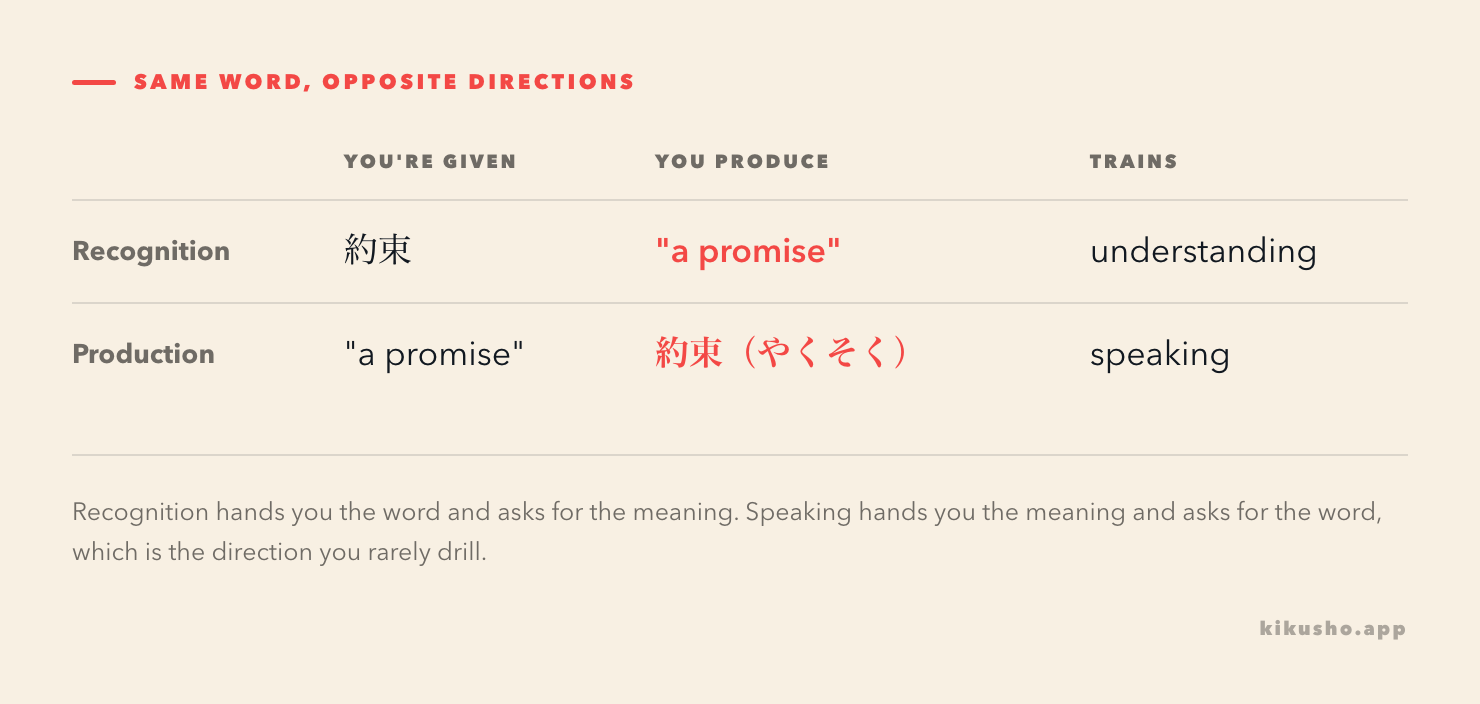
Those two directions are not equally hard, and they do not train each other. Recognition is the downhill one, because the word itself is the cue: it is right there, and your memory only has to say yes, that one. Production is uphill, because the cue is just an idea in your head, and memory has to travel all the way to a specific string of sounds with nothing to narrow the search. You can be fluent downhill and helpless uphill, and most learners are, because most study only ever runs downhill.
Your flashcards almost certainly train the easy direction
Think about what a normal review actually asks of you. The card shows 約束, and you recall "a promise". A subtitle shows a line, and you confirm you understood it. A page of reading hands you the words and you take in their meaning. Every one of these runs downhill: Japanese in, meaning out. You can do hundreds of them in a week and not once practise going the other way.
This is why a large daily review count can sit right next to a total inability to speak. The reviews are real work and they are teaching you something, but the something is recognition, and you were quietly assuming it would turn into speech on its own. It will not. To train the uphill direction you have to prompt yourself with the meaning, or a picture, or a situation, and produce the Japanese out loud before you check.
Recognition gets by on a smaller memory than production
There is a second reason understanding races ahead. The two directions do not just differ in difficulty; they need different amounts of the memory to be in place. To recognise a word you only need a loose, partial trace, enough to feel I have seen this, it means roughly that. To produce it you need the whole thing: the exact reading, the rhythm, the precise form, all retrievable with no prompt.
You already know this split from your own language. You recognise thousands of words you would never actually say. You understand perfunctory or ersatz on the page and never once reach for them out loud. That larger set is your passive vocabulary and the smaller one your active vocabulary, and the passive set is always far bigger. In a language you are still learning, the gap between the two is enormous, which is exactly why the tally of words you "know" feels like a lie the moment you open your mouth.
Keigo makes the split brutally visible. You hear いらっしゃいませ at the door and おっしゃる from shop staff every day and follow them without thinking, yet asked to produce a polite form yourself you stall completely. That is not a contradiction, it is the passive-active gap at its widest, and it is why polite Japanese is so much easier to follow than to speak.
Speaking runs on a clock that recognition never had
Even a word you can produce is not yet a word you can use, because a conversation adds something a flashcard never does: time pressure. Reading, you set your own pace; you can stop, back up, sit on a hard word. A live exchange goes forward only, at the other person's speed, and it does not wait. A word you could dredge up given five seconds is no help when the sentence needed it half a second ago and the moment has already gone.
So production has to be not merely possible but fast, automatic, retrievable without conscious searching. This is the same wall that makes listening hard, met from the other side: spoken Japanese outruns the words you know because your ear cannot decode quickly enough, and speech outruns them because your recall cannot deliver quickly enough. Both break at speed, not at vocabulary.
And you are never producing just one word
Here is the part that turns a pause into a freeze. Speaking is not one retrieval; it is several, stacked, happening at once and against the clock. Say you want I want to drink water. You have to summon the noun, choose the object particle, recall the verb and bend it into the want-to form, and land the whole thing in the right register. If any one of those jobs stalls, the sentence stalls with it.
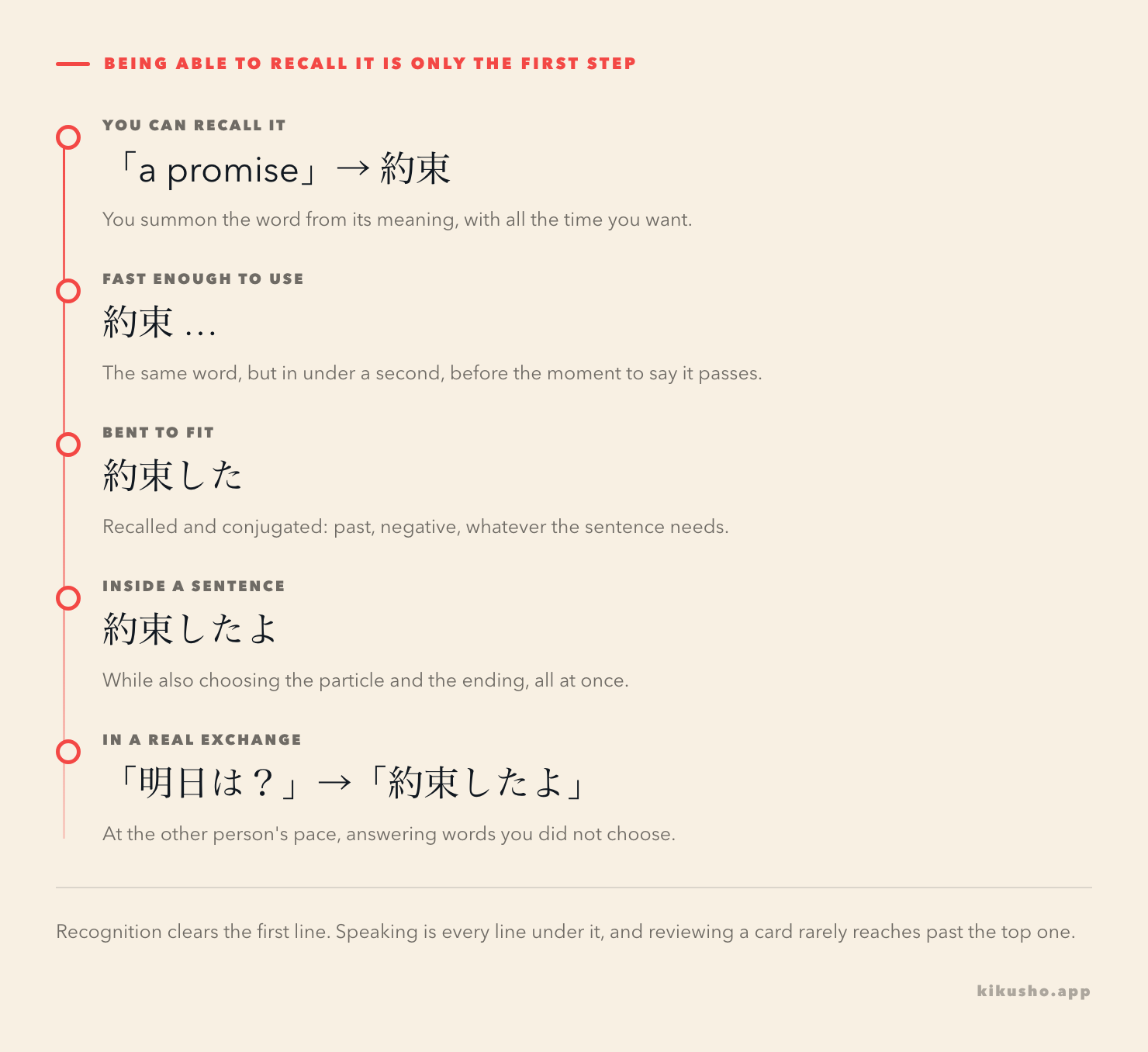
Recognition asks your memory for one thing at a time, usually with the answer in view. A sentence asks for all of it together, from meaning alone, before the moment passes. That is why you can know every word in a sentence and still be unable to build it in real time. Knowing the words was never the whole task. Assembling them under pressure is.
"Just speak more" is right, and almost useless on its own
Search this problem and most of the advice lands in the same place: speak more, stop fearing mistakes, find a partner. None of it is wrong. But as a plan it is close to "just be less stuck", because it names the destination and skips the mechanism. It also tends to blame fear, when for most people the deeper problem is simpler: the production path is untrained, so there is not yet anything there to be nervous about using.
Speaking more does work, and it helps to understand why: every real attempt to say something is one repetition in the uphill direction, the exact direction your reviews skipped. Which also means you do not have to wait for a conversation partner to start closing the gap. You can do those same retrievals deliberately, alone, long before you are ready to do them live.
What actually closes the gap
The fix follows straight from the diagnosis: practise the direction you are weak in, which means producing from meaning rather than recognising from form. A few habits do most of the work.
Turn the retrieval around. Cover the Japanese and, from the meaning or the situation alone, say the word or the sentence out loud before you check. Out loud matters: production includes your mouth, and silent recall quietly skips the step that fails in conversation. Reversed cards do this on a schedule; talking to yourself about your day does it for free.
Learn words inside sentences, not as bare pairs. A word met in a phrase arrives with its particle and its usual company attached, so the assembly is half-done before you start and you are retrieving a chunk instead of building from scratch. Memory prefers it that way too, since a word sticks from being retrieved in context, and the spacing that installs recognition installs production the same way.
Practise on the words you actually reach for and drop. The vocabulary worth making producible is not a generic frequency list; it is the specific handful you needed this week and could not say. Those are the ones with a real situation already attached, and they are the ones your speaking will keep demanding. Capturing them the instant they escape you, by saying the phrase you just failed to produce so it comes back as a card with its reading, an example sentence and native audio to rehearse against, is the loop Kikusho is built to make effortless, and since reviews are never metered, drilling the same line until it is automatic costs nothing.
None of this makes you fluent overnight, and understanding will always run a little ahead; that is the natural order, in every language you will ever learn. The point is only to stop pouring all your practice into the direction that was already winning.
Common questions
Why can I understand Japanese but not speak it?
Because understanding and speaking are opposite operations. Reading and listening run from the Japanese to its meaning, and the word on the page does most of the work. Speaking runs the other way, from the meaning to the word, with nothing to cue you and no time to search. Almost all ordinary study, flashcards included, practises only the first direction, so the second one stays untrained.
Will studying more vocabulary fix it?
Not on its own. More words add to what you can recognise, which is the side that is already ahead. Being able to produce a word is a separate ability that you build by producing, not by meeting more words. Past a basic vocabulary, the fix is practising retrieval in the speaking direction, not enlarging the list.
How do I practise producing instead of just recognising?
Turn the retrieval around. Cover the Japanese and, from the meaning or the situation alone, say the word or sentence out loud before you check. Reversed or production cards do this on a schedule, and describing your day to yourself in Japanese does it for free. Saying it aloud matters, because silent recall skips the step that actually fails in conversation.
Is the problem that I am too shy or afraid of mistakes?
Fear is real, but for most people it is secondary. Even alone, with no one listening, you would still stall, because the production path has not been trained and there is nothing there to run yet. Confidence tends to follow fluency rather than cause it, so building the retrieval usually does more than trying to feel braver.